
NACS DC Charger: J3400, CCS1 Retrofit and Buyer Acceptance Guide
Choose the charging path—and the proof behind it—before buying a connector label.
A NACS DC charger supplies direct current through a NACS interface, associated with SAE J3400. The connector name alone does not establish vehicle compatibility, charging speed or network access. For a purchase, qualify the exact vehicle, charger configuration, authorization method and site requirements—and decide whether native hardware, an approved retrofit or an approved adapter best fits the operating plan.
This guide helps fleet operators, charging-site owners and procurement teams evaluate a North American project. It is not a claim that every HG Power configuration supports NACS or holds North American certification. Source review: October 15, 2026.
Start with the charging route, not the connector photograph
Two quotations can both say “NACS DC charger” while offering different equipment. One includes a native cable assembly and supported software. Another assumes a future retrofit. A third depends on drivers bringing adapters. Those arrangements transfer different costs and responsibilities to the operator.
Write the route in one sentence: which station output charges which vehicle inlet, through which approved hardware, using which authorization method? If the supplier cannot complete that sentence for the required vehicles, the quotation is not yet comparable.
Our Route–Evidence Matrix below is a procurement tool, not a standard or a compatibility certification.
| Route | When it deserves evaluation | Evidence to request | Reason to pause |
|---|---|---|---|
| Native NACS DC output | A defined vehicle roster needs frequent access without loose adapters | Exact station and cable configuration, software versions, vehicle test results | A connector option appears only in a roadmap |
| Manufacturer-supported CCS1 station retrofit | Existing equipment has useful remaining life and an approved migration path | Eligible station serial/version range, kit, service procedure, warranty and certification implications | The proposal is merely “replace the plug” |
| Approved DC adapter | A bounded vehicle group can follow a documented adapter policy | Correct direction, approved vehicle/station combination, ratings, instructions and responsibility for inspection | An AC adapter or an unapproved combination is substituted |
| Mixed native outputs | NACS and CCS1 vehicles must charge at the same site | Port map, simultaneous-operation limits and allocation behavior | Two cables are presented as proof of two independent charging sessions |
For a site serving other interface groups, keep the separate CCS2, GB/T and CHAdeMO comparison in the project file. It does not establish a conversion path to NACS.
+ supported implementation
+ eligible revision
+ specified direction
No route bypasses vehicle, electrical, operating and destination checks.
Is NACS the same as DC fast charging?
No. NACS names an interface used in AC and DC charging applications; it does not make every connected device a DC fast charger. A purchasing specification must identify the charging mode, electrical envelope and supported implementation. A NACS-shaped connector on an AC product is not evidence of DC charging capability.
SAE maintains J3400 resources for the NACS system. Ask the supplier to name the applicable document edition and the evidence supporting its declaration; do not substitute a standards logo for a configuration record. This guide uses the public standards context, not an interpretation of inaccessible clauses. SAE J3400 resources
For adapters, record both ends explicitly. “NACS to CCS” is an incomplete purchase description unless the station-side connector, vehicle-side inlet and AC/DC mode are identified. GM’s own adapter range separates DC and Level 2 applications and distinguishes the vehicle inlet being served. That is a useful reminder to specify the actual path rather than buy by a shortened product name. GM Energy adapter overview
Can an existing CCS1 charger be converted to NACS?
Sometimes, through a manufacturer-supported conversion for the exact station. Do not assume that changing the visible connector is sufficient. Confirm the approved cable assembly, controls and software requirements, installation procedure, resulting configuration identity and service obligations before comparing retrofit costs with a replacement station.
ChargePoint publishes a specific Express 250 NACS cable-replacement procedure. Its existence shows what model-bound documentation looks like; it does not authorize a conversion on unrelated chargers. The broader ChargePoint FAQ also notes that connector availability is a site-owner decision, so network branding alone is insufficient. Express 250 service documentation, ChargePoint connector FAQ
Before buying a kit, obtain a written answer to these questions:
- Which serial numbers and hardware revisions qualify?
- What parts, firmware, labels and commissioning work are included?
- Who is authorized to perform the work, and who owns any resulting warranty issue?
- What must be retested after installation, including retained CCS1 operation?
- Which downtime, labor, freight and spare-part costs are excluded?
Do not discard a useful CCS1 capability solely because new vehicles are arriving with another inlet. Map the actual replacement schedule and peak overlap first. A retained CCS1 bay may be more valuable than converting every cable immediately. The fleet planning guide provides the wider operating-schedule framework.
Why “fits the vehicle” does not mean “works at the site”
Treat compatibility as separate evidence questions: physical connection, electrical operating range, vehicle-side communication, backend operation and access authorization. A successful check in one category cannot replace the others. Keep the station hardware and firmware identity attached to every result.
compatibility
and settings
Connector fit is one check—not a substitute for the other records.
An OCPP entry in a quotation concerns charger-to-management-system communication. It is not, by itself, evidence that a particular vehicle can establish a charging session. Equally, a successful vehicle test does not demonstrate billing reconciliation, remote recovery or the buyer’s configured backend. The Open Charge Alliance protocol resources provide the backend context; require the functions your operation actually needs.
Network access is another boundary. Tesla’s guidance distinguishes station access categories and tells drivers to check the exact vehicle/site combination. Its Supercharging policy also specifies permitted DC adapters and warns against AC adapters. Installing a third-party NACS output does not make that station part of Tesla’s network. Tesla Supercharging support
For a private depot, agree how drivers start and stop sessions, what happens when connectivity is lost, and how an operator releases a failed session safely under the manufacturer’s instructions. For a public site, add payment, receipts and support escalation. Test these operational steps instead of accepting the phrase “plug and charge” without a defined implementation.
How much power will a NACS DC charger deliver?
There is no single charging power implied by the NACS name. Delivered DC power depends on the operating voltage and current, vehicle request, station allocation and thermal conditions. Compare the supplier’s output envelope with the required vehicles; a cabinet’s maximum kW does not describe every session or every output.
For a transparent electrical check:
DC power in kW = operating voltage × operating current ÷ 1,000.
These are hypothetical arithmetic examples, not NACS limits or HG Power test results:
| Assumed operating point | Calculation | Electrical power | Procurement meaning |
|---|---|---|---|
| 400 V, 300 A | 400 × 300 ÷ 1,000 | 120 kW | A higher cabinet label cannot overcome this assumed current/voltage combination |
| 800 V, 300 A | 800 × 300 ÷ 1,000 | 240 kW | The same current produces a different result, if every relevant component supports this operating point |
| 400 V, 500 A | 400 × 500 ÷ 1,000 | 200 kW | Increasing current changes the requirement on the actual cable, connector and thermal system |
These values are not average session power. Vehicle voltage and requested current change during charging; battery temperature and state of charge also matter. Never multiply a nominal vehicle voltage by a cable’s headline rating and describe the answer as guaranteed charging performance.
Request an output curve or matrix showing continuous conditions, ambient assumptions and simultaneous use. Ask how derating is reported to the operator. For higher-current choices, the liquid-cooling guide separates cooling architecture from sustained-output proof; the HPC versus DC guide explains the wider performance boundaries.
Plan mixed NACS and CCS1 sessions before choosing ports
A mixed-output station should be evaluated against the busiest overlap in the operating schedule, not just the total number of cables. List which vehicles need charging together, their useful dwell windows and the energy they need before departure.
For illustration only, two assumed 120 kW outputs need 240 kW of available DC power to operate at those levels simultaneously. A shared 180 kW DC budget cannot provide 120 kW to both at once. That arithmetic says nothing about how a particular station allocates its 180 kW; allocation may be conditional, prioritized or restricted by its hardware.
Require a port-allocation diagram and demonstrate the agreed simultaneous mode. Record what the first vehicle receives when the second connects, how a completed session releases capacity, and whether a failed port affects the remaining output. Use the dual-gun charging guide for detailed allocation questions.
Do not choose mixed outputs when the required combination is unsupported or the retained vehicles cannot be demonstrated. “More connectors” can increase operational complexity without adding usable charging capacity.
What certification and site evidence should a buyer request?
Separate the adapter, cable assembly, complete charger and installed site. Evidence about one does not automatically approve the others. Ask the responsible project professional to identify applicable destination requirements, then match the supplier’s documents to the actual model and options being purchased.
UL Solutions describes testing and certification of EV coupler adapters under UL 2252. That is relevant to an adapter evidence request, not proof that a complete charging station or an HG Power configuration is certified. UL adapter testing and certification
For each offered certificate or listing, record the issuing organization, holder, model designation, scope, options and verification route. A certificate held by another legal entity needs a documented connection to the supplied product; a photograph of a certification wall is not that connection. Resolve mismatches before signing the equipment schedule.
For the site, obtain the proposed input requirements and have the qualified electrical designer assess available supply, protection and installation conditions. Do not select conductors or protection from this article. The DC station planning guide explains the site-to-equipment boundary, while the components guide helps assign responsibilities.
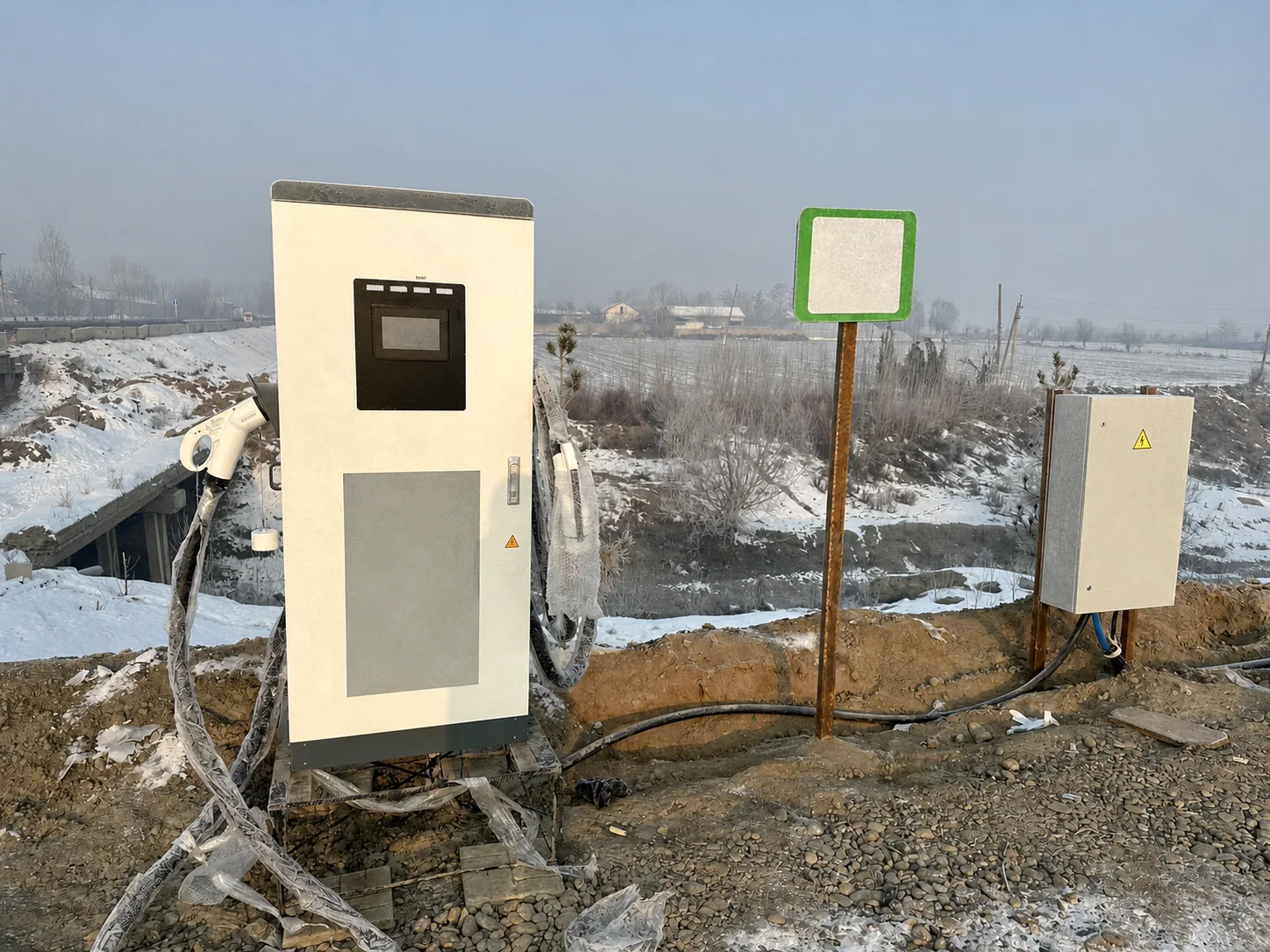
The supplied project photograph shows why environment and service access belong in the procurement discussion. It is installation context, not a NACS demonstration or a cold-weather qualification result. For your site, ask about the declared operating environment, cable handling, inspection access and the evidence supporting the offered configuration. A photograph cannot replace those documents.
Turn the quotation into a Configuration Acceptance Record
Specify deliverables before the purchase order. Otherwise, a supplier can answer “supported” while the buyer expects a witnessed result, a listing record and an operator-ready installation.
| Check | Minimum record to agree | Acceptance question |
|---|---|---|
| Identity | Station, cable/adapter and firmware identifiers | Does the delivered combination match the approved quotation? |
| Vehicle compatibility | Named variants and test conditions | Can each required variant start, sustain and end the intended session? |
| Output | Voltage/current trace and stated limits | Does performance meet the agreed conditions, rather than a brief peak? |
| Concurrent charging | Output map and simultaneous-session record | Does the required overlap work without an undisclosed restriction? |
| Operations | Authorization, stop/restart, backend and receipt records as applicable | Can the operator run the service and recover from defined faults? |
| Conformity and support | Matched documents, instructions, responsibilities and exclusions | Are unresolved items closed before release? |
Use factory acceptance testing to check the agreed equipment configuration and site acceptance testing to check the installed system under the actual project conditions. These labels are not sufficient on their own: attach the test method, responsible parties, pass/fail criteria and retained records.
If a vehicle is unavailable, label a simulated test as simulated. Do not let a load-bank result become a claim that the exact vehicle passed. Define when the remaining vehicle test will occur and which decision it blocks. Likewise, record firmware changes after acceptance and decide which affected functions must be retested.
A failed test should produce a useful next action
| Observed issue | Candidate boundary to investigate—not a diagnosis | Next evidence |
|---|---|---|
| Plug fits but no session starts | Vehicle implementation, authorization or adapter approval | Exact identifiers, timestamps and vehicle/charger logs |
| Session starts but power is low | Vehicle request, current limit, allocation or thermal condition | Synchronized voltage/current, state of charge and limit-reason records |
| Second vehicle reduces the first unexpectedly | Shared power budget or allocation policy | Configuration settings and a two-session trace |
| Charging works but operator cannot reconcile it | Backend configuration or transaction handling | Matching charger and management-system session records |
| Retrofit works on one station only | Hardware/firmware revision difference | Serial-level comparison against the approved retrofit scope |
Electrical troubleshooting and service work belong to qualified personnel following the applicable manufacturer procedures. This table is a procurement escalation aid, not repair instructions.
Ten inputs for a comparable NACS DC charger response
Send the same package to every supplier. Allow “not supported” and “requires verification” as explicit responses; those are more useful than an unbounded yes.
- Destination country, jurisdiction and intended private/public use.
- Exact vehicle makes, variants, model years and inlet information.
- Current roster and planned replacements, separated rather than blended.
- Required energy, available dwell and peak simultaneous sessions.
- Preferred route: native, approved retrofit, approved adapter or mixed outputs.
- Existing equipment identifiers if any hardware will be retained.
- Site supply information, environmental conditions and bay layout.
- Required backend, authorization, payment and operating functions.
- Requested certification evidence, service scope and spare-part responsibilities.
- Proposed acceptance conditions, witness method and required records.
Ask for separately priced hardware, conversion work, software/network obligations, freight, commissioning and support. Do not compare equipment-only pricing with an installed project total. The cheapest quotation may simply omit the very task that makes the site operable.
Where HG Power’s product evidence stops
HG Power’s approved public DC portfolio range is 40–480 kW. That describes the portfolio, not a promise of NACS availability across all ratings. The supplied CCS1 and CCS2 product documentation must not be relabeled as proof of an equivalent J3400 configuration.
Use the DC charger product entry to begin a configuration discussion, then request a written response for the precise destination and vehicle set. NACS options, compatibility, certificates, lead times and local service must be established separately. If those requirements cannot be documented, the proposal should not be presented as ready for that project.
Frequently asked questions
Does every NACS charger provide DC charging?
No. Confirm the charging mode and equipment identity. A connector name or photograph does not establish DC output, and an AC adapter must not be assumed suitable for a DC path.
Can every CCS1 vehicle charge through a NACS DC adapter?
No universal compatibility claim is justified. Check the exact vehicle, adapter, station and operator policy. Retain the approvals and instructions for that combination rather than relying on a general brand statement.
Will a third-party NACS station appear in Tesla’s network?
Not simply because it has a NACS connector. Connector implementation and network participation are different questions; specify the actual operator, authorization method and access arrangement.
Should a mixed fleet remove all CCS1 outputs?
Not without reviewing its vehicles and replacement schedule. Compare native outputs, supported retrofits and approved adapters against simultaneous demand, handling responsibilities and downtime—not a predicted universal transition date.
Does a higher kW label solve compatibility problems?
No. Output capacity does not resolve an unsupported inlet, communication implementation or access policy. Qualify compatibility first, then evaluate power at the required operating conditions.
Does HG Power offer a certified NACS model for my project?
This guide does not establish that. Request the exact proposed configuration and destination evidence. The portfolio range and existing CCS documentation cannot substitute for a model-specific answer.
About this guide and its evidence
Prepared for HG Power as a procurement decision aid. The route matrix, illustrative calculations and acceptance checklist are editorial tools—not an industry certification, a field-test report or a guarantee of interoperability. Primary references are linked beside the relevant statements. Product and operating policies can change; reconfirm the exact documents at quotation and acceptance.
Request a configuration-specific response
Send your destination, vehicle roster, preferred charging route, site information and acceptance requirements through HG Power’s inquiry page or email marketing@hjlcharger.com. Ask for supported configurations, explicit exclusions and the evidence still required before purchase—not just a connector name and maximum kW.