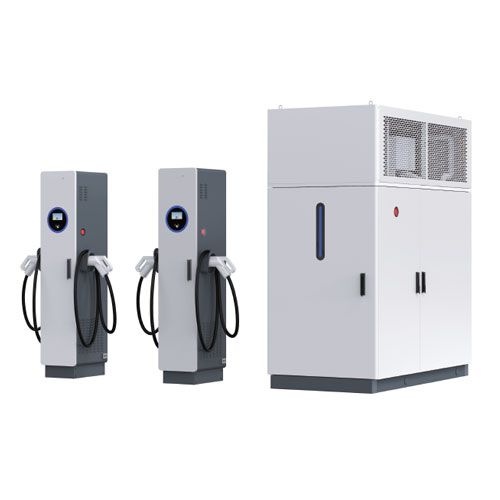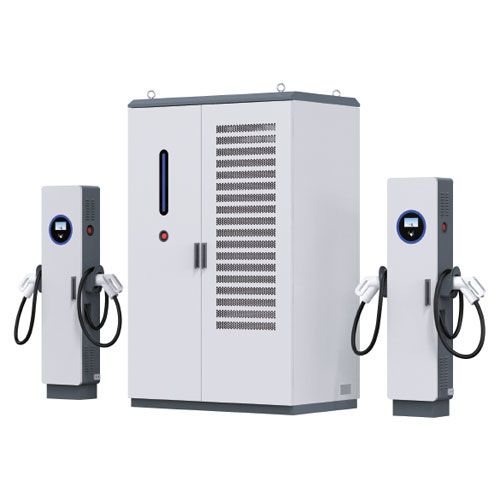
Quick answer: HG Power supplies high-power systems for sites that need more current than a standard output carries. The Aurora series covers 240 kW to 2.6 MW and the all-liquid-cooled Deepsea series covers 600–2000 kW. Liquid-cooled outputs reach 600 or 1000 A, by model, for CCS1, CCS2 and GB/T. Send your vehicles and site supply to match one.
Start with the current your vehicles need and the power your site can supply. This table gives you a starting point.
| Your project | System power | HG Power product | Why it fits |
|---|---|---|---|
| Several bays fed from one power cabinet | 240–960 kW | Aurora separated DC charging station | Split design with dynamic power allocation between outputs |
| Megawatt hub for trucks, logistics or high-turnover sites | 600–2000 kW | Deepsea all-liquid-cooled charger | Liquid cooling in the main cabinet as well as the 600 A output |
| Largest hubs at 380 Vac | 960 kW–2.6 MW | Aurora 960 kW–2.6 MW system | 1000 A liquid-cooled output and 10–24 outputs |
| Megawatt site with a 10 kV connection | 1.2–2.6 MW | 10 kV direct-connect charger | Connects at 10 kV with no large transformer |
| One or two bays below 480 kW | 40–480 kW | DC fast chargers | Integrated cabinets may be enough, so check first |
| Limited grid supply | Project-based | Energy storage | Storage can support charging where the supply is short |
Ranges are starting points, not a promise for your site. For heavy vehicles, see our heavy-duty truck charging solution.
These figures come from the HG Power 2026 product selection manual. Confirm the final specification for your configuration in the quotation.
| Item | Aurora separated | Deepsea all-liquid-cooled |
|---|---|---|
| System power | 240–960 kW | 600–2000 kW |
| Main cabinet cooling | Air | Liquid |
| Liquid cooling current | 600 A (CCS1, CCS2, GB/T) | 600 A (CCS1, CCS2, GB/T) |
| Standard single output current | 200/250 A | 200/250 A |
| Number of outputs | 10–24 | 10–24 |
| Output voltage | DC 200–1000 V | DC 200–1000 V |
| Input | 380 or 480 Vac ±15%, three-phase five-wire, 45–65 Hz | 380 or 480 Vac ±15%, three-phase five-wire, 45–65 Hz |
| Operating temperature | -25 to 55 °C | -25 to 55 °C |
| Protection | IP54 | IP54 |
| Backend | OCPP 1.6 or 2.0.1 (optional) | OCPP 1.6 or 2.0.1 (optional) |
A cable heats up with the square of the current, so twice the current makes four times the heat in the same cable. That is why current matters more here than the kW figure.
Divide the charging power you need by the vehicle's battery voltage. For example, 350 kW at 800 V needs about 438 A.
| Current needed | Example | Where to start |
|---|---|---|
| Up to 250 A | 150 kW at 800 V is about 188 A | A standard output is likely to be enough |
| 250–350 A | 240 kW at 800 V is 300 A | Check the higher-current options, such as the Genesis 360 kW model at 350 A per connector |
| Over 350 A, up to 600 A | 350 kW at 800 V is about 438 A | Choose a 600 A liquid-cooled output |
Use the vehicle's real maximum DC power and current in this test. A charger cannot push more than the vehicle accepts, and most vehicles only hold their peak for part of the session.
Voltage changes the result as well. DC power is volts multiplied by amps, so these are the upper limits at each voltage:
| Battery voltage | 250 A output | 600 A output |
|---|---|---|
| 400 V | 100 kW | 240 kW |
| 800 V | 200 kW | 480 kW |
| 1000 V | 250 kW | 600 kW |
Calculated limits, not test results. Real output also depends on the vehicle, the battery state and how much power other outputs are using.
Check this early, because it often decides the project. This table shows the three-phase current for each system power, using current = power ÷ (1.732 × voltage).
| System power | At 380 Vac | At 480 Vac |
|---|---|---|
| 240 kW | 365 A | 289 A |
| 600 kW | 912 A | 722 A |
| 960 kW | 1,459 A | 1,155 A |
| 2000 kW | 3,039 A | 2,406 A |
Calculated before efficiency and power factor, so real input current will be higher. Use the rated input current from the quotation for your final design.
Your electrician still needs to size the supply, protection and cabling to local rules. Our EV charging transformer sizing guide shows how to check spare capacity.
It is a high-power DC charger that uses circulating coolant to remove heat, so it can carry more current through a cable of practical size. On our Deepsea series, the main cabinet is liquid-cooled too. On our Aurora series, the main cabinet is air-cooled.
Look at current, not just kW. Divide the power you need by the vehicle's battery voltage. If the result is above the 200/250 A of a standard output, compare higher-current options. Above 350 A, look at a 600 A liquid-cooled output.
The Aurora series covers 240–960 kW with an air-cooled main cabinet. The Deepsea series covers 600–2000 kW with a liquid-cooled main cabinet. Between 600 and 960 kW both can apply, so we compare them against your site, climate and vehicles.
Our 2026 product selection manual lists CCS1, NACS, CCS2, CHAdeMO and GB/T as output interfaces, and it does not list MCS. If your trucks use MCS, tell our sales team before you plan the site so that we can confirm what is available.
Send the destination country, vehicle models, connector type, available supply, number of bays and how many vehicles charge at once. Our standard terms are 30–35 days after full payment, a two-year warranty and T/T payment. We confirm the terms for your configuration in the quotation.
Tell us your vehicles, site power and market. Shenzhen Hongjiali New Energy Co., Ltd. will reply with a suggested system and the specification to review.
Technical review: Marvin Zhou. Reviewed 6 November 2026.