
Liquid-Cooled vs Air-Cooled DC Fast Chargers: Which to Buy at 240 kW and Above
Crossover
Below ~180–240 kW per gun, air-cooled is cheaper and simpler. Above it, liquid-cooled wins on cable weight, sustained power, and lifetime.
Cable Physics
A liquid-cooled 500 A CCS2 cable uses ~95 mm² copper; the air-cooled equivalent needs 150–185 mm² and is twice as heavy at the handle.
Duty Cycle
Air-cooled connectors derate after sustained high-current sessions; liquid-cooled holds rated current back-to-back at 40 °C ambient.
HG Power Lineup
Air-cooled: Genesis 40–480 kW, Aurora Split 180 kW–2.6 MW. Liquid-cooled: Glacier 160–480 kW, Deepsea 600 kW–2 MW (MCS-capable).
Direct answer: Air-cooled DC fast chargers remain the economic choice up to about 180–240 kW per gun. Above that threshold, liquid-cooled cables and modules deliver higher sustained current in a lighter handle and hold efficiency flat under back-to-back sessions. The four cost drivers are cable copper mass, connector derating under duty cycle, module thermal headroom, and 10-year maintenance mix. HG Power’s Glacier 160–480 kW and Deepsea 600 kW–2 MW cover the liquid-cooled range (Deepsea is MCS-capable); Genesis 40–480 kW and Aurora Split 180 kW–2.6 MW cover the air-cooled baseline where ambient and duty cycle allow.
1. What is a liquid-cooled DC fast charger and what exactly is cooled
A “liquid-cooled DC fast charger” refers to one or both of two independently engineered subsystems. First is the liquid-cooled charging cable and connector, where a glycol-water coolant loop runs through the cable alongside the power conductors to carry away I²R heat at the handle and the CCS2 (or NACS, GB/T) pins. Second is the liquid-cooled power module, where the rectifier stack inside the cabinet uses a coolant loop instead of forced air to pull heat from the IGBTs and inductors.
Vendors routinely conflate the two. A charger marketed as “liquid-cooled” may have liquid cables but air-cooled modules (common in 350–480 kW units) or full liquid everywhere (standard above 600 kW and in MCS platforms). The decision for a buyer is which subsystem is justified at the chosen power rating, not whether to flip a single switch.
2. The four cost drivers side-by-side
| Driver | Air-cooled | Liquid-cooled | Impact at ≥240 kW |
|---|---|---|---|
| Cable copper & weight | 150–185 mm² to carry 500 A continuously; handle ~2.3–3.0 kg | ~95 mm² with coolant loop; handle ~1.3–1.8 kg | Driver experience and ergonomic compliance (EN 50620) |
| Sustained current under duty | Current derates after ~15–20 min continuous at 500 A, 40 °C ambient | Holds 500 A continuously; 600–1000 A possible with uprated handle | Highway hubs and depots cannot absorb mid-session derate |
| Module thermal headroom | Fans + heatsinks; derates above ~45 °C intake air | Coolant loop + heat exchanger; stable to ~50–55 °C ambient | Hot climates, dust ingress, 24/7 duty |
| 10-year lifetime maintenance | Fan replacement every 3–5 years, filter cleaning quarterly | Coolant replacement every 3–5 years, pump/heat-exchanger service | Operator OPEX, SLA uptime commitments |
Both approaches have scheduled maintenance; neither is maintenance-free. The decision is which failure mode and OPEX profile the operator prefers for the site’s climate and traffic.
3. Cable physics: why 95 mm² of copper outperforms 185 mm² when it is cooled
CCS2 is rated to 500 A continuous. Pushing 500 A through copper generates I²R losses proportional to resistance; resistance scales inversely with cross-sectional area. An uncooled cable at 500 A reaches handle temperatures that exceed the handle-surface limits set by EN 50620 and IEC 62196-3 (50 °C on grasped surfaces, 60 °C on other touchable surfaces during normal use) unless the copper mass is increased to 150–185 mm² — which pushes handle weight above the ergonomic one-handed-insertion threshold cited in the same standards.
Liquid cooling flips the thermodynamics: the cable’s coolant jacket actively removes heat, so the copper only needs to carry the current, not also dissipate the heat. A ~95 mm² copper conductor paired with a glycol-water loop sustains 500 A within the standard touch-temperature envelope. The uprated handles used on 1 MW+ platforms extend the same approach to 1,000 A and above when coolant flow rate is scaled, which is the mechanism MCS relies on.
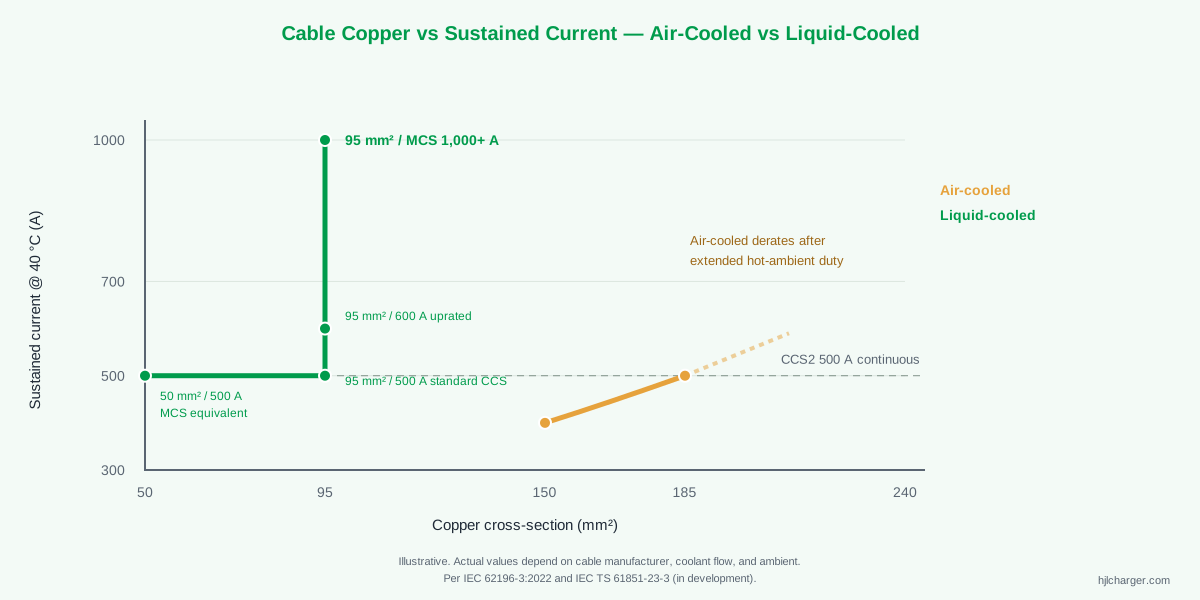
For the physical connector itself, CCS2 pins carry the same current regardless of cable cooling, but the pin-contact resistance heats up under sustained load. Liquid-cooled connectors route the coolant jacket right up to the pin backshell, keeping contact resistance stable; air-cooled connectors rely on connector-to-cable thermal mass to buffer peaks and must derate under long sessions.
4. Thermal headroom: cabinet architecture that keeps efficiency flat
Inside the cabinet, a modular rectifier stack converts AC to DC. Each 30 kW or 40 kW power module has an efficiency curve (typically 95–96% at nominal load) that drops as the module heats up: a 1% efficiency loss at 480 kW is ~4.8 kW of extra heat per cabinet, which the cooling system then has to pull out — a positive feedback loop in a hot environment.
Air-cooled architectures use front-to-back fan flow through finned heatsinks, filtered to keep dust out. Operating envelope is typically –30 °C to +45 °C intake air, with linear derating above 45 °C. Liquid-cooled modules replace the airflow path with a coolant loop that terminates at an outdoor heat exchanger (dry cooler or evaporative). Operating envelope extends to +50 °C or +55 °C intake-equivalent, and modules can be stacked more densely because they do not need airflow clearance between them.
Density is the hidden second-order gain of liquid-cooled modules: a 1 MW liquid-cooled cabinet typically occupies meaningfully less floor area than an air-cooled equivalent at the same power (the exact ratio varies by vendor and module generation), which matters when leasing highway service-area footprint. For MCS and megawatt deployments the ratio widens further — see our MCS Megawatt Charging System overview for the heavy-duty economics.
5. The 240 kW crossover: when does liquid-cooled start paying off
The crossover point is not a single number — it is a function of ambient temperature, duty cycle, and session concurrency. The table below is illustrative, based on typical site profiles and public technical literature. Actual crossover should be modelled against the specific site.
| Site profile | Per-gun power | Ambient 95th percentile | Daily utilisation | Recommended cooling |
|---|---|---|---|---|
| Workplace / destination | 60–120 kW | <35 °C | <30% | Air-cooled |
| Urban public plaza | 120–180 kW | <35 °C | 30–50% | Air-cooled |
| Suburban retail | 180–240 kW | 35–40 °C | 40–60% | Liquid-cable, air-module (hybrid) |
| Highway service area | 240–480 kW | >40 °C or <30% but 24/7 | >50% | Full liquid-cooled |
| Heavy-duty depot | 400 kW–2.6 MW | Any | >60%, back-to-back | Full liquid-cooled |
| MCS truck corridor | 1–3.75 MW | Any | Any | Full liquid-cooled (mandatory) |
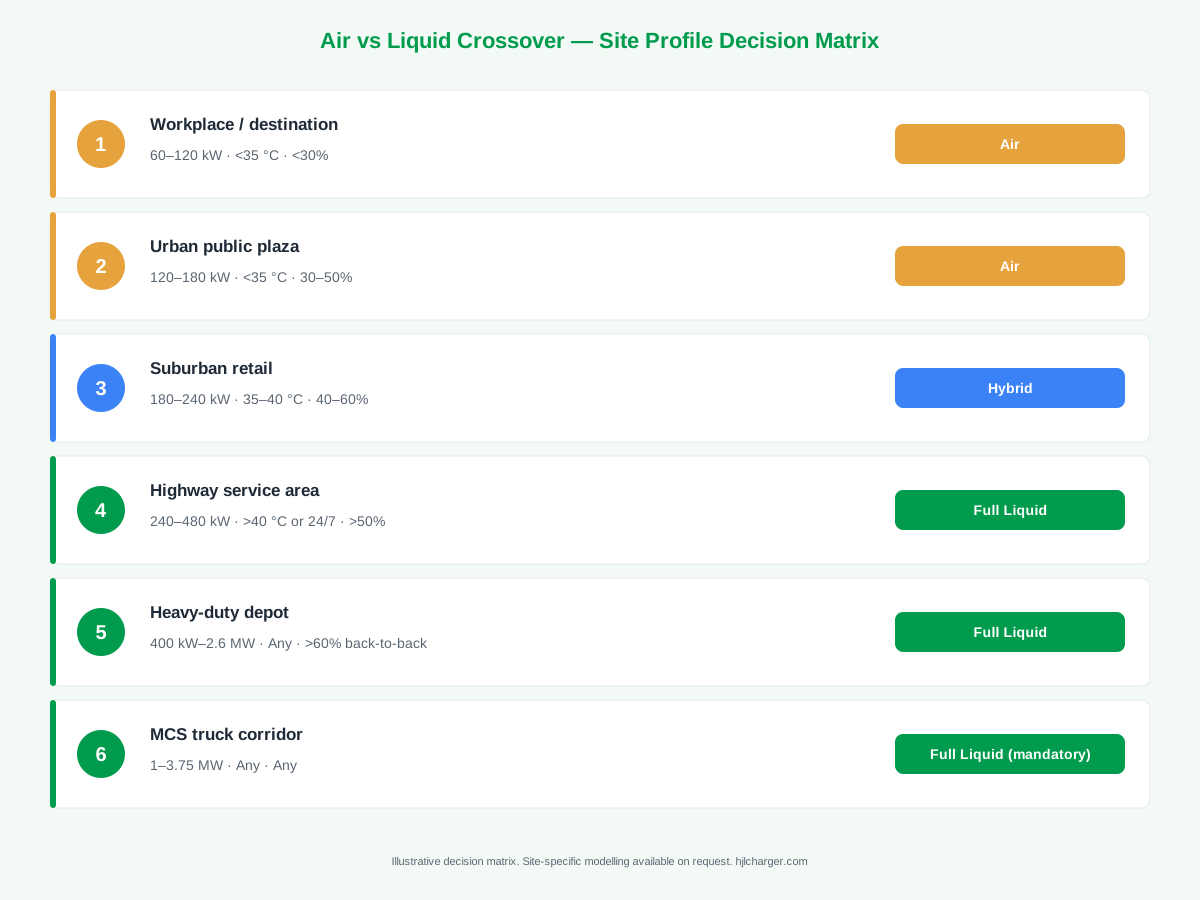
Hybrid configurations — liquid-cooled cable with air-cooled modules — occupy the middle band of the 240–360 kW segment where cable ergonomics dominate the buyer’s experience but the module heat load is still manageable with forced air. Hybrid configurations are available on specific HG Power higher-power air-cooled variants on request; the exact variant list is confirmed per quotation.
6. Duty cycle and ambient temperature: the two filters that override everything else
Two site conditions override the power-rating heuristic:
- Ambient 95th percentile above 40 °C — common in Middle East, South Asia, Australia, southern US. Air-cooled modules linearly derate above intake 45 °C, meaning a nameplate 480 kW cabinet may deliver 400 kW during the hottest 8 weeks of the year. Liquid-cooled modules hold rated power to intake 50–55 °C.
- Back-to-back duty >60% — common on urban highway corridors and depot overnight charging. Air-cooled cables and connectors absorb heat during a session and dissipate it between sessions; back-to-back use eliminates that recovery window. Liquid-cooled hardware has continuous active cooling and does not accumulate heat across sessions.
If either filter applies, liquid-cooled becomes the economic choice at a lower power threshold — often as low as 150 kW per gun in a 50 °C climate on a 24/7 corridor.
7. Lifetime, maintenance, and failure modes
Over a 10-year operating window, both architectures accumulate maintenance events; the mix is what differs.
| Event | Air-cooled frequency | Liquid-cooled frequency | Operator impact |
|---|---|---|---|
| Fan replacement | Every 3–5 years | None (no fans in module path) | Air-cooled: typically 2 cycles over 10 years |
| Filter cleaning | Quarterly (dusty sites: monthly) | None | Air-cooled: higher routine O&M labour |
| Coolant replacement | None | Every 3–5 years (glycol-water) | Liquid-cooled: scheduled coolant service |
| Pump / heat exchanger service | None | Pump 7–10 years; HX inspection annual | Liquid-cooled: higher planned-service cost per event |
| Cable replacement | Mechanical wear (connector pins, strain relief) | Mechanical wear + coolant leak checks | Liquid-cooled: additional leak-check protocol |
| Module MTBF under rated load | Air-flow derating accelerates ageing above 40 °C intake | Stable thermal envelope prolongs semiconductor life | Liquid-cooled: typically longer module life in hot climates |
Common failure modes: air-cooled fails most often on fan bearings and clogged filters (both inexpensive, routine). Liquid-cooled fails most often on coolant leaks and pump wear (less frequent, more disruptive single-event). Operator SLAs should price both profiles.
8. Five RFQ clauses to insert into every air-vs-liquid tender
| # | Clause | Verifies |
|---|---|---|
| 1 | “Vendor shall declare, per model, whether the cable and connector are liquid-cooled, air-cooled, or hybrid; cable copper cross-section, handle weight, and continuous current rating at 40 °C ambient shall be stated in writing.” | Prevents cable spec ambiguity |
| 2 | “Power modules shall be declared air-cooled or liquid-cooled; the cabinet’s full-power ambient temperature envelope (°C min to °C max intake, no derating) shall be stated in writing.” | Rules out hidden thermal derating |
| 3 | “Vendor shall supply a continuous-load test report demonstrating rated power held for ≥60 minutes back-to-back at 40 °C ambient, measured at the output contactor.” | Evidence of sustained-current claim |
| 4 | “Scheduled maintenance plan over 10 years shall be provided, including fan/filter/coolant/pump intervals and estimated labour hours per event.” | OPEX visibility before purchase |
| 5 | “Vendor shall declare coolant type, coolant volume per cabinet, and whether the coolant loop is factory-sealed or field-serviceable.” | Serviceability and spill-risk assessment |
9. HG Power air-cooled vs liquid-cooled product matrix
HG Power manufactures 30–720 kW DC fast chargers and AC wallboxes with CE, TUV CB, UKCA, Australia RCM, ETL and ENERGY STAR certifications for regional distributors, fleet integrators and OEM buyers in developed markets. Cooling architecture is engineered per series on a common controller base; the choice between air, hybrid, and full-liquid is agreed per order within the series’ supported envelope.
| Series | Power range | Cable cooling | Module cooling | Ambient envelope (full power) |
|---|---|---|---|---|
| Genesis DC Integrated | 40–480 kW | Air (hybrid liquid-cable available on higher-power variants on request) | Air | –30 to +45 °C |
| Aurora Split (standard) | 180–2,000 kW | Air (liquid-cable available on higher-power variants on request) | Air | –30 to +45 °C |
| Aurora Split (heavy-duty) | 2,000–2,600 kW | Liquid | Air (liquid-module option on request) | –30 to +45 °C |
| Glacier Liquid-Cooled | 160 / 180 / 240 / 360 / 480 kW | Liquid | Liquid | –30 to +50 °C |
| Deepsea Liquid-Cooled | 600 kW–2 MW | Liquid | Liquid | –30 to +50 °C, MCS-capable |
| V2G Bidirectional | 15–240 kW | Air | Air | –30 to +45 °C |
For dual-gun configurations on any of the above, see our dual-gun power allocation guide; for OCPP and CSMS integration see the OCPP 2.0.1 procurement guide; for broader manufacturer context see our pillar on how to vet an EV charger manufacturer in China.
10. References
| Reference A — Standards | Publisher | Edition / Date | Scope cited |
|---|---|---|---|
| IEC 61851-23 | IEC | 2023 edition | DC charging station electrical safety and ambient envelope |
| IEC TS 61851-23-3 | IEC | Technical Specification, in development | MCS high-current charging interface |
| EN 50620 | CENELEC | 2017 + A1:2019 | Electrical cables for EV charging, ergonomic touch temperature |
| IEC 62196-3 | IEC | Edition 2:2022 | CCS2 vehicle coupler specification |
| SAE J3400 | SAE International | 2024 | NACS physical connector and electrical rating |
| Reference B — HG Power sources | Document | Version / Date | Scope cited |
|---|---|---|---|
| HG Power 2026 Product Selection Manual (EN) | Genesis / Aurora / Glacier / Deepsea sections | 2026-06-01 | Power range, cooling architecture, ambient envelope |
| HG Power Company Profile (EN) | 2026-09-01 edition | 2026-09 | Manufacturing lines (Solar-Storage-Charging line, EV Charging line) |
| HG Power Certification Register | CE 3N240131.SHN0W49 · TUV CB R 50695913 0001 · UKCA CN25G3TM 001 · Australia RCM RCMC26013005D · ETL 2408B2314SHA-001 · ENERGY STAR C2506171 | Active | Certification baseline cited in Brand Formula |
11. FAQ
At what power rating does liquid-cooled become necessary?
There is no single threshold; the practical crossover is 180–240 kW per gun under moderate climate and duty, dropping to 150 kW per gun in hot climates (ambient 95th percentile >40 °C) or on back-to-back duty >60%. Below the threshold, air-cooled is cheaper and simpler. Above it, cable ergonomics and sustained-current ratings favour liquid-cooled.
Can a liquid-cooled cable be installed on an air-cooled cabinet?
Yes — this is the “hybrid” configuration: liquid-cooled cable and connector paired with air-cooled power modules. HG Power supports hybrid cabling on specific higher-power Genesis and Aurora Split variants; the available combinations are confirmed per quotation. It addresses cable ergonomics without the capex of full liquid modules.
What coolant is used in liquid-cooled DC fast chargers?
Industry standard is a glycol-water mixture (typically 40–50% propylene or ethylene glycol in deionised water) selected for freeze protection, viscosity, and dielectric properties. HG Power Glacier and Deepsea platforms ship with factory-filled coolant; replacement interval is typically 3–5 years and is a scheduled maintenance event.
Is MCS always liquid-cooled?
Effectively yes. The MCS (Megawatt Charging System) interface defined under IEC TS 61851-23-3 is designed for currents up to 3,000 A and voltages up to 1,250 V. Air cooling at those currents is not practical for cable ergonomics or connector thermal management, so all production MCS implementations use liquid cooling throughout.
Does liquid cooling improve charging speed for the vehicle?
Not directly. The vehicle’s charging speed is governed by its battery management system and cell chemistry, not the charger’s cooling. Liquid cooling lets the charger hold its rated output longer and in hotter ambient conditions, which prevents mid-session derating from the charger side. If the EV is the bottleneck, cooling architecture has no effect.
What is the maintenance cost difference over 10 years?
Both architectures accumulate maintenance; the mix differs. Air-cooled is dominated by fan replacement (every 3–5 years) and filter cleaning (quarterly, more frequent at dusty sites). Liquid-cooled is dominated by coolant replacement (every 3–5 years) and pump/heat-exchanger service. Total OPEX varies by site climate and labour cost — request a 10-year maintenance plan in the RFQ (Clause 4 above) for site-specific comparison.
Which HG Power series fits a 500 kW highway hub in a 45 °C climate?
Deepsea Liquid-Cooled (600 kW–2 MW platform) sized to the per-gun requirement, or an Aurora Split 480–720 kW heavy-duty configuration with liquid-cooled cables and liquid-module option. Both hold rated power at 50 °C intake, support MCS evolution, and share a common CSMS and firmware base with the rest of HG Power’s catalogue.
Scoping an air-vs-liquid deployment?
Send us your per-gun power target, ambient 95th-percentile temperature, daily duty cycle, and session concurrency. We respond with cabinet selection (Genesis / Aurora / Glacier / Deepsea), cooling configuration (air / hybrid / full liquid), 10-year maintenance plan, and MOQ-indexed pricing within 24 hours (GMT+8 business days).
WhatsApp: +86 189 2467 8741 · Email: marketing@hjlcharger.com · Partner program: hongjialicharge.com/partner-with-hg-power
Reviewed by: Marvin Zhou, Head of International Marketing, Shenzhen Hongjiali New Energy Co., Ltd. · Last reviewed 2026-10-22 · References: IEC 61851-23:2023; IEC TS 61851-23-3 (in development); EN 50620:2017+A1:2019; IEC 62196-3:2022; SAE J3400:2024; HG Power 2026 Product Selection Manual and 2026-09 Company Profile.