
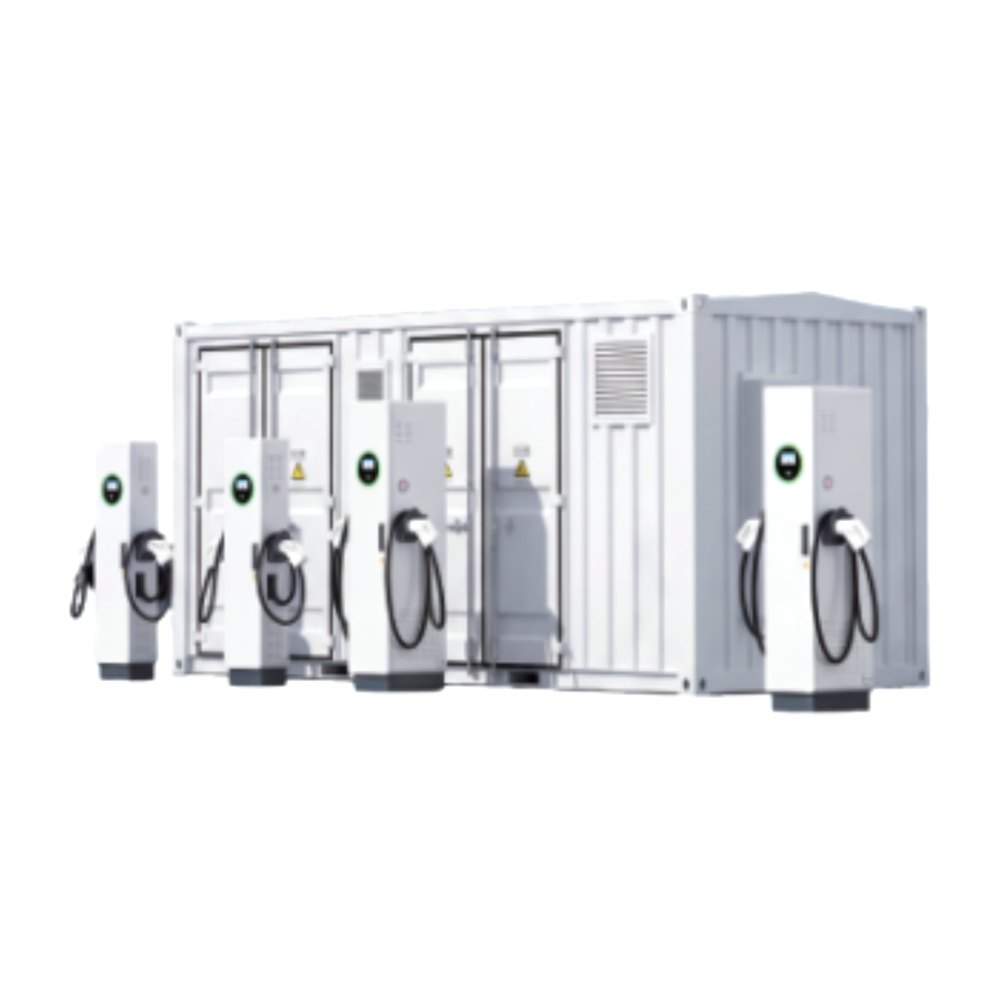
10 kV Direct-Connect Split EV Charger 1.2–2.6 MW
Quick answer: The HG Power 10 kV charger connects directly to a medium-voltage supply, so it needs no large transformer. It delivers 1.2 to 2.6 MW at 97% or higher efficiency from a 20-foot main cabinet, with 12 terminals and 24 charging guns. It suits large truck hubs and new megawatt sites.
Vehicles served: logistics vehicles, heavy-duty trucks, engineering vehicles.
- Direct 10 kV grid connection, no transformers, low losses;
- Efficiency of 97% or higher;
- Split design with multi-gun dynamic power distribution;
- Modular stacking, flexible expansion up to 2.6 MW;
- No large transformers, saves land and construction cost;
- N+1 redundancy, remote monitoring, high uptime;
SPECIFICATION
| EV Charger Type | DC |
| Charger Capacity | 2600 kW (1200-2600 kW range) |
| AC Supply System | Three-Phase |
| Nominal Input Voltage | AC10kV±15% |
| Input Frequency | 45-65Hz |
| Ambient Temperature Range | -25 to 55°C |
| Ambient Humidity | 5 to 95% |
| IP Ratings | IP 54 |
| Cooling | Air cooling (main cabinet) |
| Charging Gun Count | 24 |
| Terminal Quantity | 12 |
| Type of Each Output | DC200-1000V |
| Single Output Max. Current | 300/1000 Amp |
| Main Cabinet Size | 20 feet |
| High Efficiency | ≥97% |
| Communication between EVSE and Central Server | OCPP 1.6 / OCPP 2.0.1 (Optional) |
| Interface between Charger and CMS | Ethernet/3G/4G/WIFI (Optional) |
| Output Interface | CCS1/NACS/CCS2/CHAdeMO/GBT (Optional) |
Specifications come from the HG Power 2026 product selection manual. Confirm the final specification for your configuration in the quotation.
Why connect directly at 10 kV?
A megawatt site at low voltage has to carry very large currents. Connecting at 10 kV reduces the current, and it removes the large transformer between the grid and the charger.
| Input voltage | Current at 2.6 MW |
|---|---|
| 380 Vac | About 3,950 A |
| 10 kV | About 150 A |
We calculated these figures with current = power ÷ (1.732 × voltage), before efficiency and power factor.
Is a 10 kV charger right for your site?
- You have, or can get, a 10 kV connection from your utility
- You are building a new high-power site, and a transformer would add cost or take up land
- Your country accepts this type of connection under local grid rules
Check the last two points first. Medium-voltage work needs approved equipment and qualified contractors, so involve your utility early. If 10 kV is not available, compare the Aurora 960 kW–2.6 MW system, which runs on 380 Vac.
What does 97% efficiency mean in energy terms?
At 97% efficiency, about 3 kWh of every 100 kWh taken from the grid is lost. At full 2.6 MW output for one hour, that is about 80 kWh of losses. Real results depend on load and site conditions.
For more on megawatt sites, read our megawatt charging guide and see our heavy-duty truck charging solution.
Order terms
| Term | HG Power |
|---|---|
| Configuration | Agreed with our sales team |
| Standard lead time | 30–35 days after full payment |
| Warranty | 2 years |
| Payment | T/T (bank transfer) |
We confirm the terms for your configuration in the quotation.
Questions buyers ask
Does this charger really need no transformer?
The system connects directly to a 10 kV supply, so it does not need a large external step-down transformer. You still need a 10 kV connection, protection and approval that meet your local grid rules.
How many vehicles can it charge?
The 2026 product selection manual lists 12 terminals and 24 charging guns. The guns share the cabinet power through dynamic distribution, so the power per vehicle depends on how many charge at once.
Does it support 480 Vac or other input voltages?
No. This model is listed for 10 kV ±15% input. For 380 Vac sites, look at the Aurora 960 kW–2.6 MW system. If your medium-voltage supply is not 10 kV, ask our sales team before you plan the site.
Does this system support MCS?
The 2026 product selection manual lists CCS1, NACS, CCS2, CHAdeMO and GB/T as output interfaces, and it does not list MCS. If your trucks use MCS, tell our sales team before you plan the site.
Technical review: Marvin Zhou. Reviewed 6 November 2026.