
Battery-Buffered DC Fast Charger: What You Actually Get on a Weak Grid
A battery lets a small grid connection serve fast charging, but only within four limits: grid feed, usable energy, output current and recharge time. Test all four before you compare prices.
By HG Power. Published 10 November 2026. Technical review: Marvin Zhou.
A battery-buffered DC fast charger stores energy from a small grid connection and releases it to vehicles at a much higher power. It suits sites where the utility cannot supply full charger power without a costly upgrade. Before you buy, check four numbers: grid feed, usable battery energy, output current and recharge time.
This guide is for charge point operators, fleet and depot managers, EPC contractors and distributors who are comparing quotations for battery-buffered or battery-integrated DC chargers. It uses HG Power’s documented 261 kWh, 120 kW configuration as the worked example. Site-level storage design with solar is covered in our solar storage EV charging station guide, and vehicle-mounted units in our mobile EV charging guide.
What a battery-buffered DC fast charger is
A battery-buffered DC fast charger puts a battery between the grid and the charging connector. The grid recharges the battery at a steady, moderate rate. When a vehicle plugs in, the battery and the grid together supply the charger, so the vehicle can draw far more power than the grid connection alone could carry.
The US Joint Office of Energy and Transportation describes the same principle: the battery draws energy from the grid “at a continuous, moderate rate” and discharges it to vehicles much faster (Joint Office help sheet).
One rule explains most of what follows: the grid connection sets how much energy you can sell in a day; the battery sets how long you can charge faster than the grid allows.
There are three common ways to build one:
| Build | How it is connected | Best fit | Watch for |
|---|---|---|---|
| Battery-integrated charger (one product) | Battery, grid converter and DC charger share one DC bus inside one cabinet | Single-site fast charging on a limited connection | Output current limit, and whether the battery can be expanded later |
| Separate storage system plus standard DC charger | Storage and charger are separate products, usually joined on the AC side | Sites that already have chargers, or need storage for other loads too | Extra conversion steps, two suppliers, and who controls the battery |
| Mobile battery charger | Battery and charger on a trailer or skid that moves between sites | Roadside rescue, events, temporary sites | Recharge logistics at the base. See our mobile EV charging guide |
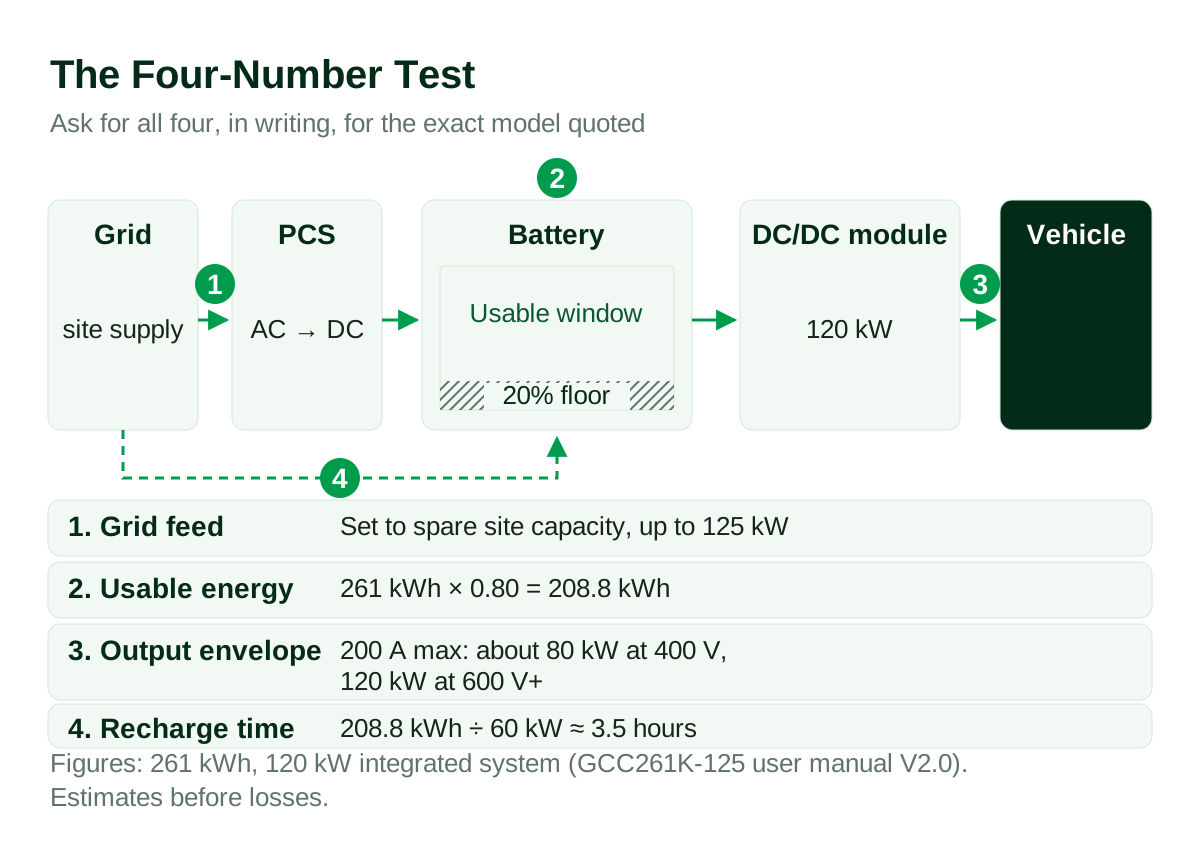
The Four-Number Test
Most spec sheets lead with two figures: charger kW and battery kWh. Neither tells you what a driver will get at 5 pm on a busy day. Ask every supplier for these four numbers, in writing, for the exact model they quote.
1. Grid feed: how much power can recharge the battery?
This is the continuous power the site can give the battery, after other loads. It is not the charger rating.
In HG Power’s GCC261K-125 integrated system, a 125 kW bidirectional power conversion system (PCS) charges the battery from the grid. The user manual tells the installer to set battery charging power and times to match the local tariff periods and “the available power capacity for the equipment”. A site with only 40 kW to spare sets 40 kW, not 125 kW.
A practical consequence: if your site can already supply about 125 kW continuously, a single 120 kW output does not need a buffer at all. The buffer earns its cost only when the grid feed is well below the charging power you want to offer.
2. Usable energy: how much of the battery can a vehicle actually receive?
Nameplate kWh is not usable kWh. Two deductions apply:
- State-of-charge floor. The GCC261K-125 stops discharging and disables the charger when the battery falls below 20% by default. That leaves 261 × 0.80 = 208.8 kWh between full and the floor.
- Conversion loss. The DC/DC charging module is rated at 95.2% efficiency or better. About 199 kWh of the 208.8 kWh reaches vehicles (estimate, before auxiliary loads such as battery cooling).
So a full 261 kWh battery with no grid input supports about four complete 40 kWh sessions and most of a fifth. That is the resilience number. With the grid connected, the battery refills between sessions and the station serves far more, as the worked example shows.
3. Output envelope: will every vehicle get the rated kW?
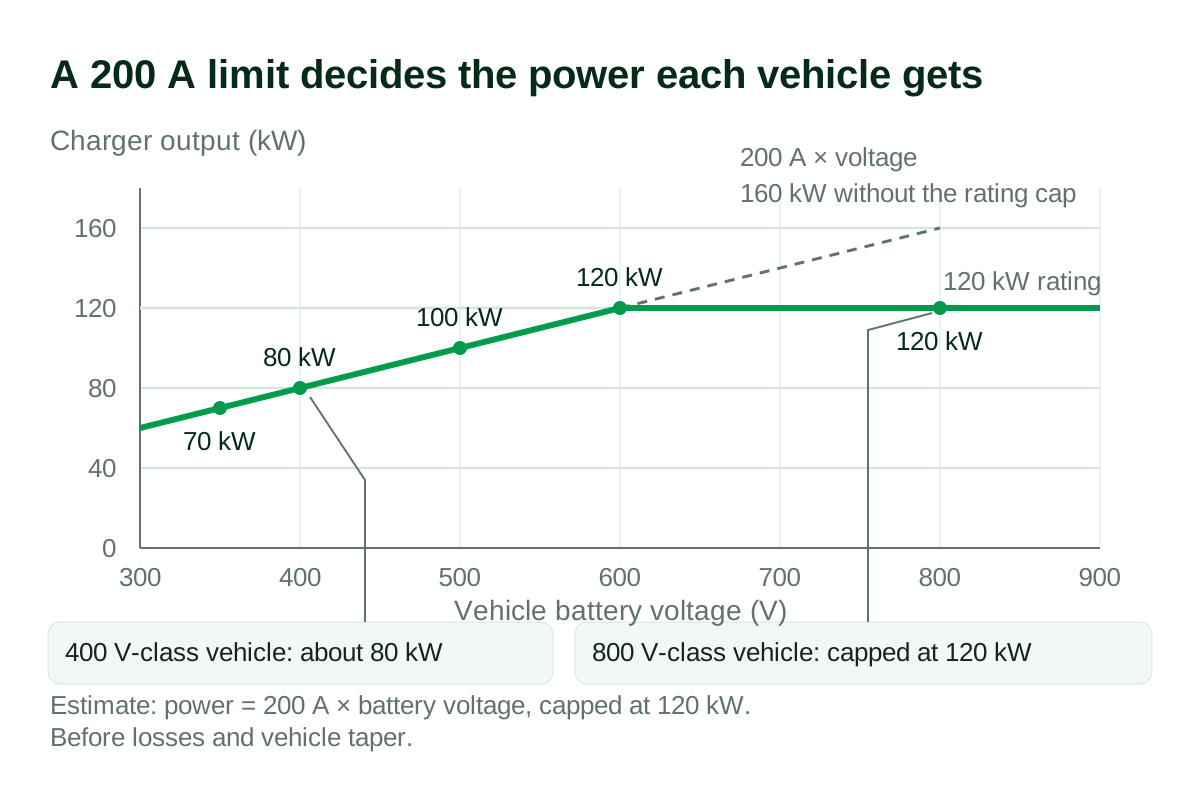
No. Power equals voltage times current, and the charger has a current limit as well as a kW rating. The HG Power 120 kW storage-charging configurations are rated at a maximum output current of 200 A. The vehicle’s battery voltage decides where the 200 A limit lands:
| Vehicle battery voltage | 200 A × voltage | What the charger can deliver (estimate) |
|---|---|---|
| 350 V | 70 kW | about 70 kW |
| 400 V | 80 kW | about 80 kW |
| 500 V | 100 kW | about 100 kW |
| 600 V | 120 kW | 120 kW |
| 800 V | 160 kW | 120 kW (capped by the rating) |
A vehicle with a 400 V-class battery will see about 80 kW from a 200 A, 120 kW unit, and its own battery management will taper that further as it fills. The full 120 kW is available only to vehicles at about 600 V or more.
The GCC261K-125 lists two guns on one 120 kW charging module. Two vehicles at once split that output; they do not get 120 kW each. Our dual-gun power allocation guide explains how that sharing works.
4. Recharge time: how long before the buffer is ready again?
Divide the usable energy by the grid feed. For the 208.8 kWh window of a 261 kWh battery, before conversion losses:
| Grid feed to the battery | Time from 20% to full |
|---|---|
| 30 kW | about 7.0 hours |
| 60 kW | about 3.5 hours |
| 100 kW | about 2.1 hours |
| 125 kW (PCS maximum) | about 1.7 hours |
If your busy periods are closer together than this, the second peak starts with a partly empty battery. That is the failure to design against. The Joint Office warns that an undersized battery can be fully depleted, “leading to severely reduced charging power” (help sheet).
Worked example: one 261 kWh, 120 kW unit on a 60 kW feed
Assume the site can give the battery a steady 60 kW and the battery starts full. Each session delivers 40 kWh. These are planning estimates, not performance promises; they ignore taper and auxiliary loads.
| Fleet of 800 V-class vehicles | Fleet of 400 V-class vehicles | |
|---|---|---|
| Output per vehicle | 120 kW | about 80 kW (200 A limit) |
| Time per 40 kWh session | about 20 minutes | about 30 minutes |
| Power drawn from the DC bus (output ÷ 0.952) | about 126 kW | about 84 kW |
| Net drain on the battery after the 60 kW feed | about 66 kW | about 24 kW |
| Continuous charging before the battery reaches 20% | about 3.2 hours | about 8.7 hours |
| Energy delivered in that time | about 380 kWh (nine full sessions and part of a tenth) | about 700 kWh (about 17 sessions) |
| After the battery reaches 20% | By default the charger is disabled while the grid keeps recharging the battery | Same |
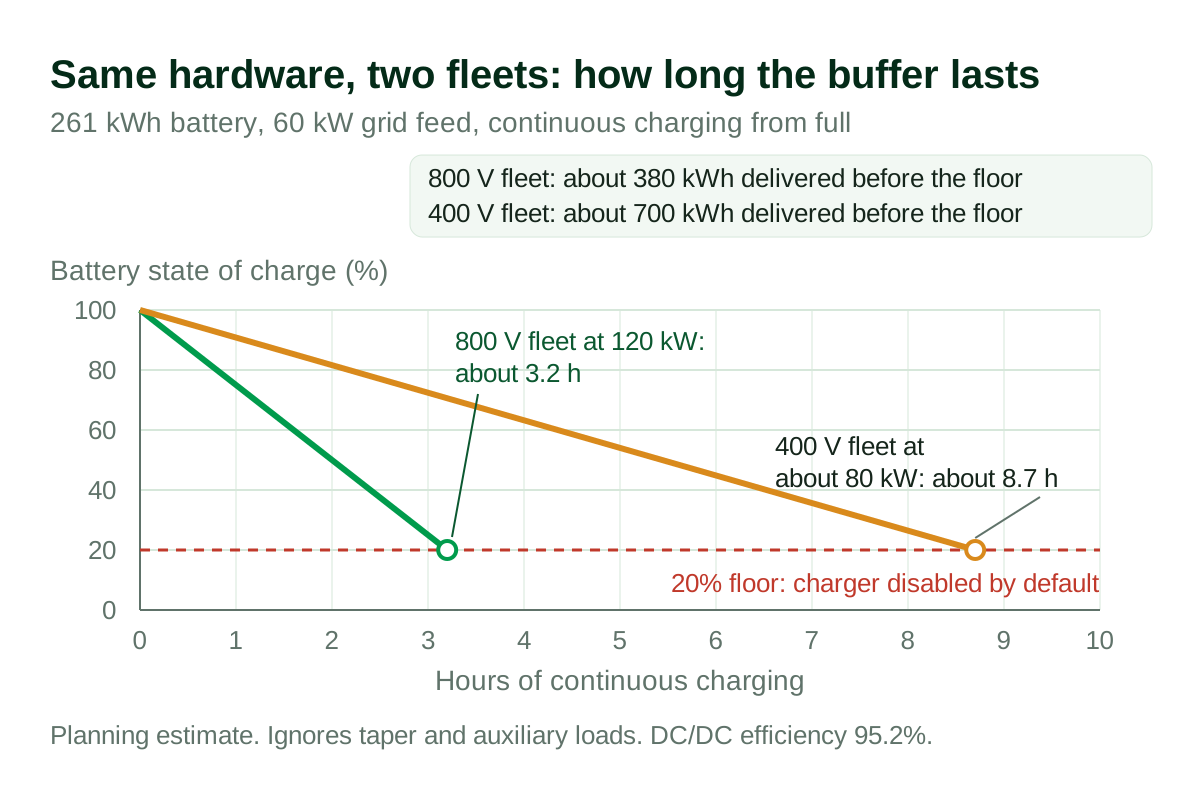
What happens at the floor matters as much as how long it takes to get there. The GCC261K-125 manual states that below 20% state of charge the charging point is disabled. It does not describe charging vehicles directly from the grid at that point, or the charge level at which charging resumes. Ask the supplier which behaviour the quoted model has, and get it in writing.
Two lessons come out of this table. First, the same hardware behaves very differently with different vehicles: the 400 V fleet charges more slowly, but the battery lasts much longer. Second, the daily ceiling is set by the grid: 60 kW for 24 hours is 1,440 kWh into the battery, or at most about 1,370 kWh at the vehicles. No battery size changes that daily total. The Joint Office makes the same point: grid input should at least equal the average charging demand over the busiest 24 hours (help sheet).
For multi-port sites, NREL uses a First Hour test: usable battery kWh ≥ 150 kWh × number of ports − grid kW × 1 hour. Its example is a four-port, 600 kW station on a 100 kW connection that needs at least 500 kWh of storage. Note that the 150 kWh-per-port benchmark assumes ports of 150 kW or more. A 120 kW unit cannot meet it, so if your funding programme requires that benchmark, ask for a larger configuration. Our solar storage EV charging station guide walks through First Hour and Design Day sizing step by step.
Battery buffer, grid upgrade or load management?
A buffer is one of three ways to fit fast charging onto a limited connection. Compare them on the same site data.
| Option | What it changes | Strong case | Weak case |
|---|---|---|---|
| Grid upgrade | Raises the connection to full charger power | High daily energy demand; utility can deliver within your timeline | Upgrade needs a new substation or takes years |
| Battery buffer | Lets short peaks exceed the connection | Low or medium daily energy, short peaks, slow or expensive upgrade | Continuous back-to-back charging all day |
| Load management (power sharing or a site power cap) | Limits total charger demand to the connection | Vehicles park for hours, so slower charging is acceptable | Drivers need fast turnaround |
A documented comparison is a Joint Office and NREL study of one rural corridor site for a state transport department. A 600 kW, four-port station needed a new substation. The utility route was estimated at about $4 million and 3–6 years; the battery-buffered route at $1.2–1.5 million and 1–2 years. That is a 65% capital cost reduction and a 2–5 year earlier opening, for that site (case study). The same study puts the incremental cost of adding a battery to a DC fast charger at $400–1,000/kWh. On that range, each extra 100 kWh of buffer adds roughly $40,000–100,000, so oversizing “to be safe” is expensive. Size from your busiest period, not from the largest cabinet on offer.
More broadly, NREL’s analysis found that appropriately sized battery-buffered stations can cut the grid service capacity needed by about 50–80%, with an identical charging experience for drivers (help sheet). Treat that as a planning range, not a promise for your site.
If load management could solve your problem, size that first. Our transformer sizing guide shows how to work out the connection you actually need.
When a battery buffer is the wrong answer
- Daily energy exceeds the grid ceiling. If vehicles need more energy per day than grid kW × 24 hours, the battery will run flat every day. Upgrade the connection instead.
- Vehicles charge back to back all day. A depot that plugs in a new vehicle the moment one leaves never gives the battery time to recover. It needs firm grid power or a slower, longer charging plan. See our fleet EV charging guide.
- The grid is already big enough. With 125 kW of spare capacity, one 120 kW output runs directly from the grid. A battery adds cost and a failure point without adding power.
- The site is cold and the battery cannot be kept warm. The GCC261K-125 manual forbids charging the battery below 0 °C. Ask how the cabinet keeps the battery above that before you choose a cold, exposed site.
- There is nowhere to put stationary storage. Battery cabinets need space, access and fire-safety approval. Ask your authority having jurisdiction which energy storage safety rules apply before you commit to a location.
Safety, climate and siting questions
Batteries change the safety case of a charging site. Settle these points before the order, not at commissioning:
- Cooling. The 261 kWh battery in the GCC261K-125 is liquid-cooled, and the manual specifies an air conditioner for battery cooling. The manual states that battery temperature must not exceed 55 °C in normal operation.
- Ingress protection. The manual rates the battery packs IP65 and the DC charging module IP54. Ask for the rating of the whole cabinet as installed.
- Operating range. The 2026 product selection manual lists −20 °C to 55 °C for the storage-charging all-in-one system, with the 0 °C battery-charging limit above still applying.
- Backup during outages. A battery does not guarantee charging during a grid outage. The Joint Office notes that hardware and software must be configured for that use. On the GCC261K-125, the static transfer switch, rated for grid/off-grid switching in under 20 ms, is fitted on higher-specification models only.
- Fire safety. Ask the supplier for the fire detection and suppression design, cell chemistry and test documents for the exact cabinet, and check them with your local fire authority. In the United States, many jurisdictions apply NFPA 855, the installation standard for stationary energy storage systems, and ask for equipment evaluated to UL 9540. Other markets use their own codes. Confirm which apply before you fix the location, because they can affect where the cabinet may stand.
HG Power configurations
We document several storage-charging configurations. Their figures come from different documents and should not be mixed.
| Configuration | Battery | Charging output | Connectors and notes | Source |
|---|---|---|---|---|
| Storage-charging all-in-one system (fixed) | 215–261 kWh, liquid-cooled, 500–900 V, >6,000 cycles | 100 or 120 kW; 200–1,000 V; 0–200 A | CCS1, CCS2, CHAdeMO or GB/T; 380 V AC ±15% input; 12.1-inch touch screen; 4G | 2026 product selection manual |
| GCC261K-125 integrated solar-storage-charging system (fixed) | 261 kWh, 728–949 V, liquid-cooled LFP 314 Ah cells | 120 kW DC/DC module, 2 guns, 200–1,000 V, 200 A max, ≥95.2% efficiency | Charging module built to GB/T 20234, GB/T 18487 and GB/T 27930; 125 kW bidirectional PCS; solar input through 2 × 100 kW MPPT | GCC261K-125 user manual V2.0 |
| CYD158K-120 mobile storage charger | 158 kWh LFP | 120 kW; 150–1,000 V; 0–200 A | GB/T, CCS1, CCS2 or CHAdeMO; OCPP; 2,720 × 1,400 × 1,692 mm, 2,600 kg | Specification V1.1 |
| EV mobile charger 180 kW | 158, 210 or 316 kWh | 180 kW; 150–1,000 V; 0–300 A | CCS1, CCS2, CHAdeMO or GB/T | 2026 product selection manual |
For a 400 V-class fleet, the 300 A limit of the 180 kW mobile charger matters more than its kW rating: 300 A × 400 V is about 120 kW, against about 80 kW at 200 A. See the storage-charging all-in-one system for the fixed unit and the transportable ESS charger for mobile units.
One recent request we received from an energy company asked for 100–120 kW chargers with 100–150 kWh of battery each. Run that through the Four-Number Test: after a 20% floor and about 95% conversion efficiency, 100–150 kWh gives roughly 76–114 kWh at the vehicles, or just under two to almost three 40 kWh sessions with no grid input. Whether that is enough depends entirely on the grid feed and the gap between busy periods, which is why we ask for both before quoting.
Supplier checklist: 12 questions before you sign
- What is the maximum output current, and what power will a 400 V vehicle receive?
- What is the usable kWh after the default state-of-charge floor, and can the floor be changed?
- What continuous grid power can the battery accept, and can it be capped to my site limit?
- How long does a recharge from the floor to full take at my grid feed?
- When the battery reaches its floor, does the charger fall back to grid power or stop?
- Do multiple guns share one power module, and how is power divided?
- Which connector standard and which back-office protocol (for example OCPP 1.6 or 2.0.1) is quoted for this exact model?
- How is the battery kept within its temperature limits, including charging below 0 °C?
- Which fire detection and suppression design and which test documents come with the cabinet?
- Is grid-outage operation included, and does it need extra hardware such as a static transfer switch?
- What battery capacity is guaranteed after how many cycles or how much delivered energy, and what does replacement cost?
- Can you supply the single-line diagram, and name who makes the cells, battery management system and power conversion equipment, and who issues the warranty?
Questions buyers ask
What is a battery-buffered DC fast charger and how does it work?
It is a DC fast charger with a battery between the grid and the vehicle. The grid recharges the battery slowly and continuously. When a vehicle plugs in, the battery and the grid supply the charger together, so the vehicle can charge at more power than the grid connection alone could provide, until the battery reaches its floor.
Is a battery-buffered charger cheaper than a grid upgrade?
It can be when the upgrade needs a new substation or years of utility work. In one Joint Office and NREL case study, a battery-buffered route was estimated at $1.2–1.5 million and 1–2 years against $4 million and 3–6 years for a substation. When a quick, low-cost upgrade is available, the upgrade is usually simpler.
How much battery do I need for a 120 kW charger on a small grid connection?
Multiply the gap between charging power and grid feed by the length of your busiest period. On a 60 kW feed, a 261 kWh battery sustains 120 kW for about three hours. Check output current too: at 200 A, 400 V vehicles draw only about 80 kW. The grid must cover the busiest day’s energy.
Will a 120 kW battery-buffered charger deliver 120 kW to every EV?
No. With a 200 A output limit, a 400 V-class vehicle receives about 80 kW; only vehicles at about 600 V or more reach 120 kW. Two vehicles on a dual-gun unit share it, and each vehicle’s own maximum DC rate and taper limit it further. Ask for output current, not only kW.
What should I ask a battery-buffered charger supplier before ordering?
Ask for the four numbers for the exact model: continuous grid feed, usable kWh after the state-of-charge floor, maximum output current, and recharge time at your feed. Then confirm what happens when the battery reaches its floor, the connector and protocol, cold-weather protection, fire safety documents and outage operation.
Can a battery-buffered charger keep working during a power cut?
Only if it is configured for it. The battery holds energy, but the system must be able to run without the grid. On the GCC261K-125, a static transfer switch for grid/off-grid switching is fitted on higher-specification models. With the grid down, a full 261 kWh battery supports roughly four to five 40 kWh sessions.
About this guide
HG Power (Shenzhen Hongjiali New Energy) was founded in 2016 and designs and manufactures EV charging and energy storage equipment. The company has 200+ employees, including 100+ engineers, and holds 100+ patents. We build both grid-only DC chargers and storage-charging systems, and this guide tells you when not to choose the storage option.
The calculations on this page use our published product documents and simple physics (power = voltage × current). They are estimates before taper, auxiliary loads and site-specific losses. Confirm every figure for the exact model you are quoted.
Reviewed by: Marvin Zhou
Sources
- HG Power, 2026 Product Selection Manual, V20260601: storage-charging all-in-one system and EV mobile charger specifications.
- HG Power, GCC261K-125 Integrated Solar Storage Charging System User Manual, V2.0, November 2025.
- HG Power, CYD158K-120 Mobile Charging Equipment Specifications, V1.1.
- Joint Office of Energy and Transportation and NREL, Battery Energy Storage for Electric Vehicle Charging Stations, Technical Assistance Help Sheet, DOE/GO-102024-6237, June 2024. Informative only; not guidance, policy or a standard.
- Joint Office of Energy and Transportation and NREL, Grid-Constrained Electric Vehicle Fast Charging Sites: Battery-Buffered Options, Technical Assistance Case Study, DOE/GO-102024-6238, June 2024. Single-site figures.
- NFPA, NFPA 855, Standard for the Installation of Stationary Energy Storage Systems. Named as a question for your authority; not a claim about any HG Power product.
- UL Solutions, UL 9540, Standard for Energy Storage Systems and Equipment. Same scope note.
Get a buffer sized to your grid feed
Send us your site details and we will propose a battery and charger configuration, with the four numbers stated for your vehicles. Include:
- Country, supply voltage and the continuous power available for charging (kW or kVA)
- Vehicle types and battery voltage class (400 V or 800 V) and connector standard
- Charging sessions on your busiest day, and when the peaks happen
- Target energy per session or target time per vehicle
- Whether you have, or plan, solar on site
- Whether charging must continue during grid outages
Related reading: Solar storage EV charging station sizing · Mobile EV charging · Transformer sizing for EV charging · 120 vs 240 vs 480 kW DC chargers · Split vs all-in-one DC chargers