
V2L Charger vs V2H vs V2G: A Bidirectional EV System Guide
Separate portable-load output, building backup and grid export—then make every “bidirectional” claim pass six independent evidence gates.
Reviewed by Marvin · Updated September 2026
V2L, V2H and V2G are not three names for the same charger. V2L lets a compatible vehicle supply limited AC power to portable loads. V2H or V2B connects vehicle energy to a building through compatible conversion, switching and protection. V2G adds grid-parallel export, utility rules, metering, controls and a commercial program. A vehicle or charger marked “bidirectional” proves only one part of that chain.
For a buyer, the right first question is not “What is the V2G charger price?” It is:
Which electrical boundary must the vehicle supply, under what operating mode, and which six independent interfaces must approve the energy flow?
This guide provides that decision path. It does not promise grid revenue, battery life or compatibility without the exact vehicle, charger, site and destination evidence.
Same vehicle battery, four different electrical jobs
→
→
The destination of energy changes the equipment, approvals and acceptance test.
V2L vs V2H vs V2G at a glance
The Australian Government places vehicle-to-load, vehicle-to-home and vehicle-to-grid under the wider V2X concept, but their boundaries are materially different.
| Mode | Energy destination | Typical conversion boundary | Site integration | External approval burden | Best first question |
|---|---|---|---|---|---|
| V2L | Portable appliance, tool or isolated load | Usually vehicle’s onboard inverter to an AC outlet/adapter | None or limited temporary distribution | Product instructions and local electrical safety | Is the required load below the vehicle’s output and suitable for the waveform/outlet? |
| V2H | Home circuits or selected backup loads | Compatible vehicle plus onboard or off-board bidirectional conversion | Transfer/isolation, protection and selected-load design | Electrical installation and local rules | Must it operate during an outage, in parallel with grid, or both? |
| V2B | Commercial building or microgrid boundary | Usually engineered bidirectional EVSE/power conversion | Switchgear, EMS, meter and load control | Building, utility and market-specific approvals | Which loads, reserve SOC and operating window are contractually available? |
| V2G | Public distribution grid or grid service | Compatible vehicle + bidirectional EVSE + grid interface | Protection, meter, communications, DER/aggregator controls | Utility/interconnection and commercial program | Who can authorize dispatch, settle energy and preserve mobility? |
Is a V2L adapter a bidirectional EV charger?
Not in the procurement sense used for V2H/V2G. V2L commonly exposes AC generated by hardware inside the vehicle. The adapter or outlet is a controlled load connection; it is not automatically a grid-interactive inverter, transfer system or utility-controlled charging station.
This distinction matters commercially. If the requirement is to power a few isolated loads, a full V2G project may add complexity without adding useful service. If the requirement is building backup or grid export, a V2L lead should never be used to backfeed a panel.
“Bidirectional” is a system claim, not a product adjective
Energy has to cross multiple control and protection boundaries:
traction battery → vehicle BMS → vehicle inlet/onboard inverter → EVSE or adapter → building/site switchgear → meter/grid connection → control and settlement system
Failure at any boundary can reduce the project to ordinary one-way charging—or make operation unacceptable.
A vehicle brochure may allow V2L but not V2G. A charger may be electrically bidirectional but lack a validated vehicle protocol. A complete vehicle/charger pair may still lack destination approval. A utility-approved system may have no viable operating window once fleet departures and reserve SOC are protected.
One failed interface stops the project
The Six-Layer V2X Feasibility Gate
Do not release a bidirectional-charging purchase order until all six layers have a named owner, evidence artifact and pass condition.
| Gate | Required proof | What fails without it | Minimum deliverable |
|---|---|---|---|
| 1. Vehicle permission | Exact make, model, model year, market, firmware, battery warranty and supported export mode | The vehicle refuses discharge or an unsupported use affects warranty/service | OEM document plus vehicle asset list |
| 2. Conversion/connector | Connector, protocol, voltage/current range, AC/DC conversion location and matched equipment | Physical fit but no handshake, wrong voltage envelope or no export conversion | Interface matrix and supported-pair statement |
| 3. Site/building | One-line diagram, loads, switchgear, grounding, transfer/islanding mode and available capacity | Unsafe backfeed, overload or no useful backup boundary | Engineer-approved one-line and protection schedule |
| 4. Grid/interconnection | Utility rule, export limit, anti-islanding, meter and permission-to-operate path | Grid-parallel export is prohibited or cannot be settled | Interconnection approval matrix |
| 5. Communications/control | EV–EVSE, EVSE–CSMS, EMS/DER controls, cybersecurity and fallback states | Hardware works locally but dispatch, limits or records fail | Protocol responsibility matrix and test cases |
| 6. Commercial/operations | Tariff/program, aggregator, dispatch rights, mobility reserve, degradation policy and settlement | A technically working asset has no bankable service or disrupts transport | Operating policy and scenario model |
Passing five gates is still a failed V2G project. Gate 6 cannot waive electrical approval, and a protocol certificate cannot waive the vehicle or grid gate.
Where does the power conversion happen?
This is one of the most important RFQ questions.
Onboard AC export
For many V2L implementations, the vehicle converts traction-battery DC into AC. The output is limited by the exact vehicle, outlet/adapter, voltage, frequency and instructions. This can be useful for portable tools, communications, refrigeration or other bounded loads.
It does not create a compliant building connection. Load startup current, grounding arrangement, extension/distribution equipment and environmental exposure still matter.
Off-board DC bidirectional conversion
In many V2H/V2B/V2G systems, DC moves through the vehicle connector to an external bidirectional power-conversion system. That equipment produces controlled AC for a building or grid boundary and coordinates with the vehicle.
The buyer must match:
- vehicle export permission and communication;
- connector and implemented protocol;
- DC voltage/current range;
- AC grid voltage, frequency and phase arrangement;
- continuous and short-duration export power;
- anti-islanding/grid-forming behavior;
- protection, meter and EMS commands.
The words CCS, CHAdeMO or GB/T alone do not prove bidirectional compatibility. Confirm the exact vehicle–EVSE implementation and destination approval.
Available energy is smaller than battery nameplate
Then protect recovery charge, auxiliaries and uncertainty before committing a grid event.
Size the Export Envelope—not just the charger kW
An EV battery is not a stationary battery that is always available. It has a transport job.
Define five limits:
- Energy reserve: minimum vehicle state of charge required for the next duty.
- Exportable energy: energy above that reserve after applying the operator’s usable window.
- Export power: the lowest active limit across vehicle, conversion equipment, connection and dispatch command.
- Available window: plug-in duration after charging/recovery and before departure.
- Recovery requirement: energy and time needed to restore the departure SOC.
A planning expression is:
Dispatchable energy = min(energy above reserve, export-power limit × available discharge time)
Then subtract auxiliary consumption and retain an uncertainty margin appropriate to the operation. Do not count the whole nameplate battery. Do not count every parked vehicle unless it is connected, authorized, above reserve and free from a departure constraint.
A simple fleet worksheet
| Input | Unit | Why it matters |
|---|---|---|
| Connected vehicles by 15-minute interval | count | Annual fleet size does not equal concurrent availability |
| Arrival and required departure SOC | % | Defines recoverable export window |
| Next-trip energy plus reserve | kWh/vehicle | Protects the transport mission |
| Vehicle export ceiling | kW/vehicle | May be below EVSE rating |
| Site export/import limit | kW | Constrains aggregate operation |
| Required recovery completion | time | Prevents an export event from creating a late vehicle |
| Allowed dispatch events | schedule/rule | Links technical availability to the commercial program |
Model at least normal, worst-arrival, early-departure, cold/hot battery, communications-loss and grid-event cases.
When V2L is enough
Choose V2L first when the real requirement is a limited, portable, isolated AC load and the compatible vehicle’s documented output is sufficient.
Examples can include tools at a temporary work area, communications equipment or bounded emergency loads. The load list must include continuous power, starting/surge behavior, voltage/frequency, protective earth requirements and operating duration.
Do not choose V2L as a shortcut to:
- energize a building panel through an outlet;
- operate in parallel with the grid;
- claim utility revenue;
- exceed the vehicle’s documented load/output rules;
- supply life-safety or mission-critical loads without a designed redundancy and transfer plan.
For many buyers, the most valuable outcome of a V2X assessment is discovering that V2L meets the job without purchasing a grid-interactive system.
When V2H or V2B is justified
V2H/V2B becomes relevant when the vehicle must support selected building loads, reduce site import under an approved operating strategy, or form part of a resilience plan.
Freeze the operating modes:
- islanded backup: the building or selected-load panel is isolated from the grid;
- grid-parallel self-consumption/peak control: export may stay behind the meter or be capped;
- grid export: energy crosses the meter under an interconnection and settlement arrangement.
The same hardware label does not prove all three. Ask who supplies and commissions the transfer/isolation function, how resynchronization occurs, which loads remain energized, and how the system behaves when the vehicle disconnects unexpectedly.
Reality check: backup duration is an energy problem
A 10 kW output does not mean ten hours of backup. Duration depends on usable exported energy and actual load:
Approximate duration = usable exported energy ÷ average supported load
Both terms must be bounded. HVAC, pumps, refrigeration and motors can also impose startup or cyclic peaks that the average hides.
When V2G is executable—and when not to buy it
V2G is justified only when a compatible technical chain meets a real grid or market service.
Proceed when:
- the vehicles and exact charger pair support the required two-way mode;
- the utility/interconnection path is known;
- a tariff, aggregator or site objective gives dispatch a defined value;
- vehicles are connected predictably without sacrificing duty;
- metering and settlement responsibility are clear;
- battery/warranty policy is acceptable to the asset owner;
- failure and opt-out behavior protect mobility.
Do not procure V2G yet when:
- the project relies on a future vehicle firmware promise;
- “ISO 15118” or “OCPP compatible” is the only evidence;
- no one owns grid approval or protection design;
- revenue is based on a generic peak/off-peak spread rather than an eligible program;
- vehicles cannot remain connected during dispatch windows;
- the operator has not set reserve SOC and override rules;
- the business case depends on exporting the full battery every day;
- the exact bidirectional SKU and destination evidence are unavailable.
Unidirectional smart charging may capture much of the operational value with fewer dependencies. Test managed charging as the baseline before attributing incremental value to export.
Standards and protocols: name the interface they control
Protocol acronyms are frequently stacked in proposals as though they were cumulative proof. They govern different interfaces.
ISO 15118-20
ISO’s official record states that ISO 15118-20:2022 defines communication messages and sequences for bidirectional power transfer between the EV and EVSE. It is a communication standard, not a complete building/grid approval or a statement that every ISO 15118 implementation supports every bidirectional use case.
Ask for the implemented edition, functions, vehicle pair and test evidence.
OCPP
OCPP connects the charging station with a central management system. Open Charge Alliance states that OCPP 2.1 adds support for ISO 15118-20, a bidirectional-charging functional block and DER control. OCPP 2.0.1 includes smart charging and ISO 15118 support, but buyers should not translate a generic “OCPP 2.0.1” line into native end-to-end V2G support.
Ask which messages, variables, schedules, export limits, transaction records and failure states are implemented by both EVSE and CSMS. Protocol version, optional function and certification profile are separate facts.
Connector/protocol family
CHAdeMO has an established bidirectional ecosystem. CCS/ISO 15118-20 and other regional interfaces continue to develop. GB/T and ChaoJi configurations are separate implementation and market questions. No connector name overrides vehicle, EVSE, grid and test evidence.
For CHAdeMO vehicle-side planning, see the 2026 compatibility guide. For CCS procurement boundaries, use the CCS charger buyer’s guide.
Turn every V2G claim into an RFQ artifact
| Supplier claim | Evidence to request | Acceptance case |
|---|---|---|
| “Bidirectional” | Exact model datasheet; charge/discharge envelope | Command charge, idle and discharge within stated limits |
| “Vehicle compatible” | Make/model/year/market/firmware matrix | Repeat sessions with representative fleet vehicles |
| “Supports ISO 15118-20” | Implemented functions and conformance/interoperability record | Verify negotiation, limits, schedule and safe stop |
| “OCPP supported” | Version, edition, profiles/functions and CSMS pairing | Confirm commands, telemetry, transaction and fault recovery |
| “Grid ready” | Destination conformity and interconnection/protection matrix | Utility/engineer witness tests required locally |
| “Backup capable” | Islanding/grid-forming/transfer architecture | Loss-of-grid, stable load pickup and resynchronization tests |
| “Peak shaving” | EMS logic, meter boundary and site constraints | Reproduce import cap with changing vehicle availability |
| “Earns revenue” | Eligible tariff/program, dispatch/settlement rules and scenario inputs | Reconcile dispatch event, meter data and settlement record |
| “Protects battery” | OEM limits, reserve policy and warranty position | Verify overrides, minimum SOC and departure recovery |
Include negative and degraded cases. What happens if a vehicle unplugs, the CSMS is unavailable, the meter link fails, the site reaches an import/export cap, or a departure time moves forward?
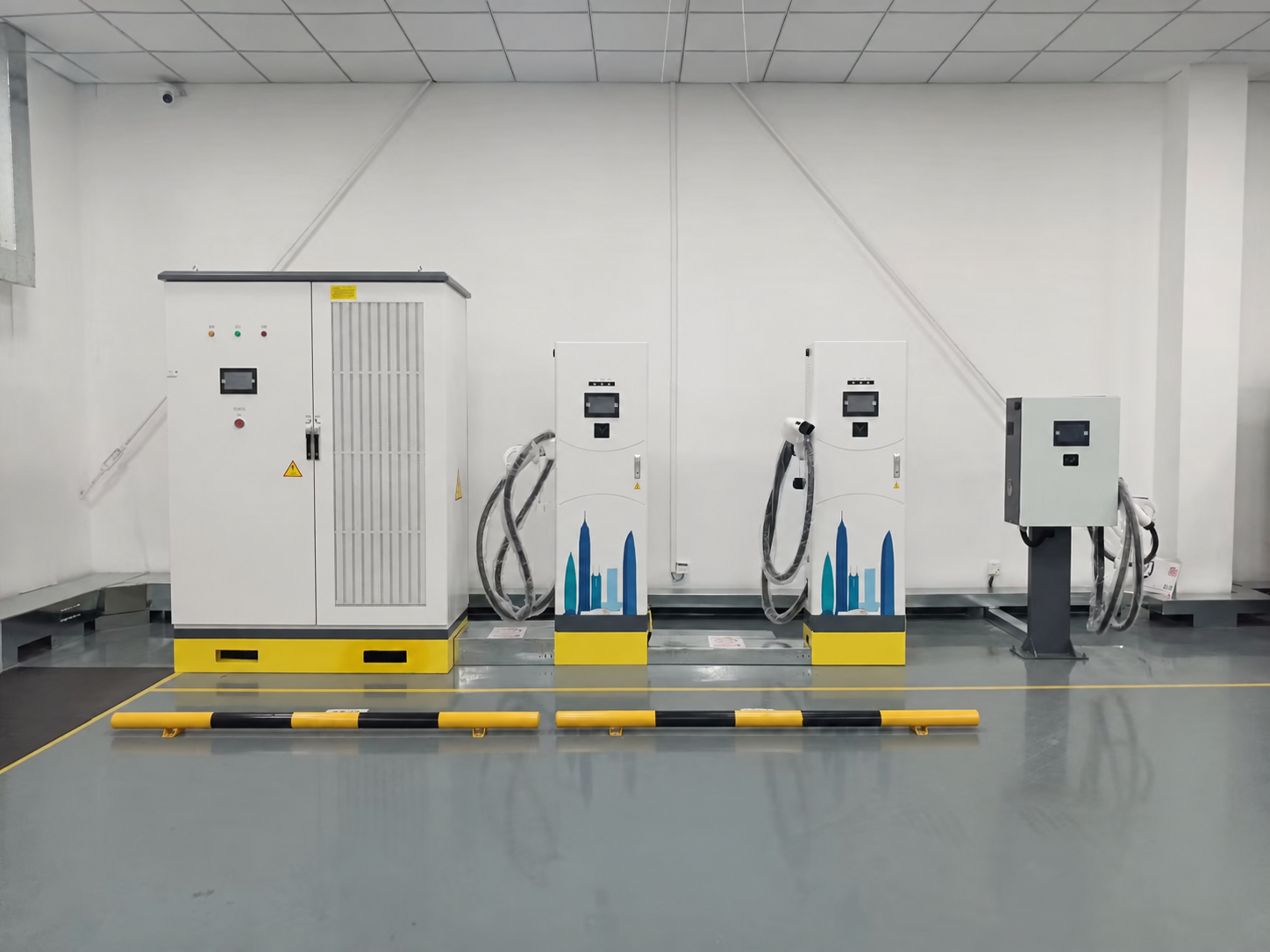
What the supplied HG Power evidence supports
HG Power’s supplied 2026 solution presentation includes V2G bidirectional charging and discharging as a solution area. A supplied test-area photograph is labelled in its project record as including a 20 kW GB/T V2G item beside other DC charging equipment.
These materials establish development/test context and product direction. They do not by themselves prove:
- a portfolio-wide bidirectional power range;
- CCS, CHAdeMO, GB/T or ChaoJi support on every model;
- ISO 15118-20 or OCPP 2.1 implementation/certification;
- grid approval in any destination;
- vehicle interoperability, field performance, revenue or customer endorsement.
Therefore, the correct commercial next step is model-specific evidence review. Before quotation, request the exact bidirectional equipment datasheet, supported vehicle/connector matrix, electrical envelope, operating modes, protocol responsibility and destination compliance package.
FAT and SAT: prove the whole chain
Factory acceptance test
Record exact hardware/firmware identity and test:
- supported vehicle or validated simulator connection;
- controlled transition from charge to idle to discharge;
- voltage/current/power limits and ramp behavior;
- reserve SOC and operator override;
- communication loss and safe state;
- CSMS/EMS commands and telemetry;
- meter/log consistency;
- protection trip and recovery;
- multi-unit/site-limit behavior if applicable.
Site acceptance test
Add the real one-line, switchgear, meter, utility settings, loads and network. Test permitted normal modes, islanding/transfer where included, import/export cap, loss of communications, unexpected disconnect, emergency stop and restoration.
A successful factory demonstration is not permission to operate in parallel with a public grid. The site test and local approval path remain separate.
Frequently asked questions
Does V2L require a special charger?
Often no external bidirectional EV charger is involved: a compatible vehicle supplies AC through its specified outlet or adapter. Follow the exact vehicle instructions and output limit. A V2L outlet is not a building- or grid-interconnection method.
Can a V2L car power a house?
It may supply selected isolated loads within its limit. Feeding fixed house circuits requires a designed and compliant transfer/isolation arrangement; never backfeed through an ordinary outlet.
Is every bidirectional EV compatible with every V2G charger?
No. Vehicle model/year/market/firmware, connector, implemented communication, voltage/current range and destination approval must match.
Is OCPP 2.0.1 enough for V2G?
No generic OCPP line is enough. OCA identifies native bidirectional and DER-control functional blocks in OCPP 2.1. In all cases, verify the exact EVSE–CSMS functions and the separate EV–EVSE and grid interfaces.
How much money can a V2G fleet earn?
There is no responsible universal figure. Calculate an eligible local service using connected-vehicle availability, reserve energy, export limit, dispatch frequency, charging recovery, tariff/aggregator terms, losses, fees, equipment cost and battery/warranty policy.
Does bidirectional charging damage the battery?
Battery effect depends on chemistry, temperature, SOC window, power, cycling pattern and vehicle controls. Use OEM/warranty guidance and model the actual operating policy. Do not publish a universal annual-degradation percentage.
Send the vehicle list, operating mode, connector, one-line diagram, grid rules, export window and control interfaces.
Build the feasibility pack before requesting price
Send these inputs for an engineering review:
- destination country and utility/interconnection context;
- V2L, V2H, V2B or V2G operating objective;
- exact vehicles, model years, markets, firmware and connector photos;
- required import/export voltage, phase, frequency, power and energy window;
- one-line diagram, meter boundary, protection and islanding requirement;
- connected-vehicle schedule, reserve SOC and departure rules;
- CSMS/EMS/aggregator interfaces and required protocol functions;
- applicable conformity, FAT, SAT and witness-test requirements.
Contact HG Power to review whether the current project evidence supports a bidirectional configuration. The output should be a named model and interface/evidence matrix—not a generic revenue promise.
Related decision guides
- DC fast charger station design
- Commercial EV charger procurement
- Solar EV charging system design
- EV charging station business model
- Supplier qualification guide
Sources and update note
Technical references were checked in September 2026. Standards, grid rules, vehicle capability and commercial programs change; reconfirm them for the exact destination and project.