
Commercial EV charging · Buyer’s guide · 2026
Commercial EV Charger Buyer’s Guide
Practical, evidence-led planning for international commercial charging projects — from site fit and electrical scope to a correctly configured 40–480 kW DC charger quotation.
Technical review: Marvin. This guide is a procurement-planning resource; site electrical design, code compliance, and final equipment selection require confirmation by appropriately qualified parties for the destination project.
HG Power portfolio scope: Commercial DC charging products cover 40 kW to 480 kW. Final configuration is confirmed in the applicable model quotation and documentation.
Commercial EV charging projects usually fail at the edges, not in the specification sheet. A charger can be well built and still be the wrong purchase if the site has short parking dwell times, inadequate electrical capacity, an unsuitable utility tariff, or no clear owner for operations and repairs. This guide is written for international buyers across Europe, the Americas, Asia, Africa, and Latin America; it deliberately does not assume that one connector, electrical input, certificate, payment workflow, or charger version is correct everywhere.
Quick answer: A commercial EV charger should be selected by the job it must do at a specific site. Level 2 is often the practical fit where vehicles remain parked for hours; DC fast charging is generally better suited to short-stay, high-throughput, or route-critical charging. Before comparing hardware, validate four gates: dwell time, electrical capacity, operating model, and procurement/compliance requirements.
Start with the site, not the charger
“Commercial EV charger” covers more than one job. A workplace wants predictable daytime charging. A hotel wants guests to plug in and return later. A fleet depot may need vehicles ready before the next shift. A public site may need to serve unfamiliar drivers, payment workflows, and higher peak demand.
The U.S. Department of Energy's Alternative Fuels Data Center (AFDC) notes that Level 1 and Level 2 charging are generally placed where vehicles are concentrated and parked for long periods, while public charging can use either Level 2 or DC fast charging. That distinction matters because commercial value comes from matching charging power to actual vehicle dwell time, not simply buying the largest kW figure available. AFDC public-charging guidance
The 4-Gate Commercial Charger Fit
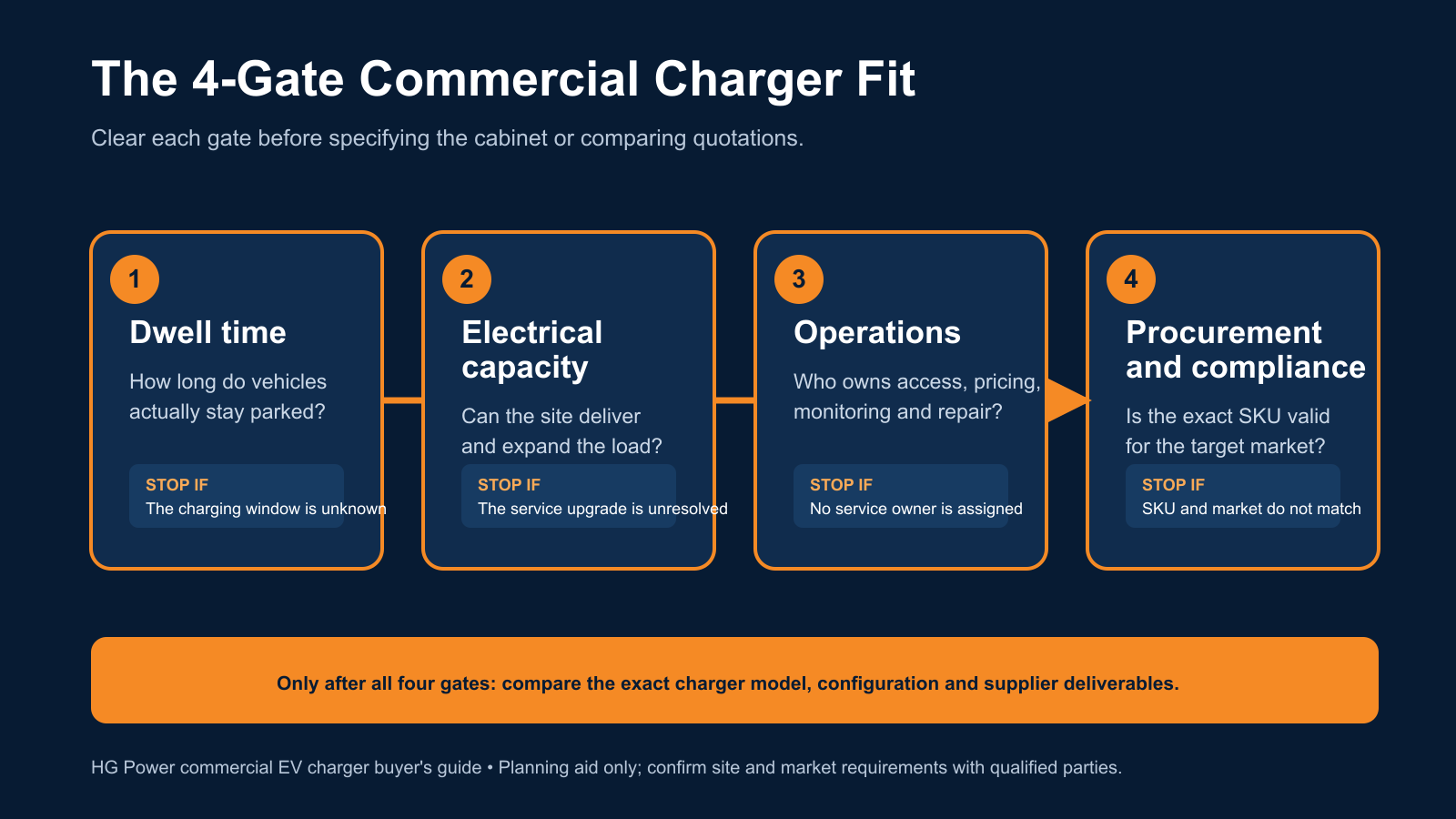
Use the following sequence before asking vendors for a quotation. A project that fails an earlier gate should not be “solved” by adding charger power at a later gate.
| Gate | Questions to answer | What a failed gate can cause |
|---|---|---|
| 1. Dwell time | How long are vehicles actually parked? Is charging destination, workplace, depot, or en-route? | Underused high-power hardware or insufficient energy delivered before departure |
| 2. Electrical capacity | What capacity is available at the transformer, panel, and service? What trenching or upgrades are required? | Delayed commissioning, unexpected construction cost, or a reduced charging plan |
| 3. Operations | Who controls access, pricing, payments, load management, monitoring, maintenance, and repair escalation? | A charger that is installed but difficult to operate or keep available |
| 4. Procurement | Which market-specific configuration, connector, input arrangement, certifications, environmental requirements, spare parts, commissioning steps, and warranty commitments apply? | A hardware purchase that cannot be accepted, supported, or expanded as planned |
Gate 1: Match charging class to vehicle dwell time
The first decision is not “AC or DC?” It is “how much usable energy must each vehicle receive during its real parking window?” Once that answer is clear, the charging class becomes more obvious.
| Site situation | Typical parking pattern | Better starting point | Why |
|---|---|---|---|
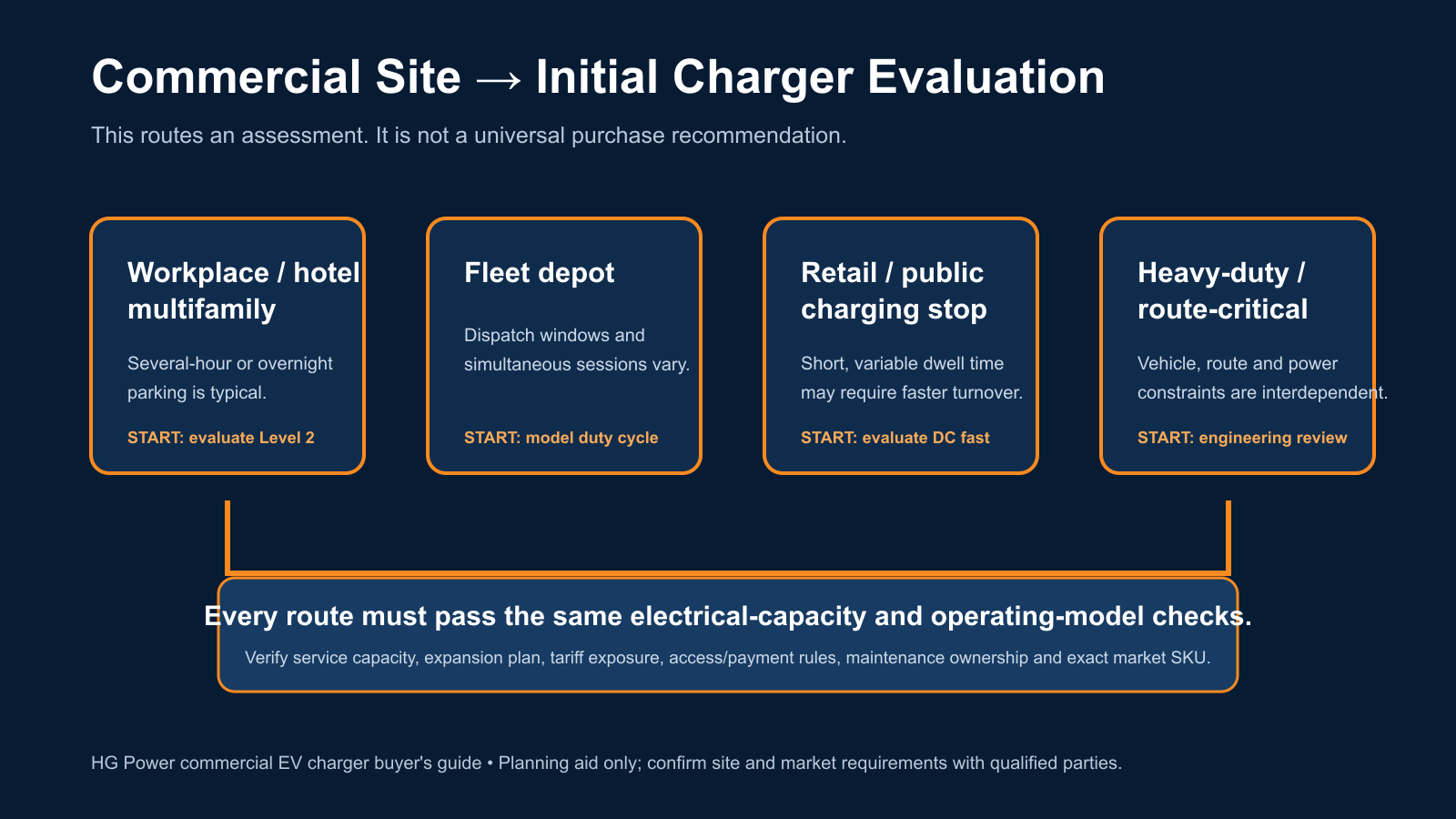
| Workplace, hotel, airport parking, multifamily destination | Several hours or overnight | Commercial Level 2 | Charging can occur while the vehicle is already parked; site economics may favor more ports over maximum power per port. |
| Fleet depot | Scheduled dwell time, often between shifts | Level 2 or DC fast, based on route and turnaround | Fleet dispatch time and simultaneous charging demand matter more than public-facing speed claims. |
| Retail stop, highway-adjacent site, public charging hub | Short and variable stays | DC fast charging | The project may need higher energy delivery during a shorter visit. |
| Heavy-duty or route-critical operation | Duty-cycle specific | Engineering assessment first | Vehicle battery, route, depot window, power availability, and site design must be considered together. |
A planning formula, not a promise
Required average charging power (kW) ≈ energy needed before departure (kWh) ÷ usable dwell time (hours).
This is a first-pass sizing check, not a delivered-energy guarantee. The final design also depends on the vehicle's charging acceptance, charging losses, simultaneous sessions, the site's available capacity, and any load-management rules. Its purpose is to expose a mismatch early: if the energy requirement divided by the realistic parking window points to a much higher power than the site can support, the project needs a change in charging strategy, electrical scope, vehicle schedule, or all three.
Reality check: DC fast charging is not a universal upgrade. If vehicles remain parked for most of a workday or overnight, a well-designed Level 2 deployment may serve the use case with less site electrical stress. Conversely, installing only low-power charging at a short-stay site can disappoint drivers even if the equipment cost looked attractive.
Case evidence: a mixed-power public site is a planning choice, not a marketing claim
HG Power's project-material archive identifies the Rixing New Energy Chengnan Charging Station in Yangjiang, China and records a mixed installation of five 120 kW dual-gun chargers, one 240 kW dual-gun charger, and one 400 kW dual-gun charger. The corresponding source photos show multiple installed DC cabinets beneath a canopy.
This is useful as a procurement lesson: the site was not documented as a one-size-fits-all power choice. It combines several power classes, which is exactly the type of configuration a buyer should only select after documenting dwell time, expected simultaneous sessions, parking layout, and site electrical capacity. The archive does not establish utilisation, revenue, charging times, uptime, or the exact rating of each photographed cabinet; those figures should not be inferred.
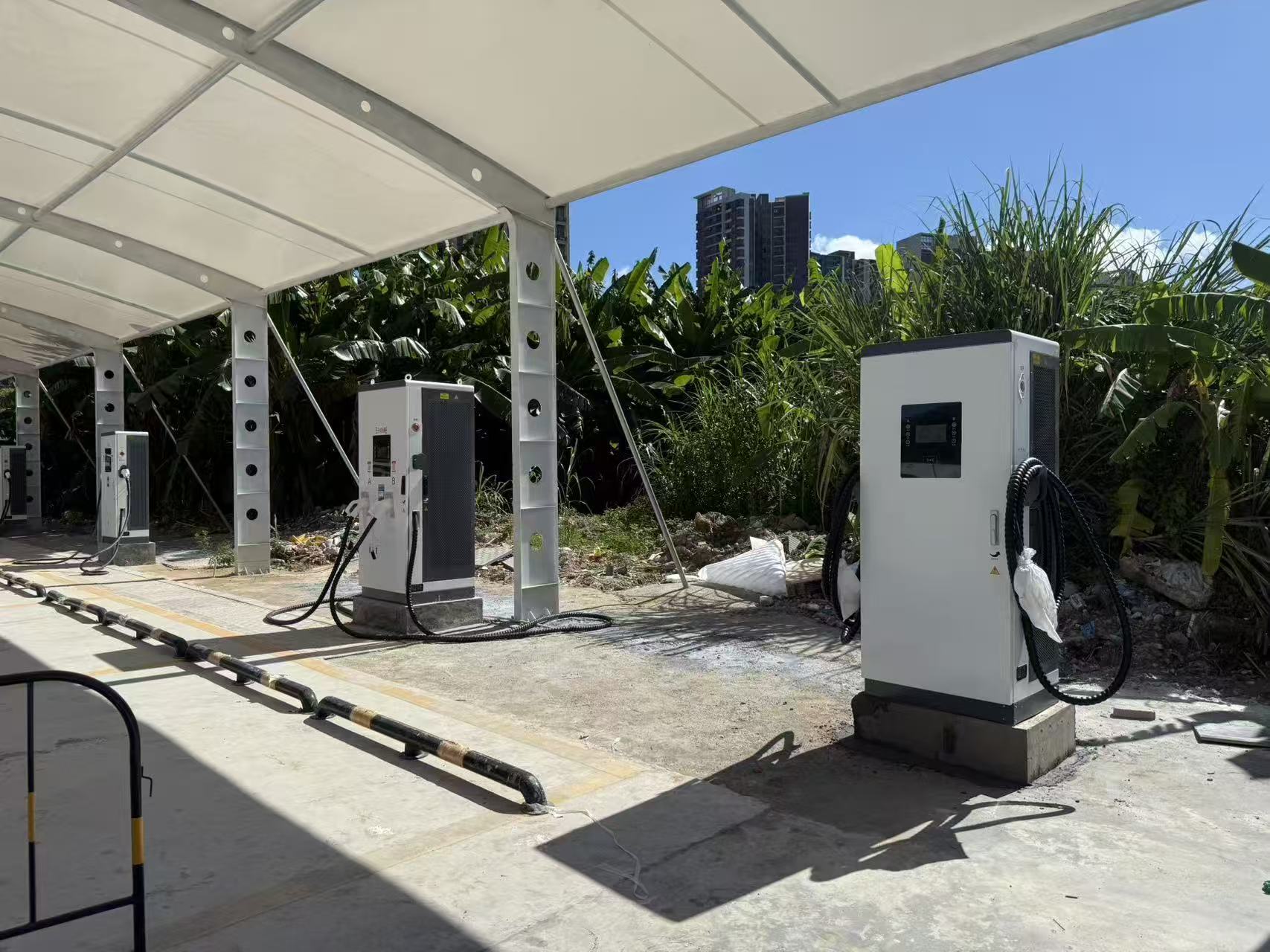
Figure: Rixing New Energy Chengnan Charging Station, Yangjiang. Archive configuration: five 120 kW dual-gun chargers, one 240 kW dual-gun charger, and one 400 kW dual-gun charger. Public-use permission recorded from Marvin; photo does not prove individual-cabinet power or operating results.
For an AC starting point, see HG Power AC EV Chargers. For projects that genuinely need faster replenishment, retain the DC requirement in the RFQ and validate the destination-market SKU before selecting hardware.
Gate 2: Treat electrical scope as part of the product decision
A commercial charger cannot be specified in isolation from the electrical system. DOE's EVI-LOCATE planning tool specifically considers transformer and peak load, service-panel capacity, wiring, and trenching when assessing an EV charging project. DOE EVI-LOCATE overview
Build the RFQ around these inputs:
- Site country/region, address, and use case.
- Existing service voltage, transformer information, panel capacity, and recent peak-load data where available.
- Desired number of ports now and expansion ports later.
- Parking layout, equipment location, cable-routing distance, bollards, accessibility, and trenching constraints.
- Required commissioning date and the utility/interconnection contact, if known.
The AFDC's infrastructure checklist recommends defining scope, budget, funding, schedule, site infrastructure, equipment count/type, and project partners such as the utility and certified electrical contractor. It also reports that installation costs vary materially by location, equipment power, port count, and site conditions. AFDC procurement and installation guidance
The electrical-upgrade trap
The most expensive surprise is often not the charger cabinet. It is discovering late that service capacity, distribution equipment, civil work, or utility timing will control the project. A useful procurement habit is to keep two budgets from the beginning:
- Equipment budget: charger, pedestal/cabinet, connector configuration, software or communications options, spares.
- Site-delivery budget: design, permits, electrical upgrades, trenching, protection, commissioning, utility work, signage, and accessibility work.
Do not publish a single “commercial charger cost” number without this separation. HG Power already covers the narrower question of commercial DC fast charger cost; this guide is designed to prevent a buyer from treating that hardware figure as the full project budget.
Case evidence: heavy-truck sites expose the electrical-scope question
A second project record describes a Foshan Sanshui general-freight logistics heavy-truck charging site with three 360 kW dual-gun chargers and one 960 kW split system with four terminals/eight guns, with a stated 2,000 kVA total site load. An original field image shows a heavy truck connected at the location.
The value of this example is not a claim about charging speed or business results. It shows why a heavy-duty RFQ needs a simultaneous-demand and site-electrical review before cabinet selection. The project label alone cannot prove delivered power, daily throughput, vehicle operator, or charging outcome; this guide therefore treats it as configuration evidence rather than a performance case study.
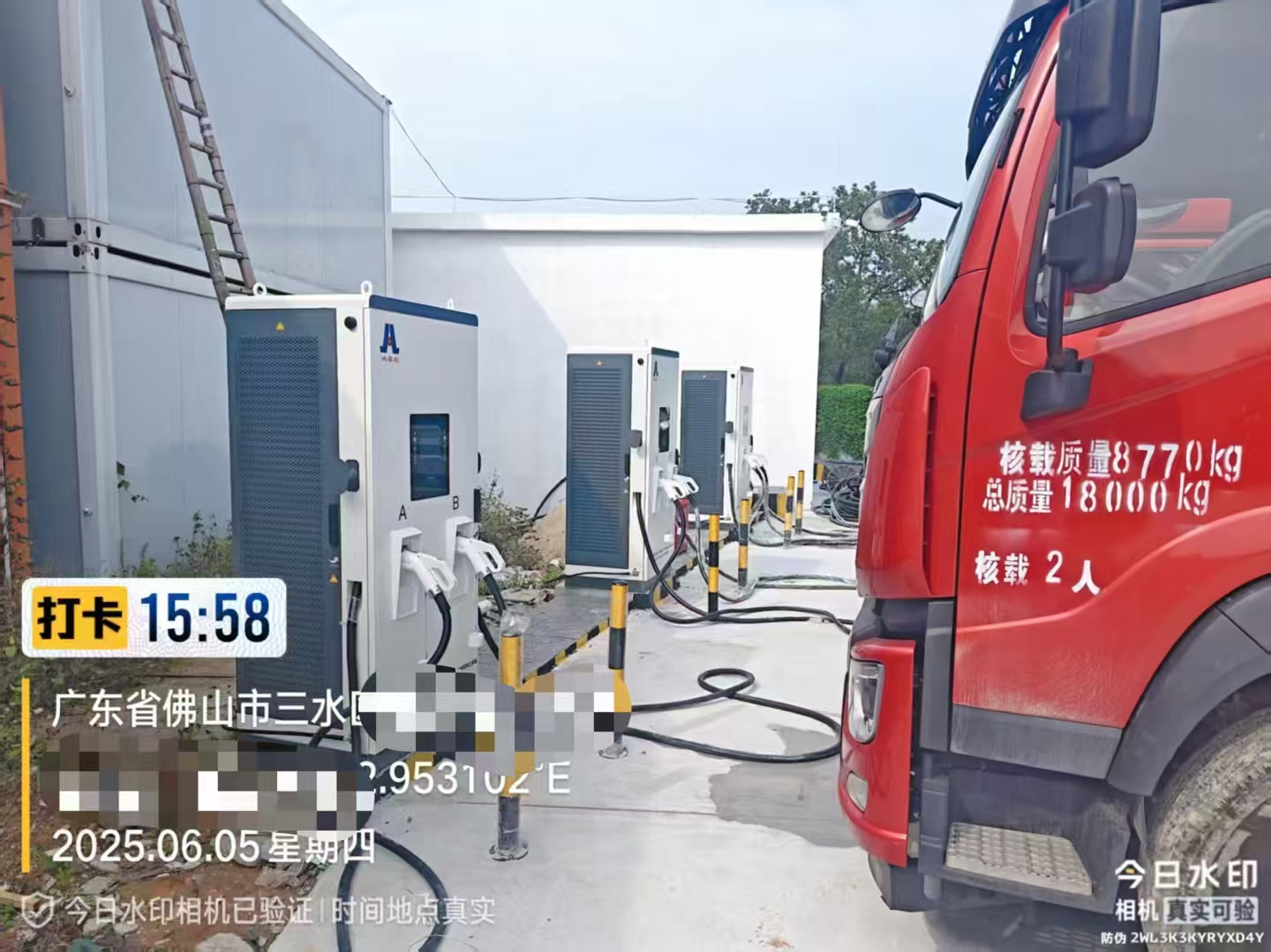
Figure: Foshan Sanshui general-freight logistics heavy-truck charging site. Archive configuration: three 360 kW dual-gun chargers plus one 960 kW split system with four terminals/eight guns; stated total site load 2,000 kVA. Public-use permission recorded from Marvin. The image documents the site setting, not delivered charge power or throughput.
Gate 3: Choose an operating model before choosing optional features
The charger is only one part of a commercial service. Decide who will own the charging experience after commissioning:
| Operating decision | Questions for the buyer | Why it belongs in the RFQ |
|---|---|---|
| Access | Employee-only, resident-only, fleet-only, or public? | Determines authorization and user-flow needs. |
| Payments | Free charging, reimbursement, session fee, or energy-based pricing? | Determines payment, reporting, and regional compliance needs. |
| Load management | Must simultaneous charging be controlled? | Can influence electrical sizing and future expansion. |
| Monitoring | Who sees alarms, sessions, energy, and availability? | Defines software and service responsibilities. |
| Maintenance | Who performs first response, field repair, parts replacement, and warranty handling? | Prevents “installed but unavailable” chargers. |
AFDC cautions that DC fast charging equipment is more likely to trigger demand charges than Level 1 or Level 2 charging. DOE explains that demand charges are generally based on the highest kW demand during a billing period, and some tariffs can include time-of-use or historical-peak rules. That does not make DC fast charging a bad choice; it means the operating model and utility tariff should be reviewed before making revenue or payback promises. AFDC operations guidance and DOE utility-rate guidance
Gate 4: Build a procurement package that can survive commissioning
Once the site clears the first three gates, the hardware comparison becomes useful. Ask each supplier to answer the same structured request, rather than comparing marketing brochures line by line.
Commercial charger procurement checklist
- Destination country/region, vehicle connector requirements, and a written market declaration.
- Required charging class and verified output range for the intended site.
- Indoor/outdoor installation environment, ambient conditions, and enclosure requirements.
- Number of ports today, physical layout, cable reach, and future expansion plan.
- Communications, network/management requirements, and integration responsibilities.
- Required certifications and documents for the target project.
- Installation drawings, foundation/pedestal requirements, commissioning plan, and acceptance test.
- Warranty boundaries, remote support, critical spare parts, repair process, and response expectations.
HG Power 40-480 kW DC charging portfolio: specify the exact model and configuration, not only the kW label
HG Power's commercial DC charging portfolio spans 40 kW to 480 kW. For a buyer whose project genuinely needs DC fast charging, that range supports a specification conversation from lower-power DC applications through high-power commercial and heavy-duty applications. The reviewed CCS1 user manual records five named, floor-mounted models within the 40-480 kW portfolio: ANSI-DCL120B, ANSI-DCL180B, ANSI-DCL240B, ANSI-DCL360B, and ANSI-DCL480B. For those manual-listed models, it states a 480 V ±15% AC nominal input, a 200-1000 V DC nominal output, dual CCS1 connectors, and 120/180/240/360/480 kW nominal power ratings. It also lists OCPP 1.6J, Ethernet/4G/Wi-Fi communications, QR/RFID/password authentication, a 5 m cable including connector, IP54 enclosure rating, and air cooling.
Manual-stated technical data within the 40-480 kW portfolio
The following table transcribes the technical-data pages of the reviewed user manual. It documents the manual-listed 120/180/240/360/480 kW models within the wider 40-480 kW portfolio. It is not a claim that every 40-480 kW HG Power DC product carries the same configuration. The physical product and current quotation prevail if documentation is updated.
| Item | Manual-stated value | Procurement meaning |
|---|---|---|
| Portfolio / manual-listed models | HG Power DC portfolio: 40-480 kW. Manual-listed models: ANSI-DCL120B / 120 kW; ANSI-DCL180B / 180 kW; ANSI-DCL240B / 240 kW; ANSI-DCL360B / 360 kW; ANSI-DCL480B / 480 kW | Quote the complete model identifier and configuration, not only the portfolio power label. |
| AC nominal input | TN-S / TT earthing; 480 V ±15%; 50/60 Hz | Confirm actual site supply and earthing arrangement before selecting this series. |
| AC input current | 185 A / 277 A / 369 A / 553 A / 738 A respectively for 120/180/240/360/480 kW | Electrical designer must validate feeder, switchgear, transformer, protection, and simultaneous demand. |
| DC nominal output | 200-1000 V; maximum 250 A (350 A optional) | Vehicle voltage and charge-acceptance limits matter; “kW” alone does not define delivered charge power. |
| Charge connector / cable | Dual CCS1; 5 m cable including connector | This is a CCS1 configuration, not a default global connector statement. Confirm vehicle and market compatibility. |
| Cabinet / installation | Galvanized steel enclosure; floor mounted | Check foundation, clearance, cable routing, drainage, bollards, lifting and service access in the site plan. |
| HMI and access | 12.1-inch touch screen; English standard; other languages available by firmware upgrade; QR code / RFID card / password login | Specify language and authentication workflow in the RFQ; do not assume every payment method is included. |
| Metering and POS | CE-certified DC meter standard; MID meter optional; POS terminal optional | Metering and payment requirements vary by market. Request the exact meter/POS configuration and supporting documents. |
| Communications | OCPP 1.6J; Ethernet / 4G / Wi-Fi | Confirm backend interoperability, SIM/data responsibility, cybersecurity ownership, and network coverage at the actual site. |
| Cable management | Listed as included | Verify physical cable reach, parking layout, connector handling, and accessibility requirements. |
| Efficiency / power quality | ≥95% at nominal output power; power factor ≥0.99 at 50% load and above; THDi <5%; ripple factor ≤±5%; standby self-consumption ≤100 W | These are manual-stated electrical characteristics. Confirm the current model-specific data sheet for contractual performance requirements. |
| Safety and enclosure | Type A RCD; emergency stop; IP54; IK10 for shell and IK08 for screen | Validate local electrical code, installation environment, and authority requirements; IP54 does not answer every climate or site-protection question. |
| Listed protections | Over-current, under-voltage, residual-current, surge, leakage, short-circuit, over-temperature, and other protections | Ask for the exact protection architecture and acceptance/commissioning procedure for the quoted model. |
| EVSE-vehicle protocols | DIN SPEC 70121; ISO 15118 | Confirm vehicle compatibility and required feature set on the selected project configuration. |
| Certifications and standards listed | ETL; IEC 61851:2017; IEC 62196-1; IEC 62196-3; and others | “Listed in the manual” is not a blanket country approval. Request current copies that match the exact quoted product and destination requirement. |
| Working environment | Air cooling; ≤65 dB(A) at 1 m / 25°C; -25°C to +55°C operation, derating above 55°C; 5%-95% non-condensing humidity; altitude ≤2,000 m | Climate, noise, altitude, shading, ventilation and local enclosure requirements must be checked in the site assessment. |
Those specifications are useful for converting an RFQ from “we need a 240 kW charger” into a checkable model request. They do not create a universal 240 kW product claim: this is a CCS1 series, and the manual itself notes that the physical product purchased prevails if documentation is updated. A buyer should therefore request the current model-specific datasheet, configuration, certification documents, and installation drawing before purchase.
What “SKU configuration” means in practice: the SKU is the precise sellable version of a charger. Two cabinets may both be labelled “240 kW” yet differ in connector type, input supply, cable/terminal arrangement, meter, payment hardware, communication options, language, enclosure/environment requirements, certification documents, or branding. For international procurement, never compare only the kW number. Compare a written configuration sheet that names each of those choices.
The pre-RFQ evidence pack: what to collect before comparing suppliers
An RFQ that says only “two 240 kW chargers” forces every supplier to make different assumptions. That makes quotations look comparable when they are not. Build one evidence pack and send the same version to every bidder.
| Evidence required | Who normally provides it | What it must answer | What breaks without it |
|---|---|---|---|
| Vehicle and duty profile | Fleet, site host, or operator | Vehicle models, battery/charge-acceptance limits, arrival/departure windows, expected simultaneous sessions | Cabinet power is selected from marketing labels rather than the actual charging window. |
| Electrical baseline | Utility, electrician, or electrical engineer | Service voltage, transformer/switchgear/panel capacity, current peak load, spare capacity, proposed equipment location | The hardware is quoted before the actual connection and upgrade scope is known. |
| Site and civil layout | Site owner and installer | Parking geometry, cable path, equipment pad, trenching route, bollards, accessibility, drainage, communications signal | The quoted cabinet cannot be placed, protected, cabled, or serviced as planned. |
| Operating policy | Asset owner/operator | Access rules, payment approach, tariffs, reporting, load-management responsibilities, first-response owner | A working charger becomes an unmanaged service with unclear revenue and support responsibility. |
| Market/compliance package | Buyer, authority, and supplier | Destination country, connector expectation, required listing/certificates, metering rules, language, branding, and documents | A global catalogue configuration is assumed to be acceptable locally when it may not be. |
| Supplier deliverables | Supplier and installer | Exact model/configuration, drawings, foundation requirements, test/commissioning scope, warranty boundaries, spares, escalation contacts | No party owns the gap between delivery, energisation, acceptance, and post-install support. |
Global-market rule: keep the article global, make the quotation local
This article can serve a buyer in any region because its first four decisions – vehicle dwell time, electrical feasibility, operating model, and supplier documentation – are universal. The final configuration is local. A Europe, Americas, Asia, Africa, or Latin America enquiry should therefore begin with a short market declaration:
- Destination country and city/region.
- Vehicle connector requirement and known fleet/vehicle models.
- Site input supply and utility constraints.
- Required local certificates, inspection documents, language, metering, payment, and accessibility requirements.
- Indoor/outdoor climate and installation conditions.
This prevents a global manufacturer page from promising that one pictured charger, connector, certificate set, or payment option fits every market. It also lets the supplier respond with a configuration sheet rather than a generic catalogue.
The U.S. DOE's AFDC infrastructure checklist independently reaches the same conclusion: scope, budget, partners, utility engagement, permits, ownership, networking, future expansion, maintenance, and electrical upgrades must be considered as part of procurement, not after equipment selection. AFDC procurement and installation guidance
For North American conductive charging compatibility, connector selection should be tied to the vehicles and market being served, not guessed from a global catalogue. SAE J1772 defines a common conductive charging method and associated functional and dimensional requirements for EV/PHEV charging equipment in North America. SAE J1772 standard record
What not to do: Do not order a connector, certification package, or high-power configuration because it appears on a supplier's global product sheet. Confirm it against the actual destination market, vehicle base, authority requirements, and selected SKU configuration.
The five commercial-charger project killers
These are not abstract risks. Each is a reason to stop, gather evidence, and change the project plan before sending a purchase order.
| Early symptom | Likely root cause | Verification before purchase | Practical mitigation |
|---|---|---|---|
| “We need the biggest charger available.” | The team has not translated dwell time and required energy into a charging window. | Confirm vehicle schedule, energy need, concurrent sessions, and vehicle charge acceptance. | Start with the energy-window calculation; then test AC, DC, port count, and load-management scenarios. |
| “The charger price fits budget, so the project is approved.” | Electrical, civil, permitting, utility, and operating scope are outside the comparison. | Separate equipment and site-delivery budgets; have the utility/installer review site data. | Hold a contingency and make each scope owner explicit before selecting hardware. |
| “We can decide the connector/certification later.” | Global catalogue language has been mistaken for destination-market approval. | Match the exact model, connector, meter, certificates, and documents to the target jurisdiction and vehicle base. | Put the destination market and compliance deliverables in the RFQ and purchase specification. |
| “The network will handle it.” | Access, pricing, data ownership, fault response, and maintenance boundaries are undefined. | Identify the platform owner, account owner, first-response contact, remote-access boundary, and service escalation path. | Write an operating and incident-response responsibility matrix before commissioning. |
| “We can add more ports when demand arrives.” | Conduit, panel capacity, transformer plan, switchgear, parking layout, or communications have not been reserved. | Review expansion capacity in electrical one-line drawings and civil/site plan. | Design the first phase with a documented future-port target and staged infrastructure plan. |
Four common commercial-charging mistakes
- Choosing the highest kW before measuring dwell time. Start with parking behavior and energy need.
- Treating hardware price as project price. Separate equipment from electrical, civil, permitting, and utility scope.
- Leaving maintenance ownership undefined. Put fault response, parts, warranty, and escalation paths in writing.
- Assuming a tariff will support a simple ROI story. Review demand-charge and time-of-use exposure with the local utility or qualified advisor.
For a focused technology comparison, read DC Fast Charger vs. AC Charger for Commercial Use. For destination-oriented site planning, see Destination Charging Solution. Fleet and high-duty-cycle projects should start from the Heavy-Duty Truck Charging Solution rather than adapting a public-site design by default.
Frequently asked questions
What is a commercial EV charger?
A commercial EV charger is charging equipment deployed for a business, fleet, workplace, multifamily, destination, or public-use application. The right configuration depends on the site's vehicle dwell time, electrical capacity, access rules, operating model, and regional requirements.
Should a commercial site choose Level 2 or DC fast charging?
Choose based on the usable parking window and the energy vehicles need before departure. Long-dwell sites often start with Level 2; short-stay, high-throughput, or route-critical sites may justify DC fast charging after the electrical and utility review.
What information should I send to an EV charger manufacturer for a quotation?
Send the site location, application, vehicle type, parking dwell time, desired port count, available electrical information, layout constraints, target market, connector needs, environmental conditions, and operating/payment requirements.
Why can installation cost vary so much?
Electrical service capacity, transformer/panel work, trenching distance, site layout, permitting, port count, charger power, and utility requirements all change the project scope. The charger itself is only one budget line.
Do commercial DC fast chargers always create demand charges?
No. Utility tariffs differ by service territory and customer class. However, DOE and AFDC guidance shows that DC fast charging is more likely to create demand-charge exposure, so the local tariff should be checked before modelling operating economics.
Can a project expand later?
Often, but only if the early design preserves capacity in the electrical system, layout, conduit, communications, and operating plan. Put the future-port requirement into the first site assessment rather than treating expansion as an afterthought.
Request a site-fit charger specification
HG Power can help buyers structure an equipment discussion around the actual project rather than a generic catalogue. To begin, provide:
- Site type and location — workplace, hotel, retail, depot, public site, or another application.
- Vehicle and dwell-time profile — how long vehicles park and when they must be ready.
- Electrical and layout information — available service details, planned port count, parking layout, and expansion target.
- Market requirements — destination region, connector expectations, required documents/certifications, and operating model.
Start with the HG Power product overview, review available specifications, or request a project quotation.
About this guide and its evidence
This guide was technically reviewed by Marvin. It combines public technical guidance, two named project-material records, and a reviewed product manual. Where this article describes a project, it identifies the documented equipment configuration and does not claim utilisation, revenue, charging outcome, or site-wide performance unless separately evidenced.
Sources to retain before publication
- U.S. DOE AFDC: Charging Electric Vehicles in Public
- U.S. DOE AFDC: Procurement and Installation for EV Charging Infrastructure
- U.S. DOE AFDC: Operation and Maintenance for EV Charging Infrastructure
- U.S. DOE: Introduction to EVI-LOCATE
- U.S. DOE: Evaluating Your Utility Rate Options
- SAE J1772 conductive charge coupler standard record