
How to Qualify Electric Car Charging Stations Suppliers Before You Approve a Bid
Connect destination rules, the exact SKU, its controlled build, repeatable production and acceptance evidence before price becomes an approval.
Choosing among electric car charging stations suppliers is not a directory exercise. A supplier can look credible, send an attractive quotation and still leave the buyer with an unapproved model, an untested backend connection or a production build that differs from the sample.
The practical question is narrower: can this supplier provide repeatable evidence for this exact charger configuration, in this destination, for this operating model?
Before approving a bid, connect five things:
- the rules and operating requirements of the destination market;
- the exact SKU on the quotation;
- the hardware, firmware and documentation baseline behind that SKU;
- the controls used to reproduce the approved build; and
- the factory, pilot and site evidence that will close acceptance.
This guide calls that sequence the Five-Link Supplier Evidence Chain. It gives distributors, CPOs, EPCs, fleets and project buyers a defensible way to reach one of four decisions: approve, approve with conditions, continue to a pilot, or reject.
It is not legal advice and it is not a universal specification. Product rules, electrical codes, payment requirements, legal metrology and importer responsibilities vary by destination and use case. The purpose is to expose those variables before a purchase order turns them into expensive surprises.
Start With the Bid, Not the Supplier Brochure
A company profile can help establish identity, factory location, product range and contact points. It cannot define the configuration you are buying.
Two offers described as “a 120 kW dual-connector DC charger” may differ in input system, output voltage and current envelope, power sharing, connector standard, cable arrangement, ingress protection, modem, payment hardware, OCPP version, language pack, branding, documentation, spare parts, warranty process and delivery boundary. The headline power rating does not make the bids equivalent.
Create a Bid Baseline before comparing price. At minimum, freeze:
- destination country and intended use;
- private fleet, workplace, public paid charging or another operating model;
- exact supplier model and option codes;
- AC input and protection/interface assumptions;
- required DC voltage, current and power envelope;
- connector type, cable arrangement and vehicle population;
- charger-to-CSMS protocol version and required workflows;
- authorization, payment and metering boundary;
- environmental and enclosure requirements;
- language, labels, branding and user interface;
- required declarations, certificates, reports and manuals;
- FAT, pilot, SAT and handover evidence;
- warranty, spare-parts and escalation responsibilities; and
- Incoterm, freight, duties, installation and commissioning inclusions.
If a field is unknown, mark it as an open decision rather than allowing each supplier to make a different assumption. You cannot compare quotations fairly when the scope is moving underneath the price.
For charger architecture and general hardware selection, use the commercial EV charger buyer’s guide. This page stays focused on supplier and bid qualification.
One broken link reopens supplier approval
→
→
→
→
Approve the connected evidence chain—not five unrelated folders.
The Five-Link Supplier Evidence Chain
Supplier due diligence often fails because documents are collected in separate folders but never connected. A certificate is reviewed without matching its model to the quote. A sample is tested without recording its firmware. A factory audit is completed without defining which product or process it covers.
The Five-Link Supplier Evidence Chain keeps those decisions connected.
Link 1: Market rule
Define where and how the charger will operate before asking whether it is “compliant.” The destination, grid interface, public or private use, payment model, importer role and local authority requirements determine which evidence matters.
For example, a public paid charging system may introduce legal-metrology, receipt, pricing-display or payment obligations that do not apply in the same way to a private depot. Accessibility, electrical installation, communications, cybersecurity and data rules may also sit outside the charger manufacturer’s product file.
The output of Link 1 is a destination-specific compliance and responsibility list. Every item needs an owner: supplier, importer, EPC, CPO, payment provider, site host or another named party.
Link 2: Exact SKU
Replace product-family language with one exact configuration. Record the model, option codes, rating, connector, cable, modem, payment terminal, meter, protection options, branding and label language.
Then require the same identity across the quotation, datasheet, label drawing, declaration, certificate, test report, manual, packing list and FAT record. A family name that appears in marketing material is not enough if the documents behind it identify a different model or rating.
Link 3: Hardware and firmware build
Define the build behind the SKU. This may include critical power modules, controller, meter, modem, connector/cable assembly, protective devices, HMI, firmware version, OCPP stack and configuration file.
The goal is not to force disclosure of every proprietary design detail. It is to create a sufficient baseline for three questions:
- Is this the build represented by the compliance evidence?
- Is this the build used for the pilot and FAT?
- Will the production unit remain inside the approved boundary?
Link 4: Repeatable production
An approved sample is not yet evidence that a factory can reproduce the same build. Examine the quality-management scope, incoming inspection, assembly controls, end-of-line tests, calibration controls, serial or lot traceability, non-conformance handling and approved-substitution process.
ISO 9001 certification can provide information about a quality-management system, but ISO itself describes ISO 9001 as a QMS standard—not product certification. The certificate scope and factory identity must still match the activity being evaluated, and the charger needs its own applicable product evidence.
Link 5: Acceptance and change control
Close the chain with evidence that the defined build works in its intended system. FAT, pilot and SAT should have written inputs, procedures, acceptance criteria, records, deviations and sign-off owners.
Then define what happens after approval. A change to a power module, controller, meter, connector, firmware, label, model code, factory or referenced report may require document review, regression testing, re-FAT or renewed approval. The purchase order should state notification and approval triggers.
A bid is only as defensible as the weakest link. Strong company credentials cannot repair an unidentified SKU; a valid report cannot control an unrecorded production substitution.
Turn every promise into a verification route
→
→
→
→
Build a Claim-to-Artifact Matrix
Sales language becomes useful when every material claim is converted into an artifact and a verification action. Build one row per claim.
| Supplier claim | Artifact to request | Fields that must match | Independent check | Change trigger |
|---|---|---|---|---|
| “This model is CE compliant” | EU Declaration of Conformity, applicable reports and technical-file index | manufacturer, exact model, directives, standards/editions, date and signatory | check issuer/report identity where applicable; confirm destination obligations | model, critical component, firmware affecting conformity, standard or legislation change |
| “Our factory is ISO 9001 certified” | QMS certificate and scope | legal entity, site address, activities, expiry | verify certification body and certificate status | factory, scope or certificate-status change |
| “The charger supports OCPP” | version/profile statement, OCA certificate if claimed, CSMS test report | product identity, OCPP version, firmware, supported feature set | OCA certified-products/verification resources and buyer’s CSMS test | firmware, protocol stack or CSMS change |
| “CCS compatible” | connector/cable specification plus EV interoperability record | connector variant, voltage/current envelope, charger build, vehicle set | pilot with intended vehicles and documented session workflows | cable/connector, power stage, controller or vehicle-fleet change |
| “Outdoor rated” | model-specific datasheet and applicable environmental test evidence | enclosure/model, rating, conditions and test reference | inspect report scope and installation limitations | enclosure, seals, cooling or cable-entry change |
| “Warranty and local support included” | signed warranty, responsibility and escalation matrix | territory, parts/labour/travel, response process, exclusions | confirm named service owner and spare-parts route | partner, territory, term or product revision change |
| “Delivery in the quoted lead time” | capacity/production plan and contractual delivery milestone | quantity, approved build, document freeze, Incoterm and readiness assumptions | milestone review and pre-shipment evidence | quantity, customization, approval or component change |
The final two columns matter as much as the document itself. A PDF can be authentic and still be irrelevant to the quoted model. A valid artifact can also become stale when the approved build changes.
A bounded certificate example
One supplied HG Power document illustrates the method. Certificate CKEYS250320024 identifies Shenzhen Hongjiali New Energy Co., Ltd. as applicant and manufacturer, names a split DC charging-station product and a model family, and lists 480 kW, DC 200–1000 V and 600 A maximum data. It references LVD 2014/35/EU, named EN/IEC standard editions and test report RKEYS250220062.
Those fields are useful only after they are matched to the exact quoted unit. The certificate also states that it evaluates one sample and does not imply an assessment of production. That limitation is not a defect to hide; it tells the buyer what additional production and acceptance evidence is still needed.
It would be incorrect to turn this document into a claim that every HG Power product from 40 to 480 kW has the same certification scope. The correct statement is narrower: HG Power’s DC portfolio spans 40–480 kW, while exact configurations and compliance evidence are model-, project- and market-specific. Buyers should request the evidence pack for the SKU under review.
Verify Compliance Without Collecting Meaningless Logos
“CE,” “UL,” “IEC” and “ISO” are often placed in one logo strip, but they do not describe the same type of evidence.
For the EU, trace CE marking to the conformity file
The European Commission states that the manufacturer is responsible for conformity assessment, technical documentation, the EU Declaration of Conformity and affixing the CE marking when applicable. Your Europe also explains that there is no central EU body that grants permission to use the CE mark.
Therefore, do not ask only for a CE logo or an isolated certificate. Request the EU Declaration of Conformity and identify:
- the manufacturer and product;
- the exact model or defensible family relationship;
- applicable legislation;
- referenced standards and editions;
- linked test reports or technical-file records;
- authorised signatory and date; and
- change-control responsibility.
Product changes may require the documentation to be reviewed or updated. Importer and other economic-operator duties also need destination-specific confirmation.
For the United States, identify the product and use-case route
If a supplier claims a UL certification, search the official UL Product iQ database and match the listed company, product category, model and conditions of acceptability. A component recognition is not automatically a certification of the complete charger.
Public paid charging may also raise weights-and-measures requirements. NIST Handbook 44 includes Section 3.40 for Electric Vehicle Fueling Systems, while adoption and enforcement involve state and local authorities. The correct RFQ question is not “Is it NIST certified?” It is “Which legal-metrology and inspection requirements apply at this destination, and who owns the evidence and approval?”
Treat standards as scoped references
Standards have defined subjects and editions. IEC 61851-23:2023 addresses DC EV supply equipment. IEC 62196-3:2022 addresses dimensional compatibility for DC and AC/DC vehicle couplers. Referencing one of them does not automatically establish every aspect of product safety, market access or vehicle interoperability.
For each standard claim, record the edition, test-report identity, tested model and applicable conditions. If a certificate uses an older edition, do not silently replace it with the current edition in marketing copy. Ask the responsible compliance party to determine what is acceptable for the destination and project date.
Keep product certification separate from management-system certification
ISO explains that ISO 9001 addresses a quality-management system, and ISO does not itself certify companies. A QMS certificate can support questions about process control, corrective action and traceability. It cannot establish that the quoted charger complies with a product standard.
The result of this review should be a compliance map with green, conditional and open items—not a folder counted by the number of logos.
Test OCPP, Connector and Vehicle Compatibility as Separate Layers
An EV charging system has at least two different communications relationships:
- the charger communicates with the vehicle; and
- the charger communicates with a charging-station management system, or CSMS.
A connector label such as CCS describes an important physical and communications framework on the vehicle side. OCPP addresses the charger-to-CSMS relationship. Neither label should be used as a shortcut for the other.
The Open Charge Alliance certification programme tests an OCPP implementation against OCA requirements. OCA also provides certificate-verification guidance and certified-product resources. If a supplier claims OCPP certification, ask for the certificate number, product identity, OCPP version and the firmware/build represented by the certificate. Verify those details through the official route.
Then test the workflows required by the actual business. The list may include:
- local, RFID, app or payment-terminal authorization;
- remote authorization and transaction start/stop;
- connector status and availability;
- meter values and transaction records;
- tariff or price information where applicable;
- offline behaviour and reconnection;
- alarm and fault reporting;
- remote reset and configuration;
- reservation or load-management functions if required;
- firmware-management policy and rollback/recovery; and
- data export, ownership and retention responsibilities.
Do not accept “OCPP 1.6 supported” as the whole answer. Record whether the claim concerns OCPP 1.6J, which feature set is implemented, which CSMS and version were tested, which charger firmware was used, and which deviations remain. Apply the same discipline if OCPP 2.0.1 is requested.
Vehicle-side testing needs its own matrix. Record vehicle make/model or a defensible vehicle set, inlet standard, battery state and limitations, charger connector/cable, output envelope, session-start result, current/power behaviour, stop/recovery behaviour and any repeatable fault. Connector geometry alone cannot prove a successful session across the intended fleet.
CharIN Testivals exist precisely because real implementations need conformance and interoperability exercise. A buyer does not need to reproduce a global Testival, but the principle is valuable: test the exact EV, EVSE build and backend workflows that matter to the project.
For a deeper treatment of CCS1, CCS2 and the boundary between physical fit and system compatibility, see the CCS charger buyer’s guide.

Audit Production Repeatability Before Volume Approval
The sample on a meeting-room floor is not the supply chain. Volume approval requires evidence that the factory can identify, reproduce and test the accepted build.
Start with identity and scope. Does the legal entity on the quote match the manufacturer, exporter or trading party named in the contract? Which factory will build the charger? Does the QMS certificate cover that site and relevant activity? Which party controls firmware, final testing, labels and shipment release?
Then follow one unit through the process:
- Incoming control: Which critical parts are verified, and against which drawing, specification or approved-supplier entry?
- Build control: How are model options, wiring, torque, connector, protection, controller and firmware configuration identified at the workstation?
- End-of-line control: Which safety, functional, communications and load tests are performed on every unit, by sample or by lot?
- Measurement control: How are relevant test instruments identified and kept within their control period?
- Traceability: Can a serial number be linked to build revision, firmware, critical lots, test result and shipment?
- Non-conformance: Who has authority to hold, rework, retest and release a failed unit?
- Substitution: Can a component or firmware version change without buyer notice and approval?
Ask for records, not only process names. A blank inspection template shows intent. A completed and traceable record from the relevant product shows implementation. A controlled audit sample can establish whether the record maps back to the unit.
A supplied overseas photograph shows people examining a wrapped charger at an outdoor worksite. It is useful as visible project and inspection context. It does not establish production capacity, certificate validity, commissioning or customer endorsement. The same evidence discipline applied to documents must also be applied to images.
Documents, hardware and system behaviour answer different questions
Use the Three-Sample Gate
Supplier approval should pass through three different “samples.” Each catches a different failure mode.
1. Paper sample: are the identities coherent?
The paper sample is the evidence pack. Compare the quotation, datasheet, drawing, label, bill-of-material or critical-component baseline, declaration, certificates, reports, manual, warranty and acceptance plan.
The paper sample passes when the exact model is identifiable, required fields match, gaps are owned and official verification routes have been used where available. It fails when a certificate belongs to another entity or model, a product-family relationship is unexplained, or the supplier cannot identify the build behind the quote.
2. Physical sample: is this the approved build?
The physical sample is the pilot or FAT unit. Record serial number, model label, visible configuration, critical build revision, firmware and test setup. Use a buyer-approved FAT procedure rather than a supplier demonstration chosen after the unit is ready.
Project-specific FAT may examine document identity, workmanship, protection/interlocks, user interface, authorization, communications, metering outputs, output behaviour, thermal or load behaviour, fault handling and recovery. The exact tests, instruments, duration and acceptance values must come from the project specification and applicable standards; they should not be invented from a generic article.
Every deviation needs a disposition: accepted as-is by an authorised party, corrected and retested, deferred to a named SAT item, or rejected.
3. Operational sample: does the system work in context?
The operational sample is the charger interacting with the intended environment. That may include actual vehicles, the buyer’s CSMS, authorization/payment path, local network, power-management system, site electrical interface and operational team.
Exercise normal and abnormal workflows. What happens after a communications outage? Does a stopped transaction close correctly? Are alarms visible to the right operator? Can support identify the unit and firmware? Does the cable reach the intended inlet position without creating a site hazard? Are labels, language and emergency instructions correct for the destination?
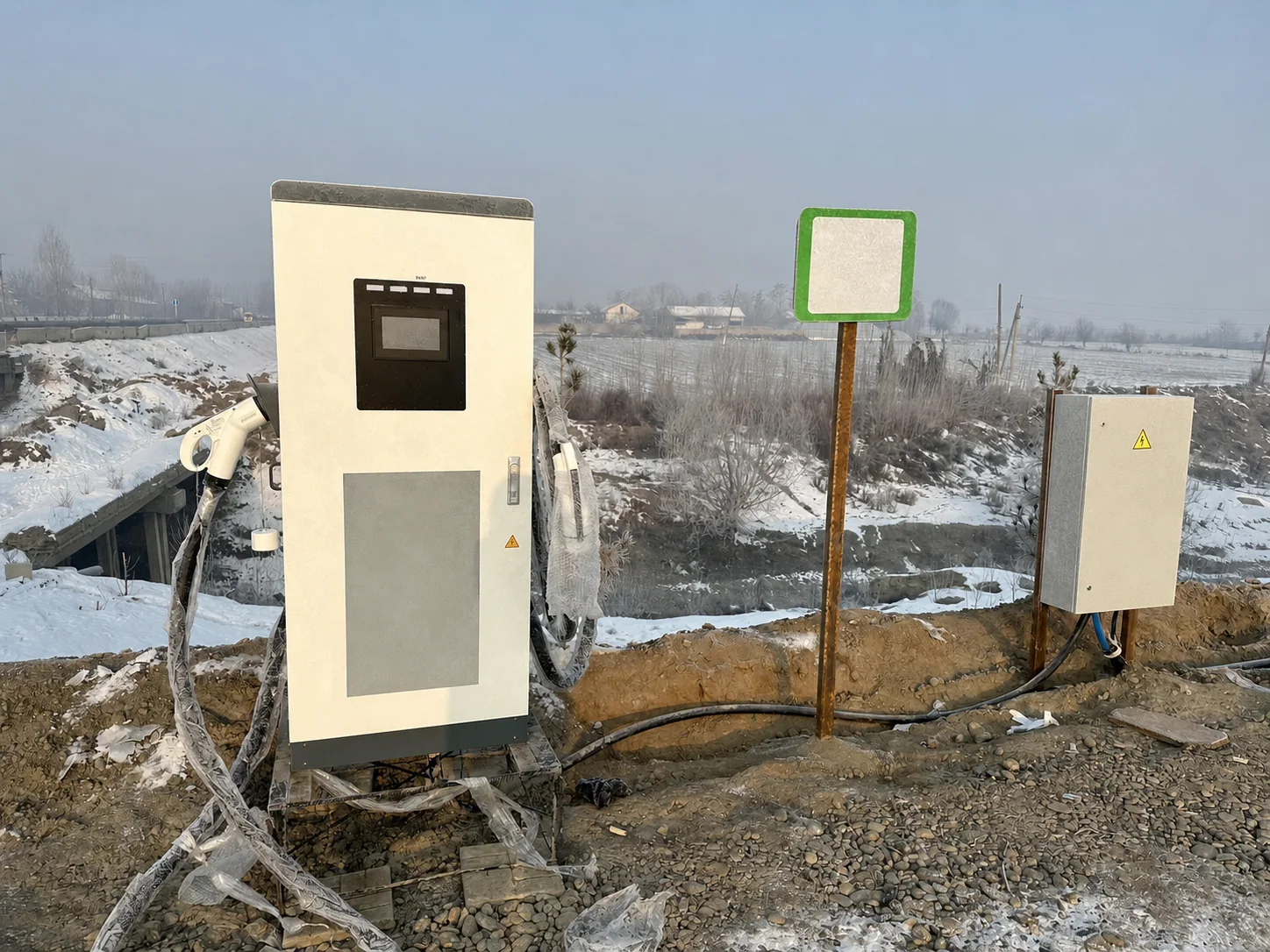
Supplied overseas photographs show chargers in a cold roadside environment, an electric truck beside a charger, and a container-site installation with a connected vehicle. They demonstrate why intended context matters. They do not prove environmental rating, charge-session performance, compliance or uptime; those conclusions require the model evidence and test record.
Turn results into a decision
| Result | Decision | Required record |
|---|---|---|
| All critical gates pass | Approve the named build | signed evidence index, FAT/pilot/SAT records and build baseline |
| Non-critical gaps have owners and deadlines | Conditional approval | deviation list, responsibility, due date and hold/release point |
| Paper evidence is credible but system behaviour is unproven | Continue to pilot | pilot scope, vehicles/CSMS, acceptance criteria and exit decision |
| Critical identity, safety, compliance or workflow gate fails | Reject or repeat after correction | failure evidence, corrective action and full retest boundary |
Do not average a critical failure away with strong scores in less important categories.
Make Commercial Bids Comparable
Technical evidence cannot repair an undefined commercial boundary. Normalize every quotation into the same table before ranking price.
Separate at least these cost and responsibility lines:
- charger base hardware and exact option codes;
- connector/cable quantity and cooling arrangement where applicable;
- modem, SIM/data responsibility and network accessories;
- payment terminal, meter and backend licences;
- branding, language and label changes;
- declarations, reports, manuals and project documentation;
- packaging, export documents and pre-shipment inspection;
- freight, insurance, Incoterm, duties and taxes;
- site installation, civil/electrical work and utility interface;
- commissioning, CSMS integration and SAT;
- training, remote support and field-service boundary;
- initial spare parts, special tools and consumables;
- warranty parts, labour, travel and escalation exclusions; and
- recurring software, connectivity or support charges.
Next, build a responsibility matrix. The supplier may provide product documents while the importer confirms destination-market obligations. The EPC may own installation and protection coordination. The CPO may own CSMS, payment and operational monitoring. The site host may own access, utility contracts and physical security. Whatever the structure, an unowned requirement is a project risk.
Do not ask only which supplier has the lowest price. Ask which bid has the lowest unresolved scope. A cheap offer with no identified compliance path, integration evidence or spare-parts responsibility is not yet comparable with a fully defined offer.
Put Change Control Into the Purchase Order
The approved sample can drift long before the final shipment. Protect the evidence chain with a named build baseline and written change rules.
Require notice before changes to items such as:
- model code or product label;
- critical electrical or protective components;
- power module, controller, meter or modem;
- connector, cable or cooling arrangement;
- enclosure, seals, ventilation or thermal design;
- firmware, OCPP stack or configuration baseline;
- manufacturing site or critical subcontractor;
- declaration, certificate or test-report scope;
- packaging that affects transport protection; and
- manuals, warnings, language or required records.
The contract should define notice period, evidence to submit and who can approve the change. It should also define the consequence: document-only review, targeted regression test, repeat FAT, new pilot, third-party review or rejection.
Map each shipped serial number to the approved revision and release evidence. Retain the records for the period required by the contract and applicable rules. If field support later investigates an alarm or component issue, the team should be able to identify what was actually built—not only what appeared on the original brochure.
Use Gates Before a Weighted Supplier Scorecard
Weighted scorecards are useful after mandatory evidence gates have passed. Used too early, they can conceal decisive problems.
Set hard-stop conditions first. Examples include:
- the quoted model cannot be connected to the declaration, certificate or report presented for it;
- a claimed certificate cannot be verified or its issuer/product identity is inconsistent;
- the destination compliance path has no responsible owner;
- the supplier will not control or disclose changes to the approved build;
- a critical vehicle, CSMS, authorization, safety or recovery workflow fails;
- the warranty has no identified parts and escalation route; or
- FAT/SAT acceptance criteria cannot be agreed before shipment.
Only suppliers that clear the applicable gates should enter weighted comparison. The buyer can then assign project-specific weights to technical fit, evidence quality, integration, production control, service/spares, delivery, lifecycle commercial terms and strategic factors.
There is no honest universal weighting. A fleet depot with a controlled vehicle population may prioritize serviceability and vehicle-fit evidence. A distributor may place more weight on documentation, configuration control and repeatability across customer markets. A public CPO may emphasize payment, backend workflows, metrology and operational recovery.
Keep the raw evidence beside the score. Record why a score was assigned, who assigned it and which open condition could change it. A score without a linked artifact is simply another claim.
What to Send in the RFQ
A strong supplier response begins with a strong request. Send a structured RFQ containing:
- Destination and use: country/region, public or private operation, buyer/importer structure and expected regulatory stakeholders.
- Site input: grid/interface assumptions, available capacity, protection boundary, layout and environmental conditions.
- Vehicle duty: vehicle population, inlet/connector, voltage/current needs, arrival energy, dwell window and expected concurrency.
- Charger configuration: power architecture, port/cable arrangement, user interface, payment/authorization, communications and branding.
- CSMS scope: OCPP version/features, named backend, test responsibilities, data ownership and cybersecurity requirements.
- Compliance evidence: required declarations, standards/editions, certificates, reports, labels and destination-specific approvals.
- Documentation: datasheet, drawings, installation/operation/service manuals, parts list, troubleshooting, training and language.
- Acceptance: document review, FAT, pilot, SAT, instruments, criteria, records, deviations and sign-off owners.
- Support: warranty boundary, spares, escalation, remote support, field-service responsibility and end-of-life approach.
- Change and delivery: approved baseline, notification triggers, quantity, milestones, inspection, packaging, Incoterm and shipment records.
HG Power’s DC charger portfolio spans 40–480 kW. That range is a starting point for configuration—not evidence that every connector, option or certificate applies to every rating and destination. Review the current specifications and certifications, then send the intended market, vehicle, site, backend and acceptance inputs for a model-specific response.
Frequently Asked Questions
How do I verify an EV charger supplier?
Verify the legal entity and factory, then approve an exact SKU rather than a company in general. Match the quotation, label, declaration, certificates/reports, manual, firmware/build baseline and acceptance records. Use official databases when available, test the intended vehicles and CSMS, and place production substitutions under change control.
Is CE a certification issued by the EU?
No central EU body grants permission to use the CE mark. The manufacturer is responsible for the applicable conformity assessment, technical documentation, EU Declaration of Conformity and CE marking. Buyers should verify the exact model, legislation, standards, reports and economic-operator responsibilities for the destination.
Does ISO 9001 mean the charger is certified?
No. ISO 9001 addresses a quality-management system. It can support evaluation of process controls and traceability, but it is not product certification and does not by itself establish charger compliance.
Does OCPP guarantee backend compatibility?
No. OCPP certification can provide valuable protocol-conformance evidence for an identified product/version, but the buyer should still test the exact firmware, CSMS and required operational workflows. OCPP also does not replace vehicle-side interoperability testing.
Should I approve a supplier after one sample passes?
Not for volume supply without additional controls. Connect the passing sample to its documents, hardware/firmware baseline, factory process, serial traceability, production tests and change-control requirements. Then define how production units will be verified against the approved sample.
What documents should an EV charger supplier provide?
The list is destination- and project-specific, but it commonly includes a model-specific quotation and datasheet, drawings, label, declarations, applicable certificates/reports, installation/operation/service manuals, firmware/protocol statement, warranty, spare-parts information, FAT/pilot/SAT plan, completed test records and a controlled evidence index.
Sources and Scope Notes
The regulatory and standards references in this guide are used to explain verification methods, not to declare that one configuration is approved for every market. Buyers should confirm the current rules, editions, product identity and responsible economic operator for the destination.
- European Commission: manufacturer obligations for CE marking
- Your Europe: CE marking
- Open Charge Alliance: certification programme
- Open Charge Alliance: certificate verification
- ISO: ISO 9001 explained
- IEC 61851-23:2023 and IEC 62196-3:2022
- NIST Handbook 44, current edition
- UL Product iQ
- CharIN Global Testivals
Related Buyer Guides
- DC fast charger station design and commissioning
- Public EV charging stations: site-host and CPO planning
- EV charging station business decision framework
- EV charging for commercial properties
Approve the Evidence Chain, Not the Brochure
The most credible electric car charging stations suppliers are not identified by the longest product list or the largest collection of logos. They are identified by how clearly they connect a market requirement to an exact SKU, a controlled build, repeatable production and accepted system behaviour.
Use four explicit outcomes: approve, approve with conditions, continue to pilot, or reject. Preserve the evidence and the reasoning behind the decision. When a model, component, firmware, factory or compliance artifact changes, reopen the affected gate rather than assuming the old approval still applies.
If you are evaluating HG Power for a distributor, CPO, EPC, fleet or charging project, send the destination market, site input, vehicle/connector set, CSMS, operating model and acceptance requirements through the contact page. Ask for a model-specific Supplier Evidence Pack so the proposed 40–480 kW configuration can be reviewed against your actual project boundary.
Technical review: Marvin.