
EV Charger Certification by Country: What Distributors Need in 2026
What the factory must give you, what you must do as importer, and what only the installed site can produce, for the Netherlands, Poland, Australia, Brazil and Indonesia.
By HG Power. Published 11 November 2026. Technical review: Marvin Zhou.
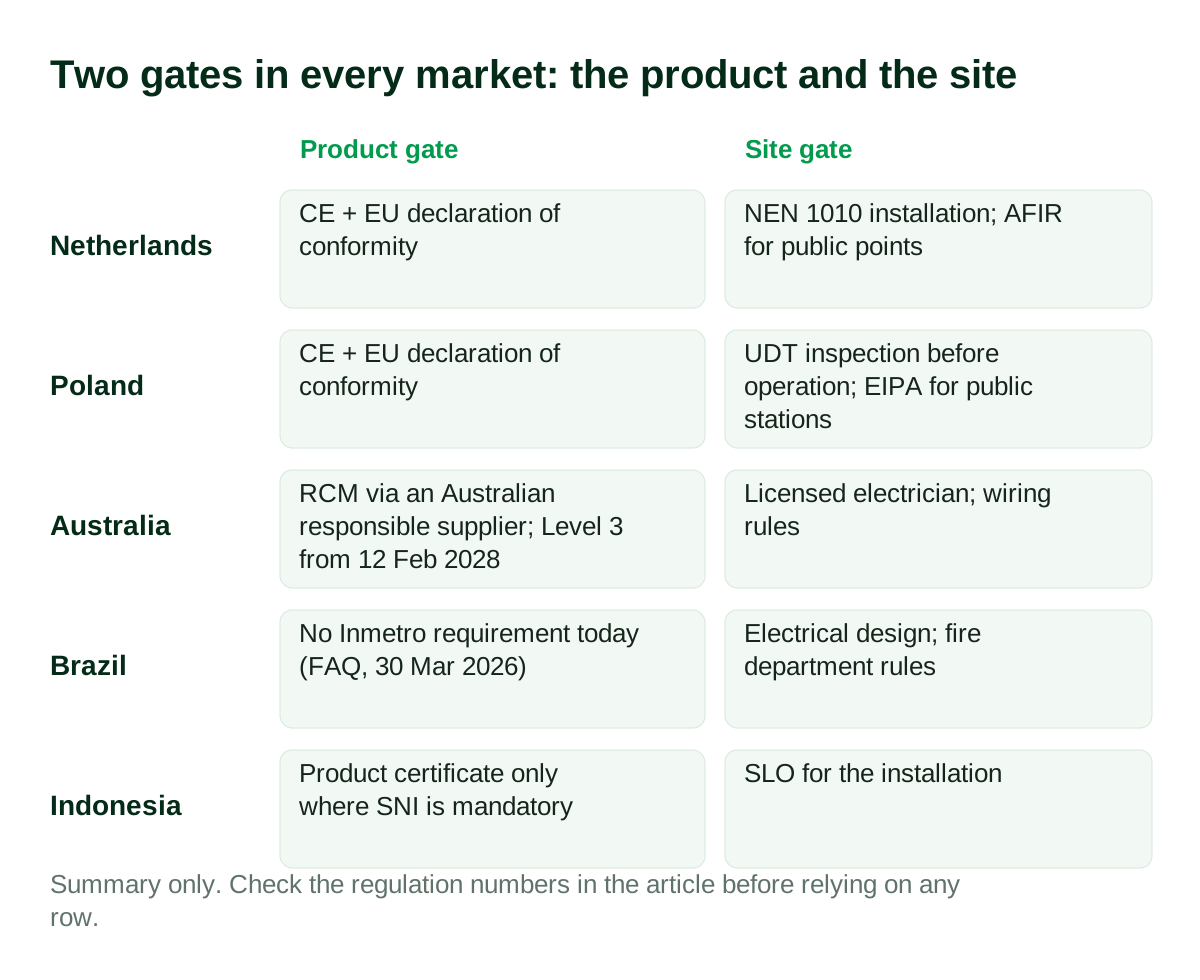
No single certificate lets you sell a DC charger everywhere. In the EU, the manufacturer’s signed declaration of conformity is the legal document, and Poland adds a UDT inspection before each station runs. Australia needs a local responsible supplier and the RCM. Brazil has no Inmetro requirement today. Indonesia asks for SNI certificates only where SNI is mandatory.
This guide is for solar, battery and inverter distributors who are adding DC chargers to their range and buying them from China. It covers the Netherlands, Poland, Australia, Brazil and Indonesia, plus the EU rules underneath the first two. For each market it answers three questions: what the factory must give you, what you or your importer must do, and what only the installed site can produce.
Rules change. Treat this as a checklist to take to your regulator, test lab or customs broker, not as legal advice. Where we could not confirm a point from an official source, we say so.
The short answer by market
| Market | Product gate | Site or operating gate | Who is legally on the hook | Not confirmed by us |
|---|---|---|---|---|
| Netherlands | CE marking backed by the manufacturer’s EU declaration of conformity | Installation to NEN 1010; AFIR duties for public points | Manufacturer, then the EU importer | Current DC metering rule for public billing |
| Poland | Same EU route as the Netherlands | UDT technical inspection before the station operates; EIPA registration for public stations | Manufacturer and importer for the product; station operator for UDT | Inspection fees |
| Australia | RCM through a registered Australian or NZ responsible supplier; EVSE becomes EESS Level 3 on 12 February 2028 | Licensed electrician; wiring rules; state rules such as South Australia | Australian responsible supplier | Whether commercial-only DC chargers fall inside EESS scope |
| Brazil | No Inmetro regulation or certification requirement for conductive EV charging systems | Local electrical design; fire department rules, for example São Paulo | Designer, installer, operator | Anatel position for chargers with radio modules |
| Indonesia | Product certificate only where SNI is mandatory; otherwise manufacturer test results | Sertifikat Laik Operasi (SLO) for the SPKLU installation | Operator and manufacturer | Any 2026 order making SNI mandatory for chargers |
The column that catches most buyers is the last one. A supplier’s brochure will often fill those gaps with confident claims. Ask for the regulation number behind every claim.
Three kinds of paper: factory, importer, site
Most delays come from asking the factory for documents only the site can produce, or the reverse. Sort the list first.
| Who produces it | Examples | When you need it |
|---|---|---|
| The factory | Signed EU declaration of conformity for the exact model; test reports behind it; technical description; operating and service manual; electrical diagrams; protection requirements | Before you place the order |
| You, as importer or responsible supplier | Your name and address on the product (EU); Australian supplier registration and RCM labelling; customs classification | Before the goods are sold |
| The installed site | Electrical measurement records; installation certificate; grid connection acceptance; fire opinion; UDT decision; SLO | Before the station runs |
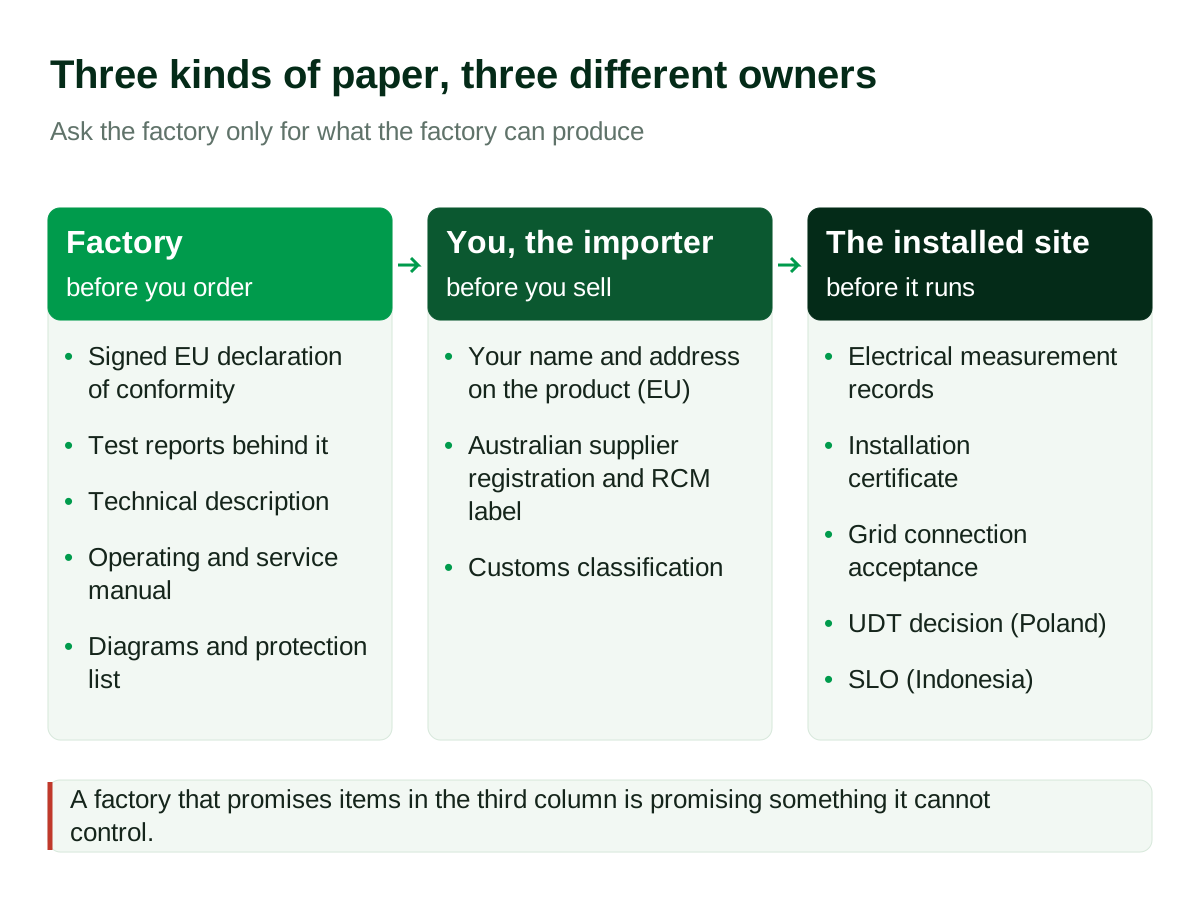
A factory that supplies every item in the first row is doing its job. A factory that promises items from the third row is promising something it cannot control.
The EU baseline: what CE actually means
The Low Voltage Directive (2014/35/EU) contains no conformity assessment route that requires a notified body. The manufacturer assesses the product, draws up the technical documentation and signs the EU declaration of conformity. It must keep both for 10 years (Article 6). The EMC Directive (2014/30/EU) allows internal production control too, with a notified body as an option rather than a requirement.
If the charger has Wi‑Fi, 4G, Bluetooth or another radio, the Radio Equipment Directive (2014/53/EU) applies instead of the LVD. Its essential requirements bring in the LVD safety objectives with no voltage limit, plus EMC. RoHS (2011/65/EU) adds its own internal production control and declaration.
Your duties as the importer. Under Article 8 of the LVD, you must ensure the manufacturer carried out the conformity assessment, drew up the technical documentation and applied the CE marking. You must also put your own name and postal address on the equipment. Buying from China does not move these duties back to China.
The “CE certificate” problem. Many factories send a certificate from a private body instead of a declaration. The European Commission says voluntary certificates of this kind “have no value” in checks by market surveillance authorities or customs. It also says certificates should not bear a CE marking. The Blue Guide (2022, section 4.4) is clear that the manufacturer takes responsibility by signing the declaration of conformity, and that notified bodies do not provide it (section 5.2.2).
A declaration of conformity must identify the product model, the manufacturer’s name and address, a statement of sole responsibility, the legislation it conforms to, the standards used, the place and date of issue and the signatory (LVD Annex IV).
Check the standard edition. For DC chargers, the standards cited in the Official Journal under the LVD include EN 61851-23:2014 with its 2016 corrigendum and EN 61851-24:2014 with its 2015 corrigendum (Implementing Decision (EU) 2023/2723). For the general part, Decision (EU) 2024/2764 replaced the plain EN IEC 61851-1:2019 entry with EN IEC 61851-1:2019 + AC:2023-12, from 30 April 2026. A test report against an older edition is not automatically wrong, but ask why.
AFIR for public DC chargers. Under Regulation (EU) 2023/1804, publicly accessible recharging points deployed from 13 April 2024 must accept ad hoc electronic payment through a payment card reader or a contactless device that can read payment cards. An internet-based payment option alone is allowed only below 50 kW (Article 5(1)). Points of 50 kW or more must show the ad hoc price per kWh (Article 5(4)). New points must be digitally connected and capable of smart recharging (Article 5(7) and 5(8)). For a distributor, this is a specification item: a 120 kW public charger without a card reader option is hard to sell.
Netherlands
We found no Dutch type approval for chargers beyond the EU route. The product side is CE, as above. Market surveillance for EMC and radio is carried out after the fact by the Rijksinspectie Digitale Infrastructuur (RDI).
Two national points matter for the site:
- Installation. The Dutch building decree (Bbl, article 4.199) requires charge points to meet NEN 1010, according to the government’s IPLO guidance.
- Metering. In a 2021 parliamentary answer, the government said AC charge point meters fall under the metrology law and the MID requirements, while the requirements for direct current were still being developed. We found no newer official text. If your customer bills per kWh on DC chargers, confirm the current metering route with them before quoting.
Public charge point tenders in the Netherlands often add their own technical demands. Ask your customer for the tender specification, not just the power rating.
Poland
Poland uses the same EU product route, then adds a site inspection that most buyer guides skip.
Under the Act of 11 January 2018 on electromobility and alternative fuels (Article 16), a charging station undergoes a technical inspection by UDT before it is put into operation. It is inspected again after a repair or modernisation, including adding charging points. This applies to publicly accessible stations and to other stations, on request of the operator or the entity running them. UDT can order a station to stop. Under the act’s definitions, a point of 3.7 kW or less installed outside a public station does not count as a normal-power point, so small private home units usually fall outside. Confirm your case with UDT.
The 2019 regulation on technical requirements for charging stations (Dz.U. 2019 poz. 1316) lists what the operator attaches to the first inspection application:
| Attachment (§ 20) | Who can supply it |
|---|---|
| Technical description of the station | Factory, with site data added |
| EU declaration of conformity | Factory |
| Operating instructions in Polish | Factory, translated |
| Installation correctness certificate | Installer |
| Electrical measurement records, signed by a qualified person | Installer |
| Site drawing showing mechanical protection and drainage | Designer |
| Power supply diagram | Designer |
| Acceptance record for the installation or grid connection | Installer or grid operator |
| Fire protection expert opinion | Fire expert |
UDT decides within 30 days of a complete application (§ 19). Public stations use Type 2 for AC and Combo 2 (CCS2) for DC (§ 15–16).
The operator of a publicly accessible station must register it in EIPA no later than the day it files the inspection application (Article 42(5)). The public map shows only stations that have passed inspection.
What to ask the factory for Poland: the declaration for the exact model, a full operating and service manual that a translator can turn into Polish, the service schematic, the electrical measurement and safety-function test procedures, and a clear statement of which protective devices are inside the charger and which must be in the site switchboard. A two-page quick-start guide will not get through UDT.
Australia
Australia does not accept a CE file as Australian compliance. Everything runs through a responsible supplier: a legally identifiable Australian or New Zealand entity with an ABN (or NZ IRD number), registered on the national database and renewed each year. If you import, that entity is usually you.
Electrical safety today. The Electrical Equipment Safety System (EESS) sorts in-scope equipment into three risk levels. EV supply equipment is not on the current Level 2 or Level 3 lists. An EESS bulletin from 2020 puts EV charge cables with an integral protection device at Level 1. Level 1 equipment still needs the RCM, English-language evidence of compliance and a link to a registered responsible supplier. EESS scope covers equipment “designed or marketed as suitable for household, personal or similar use”, so a DC charger sold only for commercial sites may fall outside it. Ask your state regulator in writing.
The 2028 change. Amendment 1:2026 to AS/NZS 4417.2 adds a new Level 3 class for EV supply equipment, taking effect on 12 February 2028. Energy Safe Victoria’s definition covers portable or fixed equipment that supplies AC or DC to charge a vehicle, or transfers energy in both directions, including in-cable control and protection devices. Level 3 means a certificate of conformity issued in Australia or New Zealand, plus product registration. South Australia’s Technical Regulator describes the same date for “residential type EVSE” and lists DC chargers among the covered types.
The same date matters for batteries. Energy Safe Victoria’s list also adds battery energy storage systems as a Level 3 class from 12 February 2028. If you sell solar batteries and chargers together, plan certification for both product lines on the same timeline.
EMC and radio. These are regulated by ACMA, separately from electrical safety. Responsible suppliers register on the same national database. ACMA’s list of mandated EMC standards includes IEC 61851-21-2 for EV conductive charging, according to the list’s search summary; we could not open the file to confirm the edition. If the charger has 4G, Wi‑Fi or Bluetooth, ask your test lab which radio standards apply.
State rules. South Australia has its own EV charger rules, including demand response capability. Check the state where the charger will be installed, not only the state where you import it. Installation must be done by a licensed electrician to the wiring rules.
What to ask the factory for Australia: full test reports to IEC 61851-1, IEC 61851-23 and IEC 61851-21-2 from an accredited lab that your Australian certifier will accept, plus the label artwork for the RCM and your supplier details. Ask whether the factory has already worked with an Australian certification body. If it has not, budget time for that before 2028.
Brazil
Inmetro’s own FAQ, updated on 30 March 2026, says: “Atualmente, não há regulamentação do Inmetro para sistemas de carregamento condutivo de veículos elétricos, nem exigência de certificação pelo Inmetro.” In plain terms: there is currently no Inmetro regulation for conductive EV charging systems and no Inmetro certification requirement. They are covered by the IEC 61851 series, adopted in Brazil as ABNT NBR IEC 61851.
Google’s AI Overview and several supplier pages still say otherwise. If someone tells you an Inmetro certificate is mandatory for your DC charger, ask for the Portaria number and its effective date.
This may change. A Brazilian government news report in May 2026 said Inmetro is studying whether technical regulations are needed for EV supply equipment (SAVE). The studies are expected to finish by December 2026, and safety requirements may follow if the impact analysis supports them. Recheck before you sign a multi-year supply agreement.
No Inmetro certificate does not mean no rules:
- Fire departments. São Paulo’s Portaria nº 003/970/2026 of 17 March 2026 brought EV charging into the fire department’s technical instruction on electrical installations. The November 2025 draft referred to ABNT NBR 5410, NBR 17019 and NBR IEC 61851-1, allowed only charging modes 3 and 4 inside buildings, and required a dedicated circuit with residual-current protection and an emergency shut-off. Check the final text for your state and building.
- Radio modules. If the charger has 4G, Wi‑Fi or Bluetooth, ask your importer whether Anatel homologation applies to the module or the finished product. We could not confirm the answer from an official Anatel page.
- Batteries sold with the charger. A battery-buffered charger or a storage cabinet is not the same product as a charger. Have it assessed separately.
Indonesia
Permen ESDM No. 1 of 2023 sets the rules for charging infrastructure. Two articles decide what the factory must give you:
- Article 31: charging equipment whose SNI mark or conformity mark has already been made mandatory must hold a product certificate. SPKLU installations must meet the Sertifikat Laik Operasi (SLO) requirement.
- Article 32: where SNI has not yet been made mandatory, the equipment must come with test results from the manufacturer.
So the question to settle first is: has SNI been made mandatory for this equipment? We saw a June 2026 trade report claiming SNI becomes mandatory for EV chargers from 1 July 2026. We could not find the official regulation behind it, so ask your importer or the Ministry of Energy for the decree number before you rely on it either way.
The same regulation’s annex sets the connectors: Type 2 for AC under SNI IEC 62196-2:2016, and configuration AA (CHAdeMO) or FF (CCS2) for DC under SNI IEC 62196-3:2014 and its amendments.
Worked example: four of our own certificates
Shenzhen Hongjiali New Energy Co., Ltd. (HG Power) shows these so you can practise reading the remarks section. That is where the limits are written.
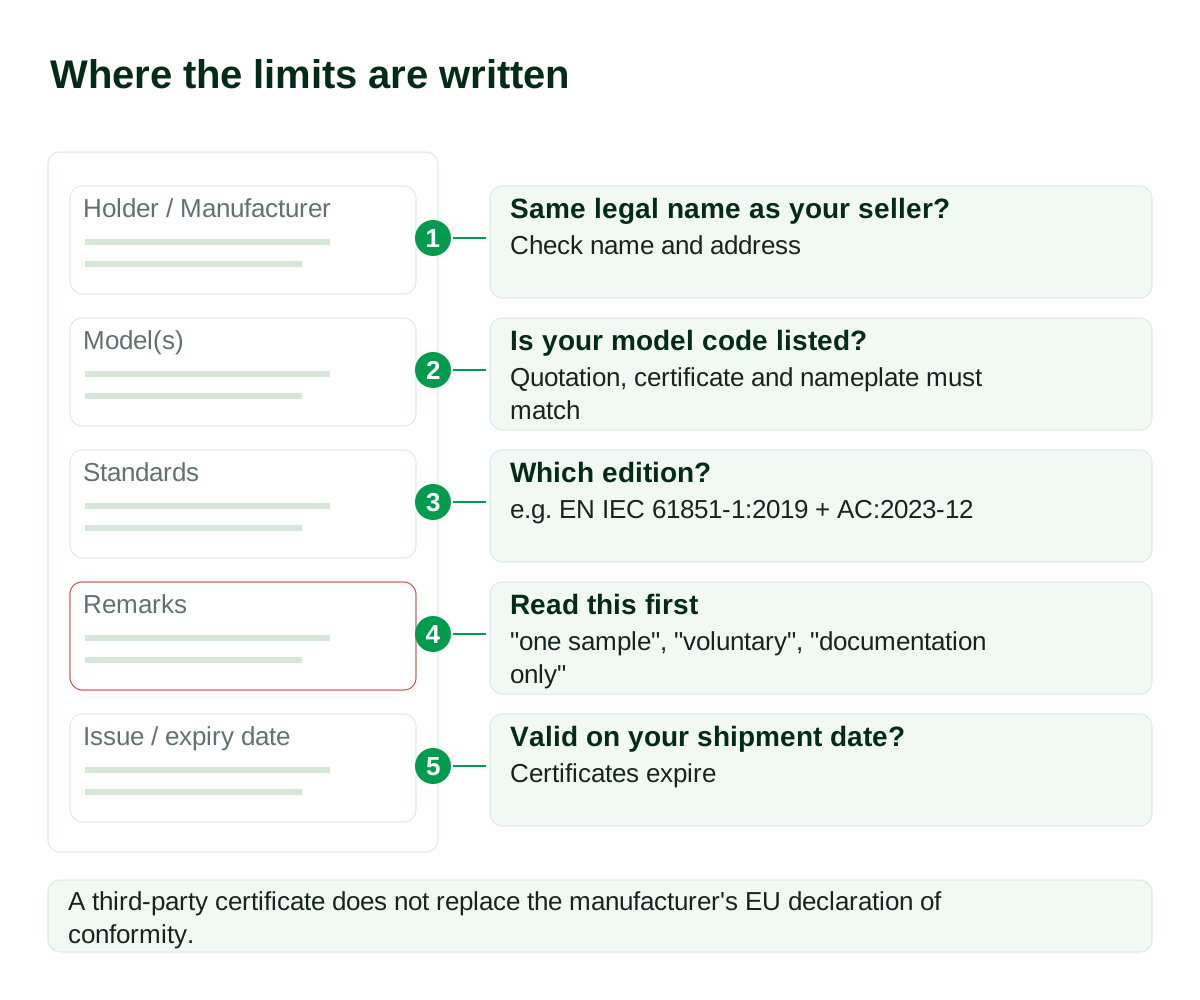
| Document | Issuer and type | Product and scope | What the remarks say | Dates |
|---|---|---|---|---|
| CKEYS250320024 | Guangdong KEYS Testing Technology, certificate of conformity with test report RKEYS250220062 | Split DC charging station; LVD; EN IEC 61851-1:2019/AC:2023-12, EN 61851-23:2014/AC:2016-06, EN 61851-24:2014/AC:2015, EN IEC 62196-3:2022. Tested sample rated 480 kW, 200–1,000 V DC, 600 A max | Based on one sample; does not imply assessment of production | Issued 20 March 2025; no expiry stated |
| 3N240131.SHN0W49 | Ente Certificazione Macchine, voluntary ECM certificate | 180 kW DC EV charger and listed models; LVD and EMC | Only the technical documentation was checked; no verification was carried out on the product; cannot replace the EC declaration of conformity | 31 January 2024 to 30 January 2029 |
| 3N220519.SHNDU72 | Ente Certificazione Macchine, voluntary ECM certificate of compliance | 120 kW floor-standing double-gun DC charger and listed models; LVD and EMC | Issued on a voluntary basis; the manufacturer is responsible for CE marking | 19 May 2022 to 18 May 2027 |
| 3N210514.SHNUN61 | Ente Certificazione Macchine, voluntary ECM certificate of compliance | 180 kW DC EV charger and listed models; LVD and EMC | Same voluntary wording | 14 May 2021 to 13 May 2026: expired |
Three lessons from our own file:
- The KEYS document is the strongest of the four, because a lab tested a sample against the current harmonised editions. It still says nothing about production units.
- The ECM documents are honest about their limits. One says in plain words that no product was checked and that it cannot replace the declaration. Read that line before you treat any similar paper as approval.
- Certificates expire. 3N210514.SHNUN61 ran out in May 2026. A later ECM document, 3N240131.SHN0W49, names some of the same model codes. Always check the date against your shipment, and check that the model code on your quotation appears on the newer document.
None of these is an Australian, Polish, Brazilian or Indonesian approval, and none replaces a declaration of conformity.
The document pack to request from a Chinese DC charger factory
Put this list in your purchase contract, model by model:
- Signed EU declaration of conformity naming the exact model (EU markets).
- Full test reports behind it, not only the cover certificate: electrical safety (EN IEC 61851-1, EN 61851-23), DC communication (EN 61851-24), EMC (EN IEC 61851-21-2) and the connector standard.
- RoHS documentation.
- Radio documents if the charger has 4G, Wi‑Fi or Bluetooth.
- Technical description: input supply, output voltage and current range per connector, number of outlets, IP rating, operating temperature.
- Operating and service manual, complete enough to translate and to pass a UDT review.
- Service schematic and the list of protective devices inside the charger versus those required on site.
- Electrical measurement and safety-function test procedures, with acceptance criteria.
- Label artwork showing where your importer name and address will go.
- OCPP version and any conformance certificate, if your customer runs a back office. OCPP is interoperability, not safety.
- Evidence for your market: Australian compliance evidence for the responsible supplier, manufacturer test results for Indonesia where SNI is not mandatory.
- A change notice promise: the factory tells you when components or firmware change after testing.
Seven checks before you pay a deposit
- Match the model code on the certificate, the quotation and the nameplate.
- Check the holder’s legal name and address against the seller.
- Read the scope: directive, standard, edition and connector.
- Ask for the full report behind the certificate number.
- Check issue and expiry dates against your shipment date.
- Read the remarks for “one sample”, “voluntary” or “documentation only”.
- Confirm the issuer using contact details from its own website.
Questions buyers ask
Is a CE certificate enough to sell DC chargers in the Netherlands or Poland?
No. The legal document is the manufacturer’s signed EU declaration of conformity, backed by technical documentation. The European Commission says voluntary third-party certificates have no value in market surveillance or customs checks. As importer, you must also confirm the conformity assessment was done and put your name on the product.
Does Brazil require Inmetro certification for EV chargers?
Not at present. Inmetro’s FAQ, updated 30 March 2026, says there is no Inmetro regulation or certification requirement for conductive EV charging systems, which fall under ABNT NBR IEC 61851. Inmetro is studying the topic, with studies expected by December 2026, so recheck before long contracts.
What does UDT need before a charging station in Poland can operate?
A positive UDT technical inspection. The application includes the EU declaration of conformity, operating instructions in Polish, a technical description, electrical measurement records, an installation certificate, site and supply drawings, a connection acceptance record and a fire opinion. UDT decides within 30 days of a complete file.
Is SNI mandatory for EV chargers in Indonesia?
Under Permen ESDM 1/2023, a product certificate is required only where SNI has been made mandatory for that equipment. Otherwise the charger must come with the manufacturer’s test results. The installation also needs an SLO. We could not confirm an official order making SNI mandatory for chargers in 2026.
Do public DC chargers in the EU need a card reader?
Yes, for publicly accessible points deployed from 13 April 2024 at 50 kW or more. AFIR Article 5(1) requires a payment card reader or a contactless device that reads payment cards. An internet-based payment option alone is allowed only below 50 kW.
Do EV chargers need Level 3 certification in Australia?
Not yet. EV supply equipment is not on the current EESS Level 2 or Level 3 lists. Amendment 1:2026 to AS/NZS 4417.2 makes it Level 3 from 12 February 2028, which means an Australian or New Zealand certificate of conformity and registration. Chargers in scope still need a registered responsible supplier and the RCM, and EMC rules apply through ACMA.
What this page does not prove
This page does not say any HG Power product is approved for a given market. It does not cover every utility rule, tax or local permit. HG Power claims only what the named documents state for the named models.
Send us your country and model
Tell us the destination country, charger model and connector, whether the unit needs 4G or Wi‑Fi, and whether the site is public. We will reply with the documents that exist for that model and the gaps you should plan for. Distributors can also read our distributor programme and see our certificate page.
Related reading: how to verify a Chinese EV charger manufacturer, split vs all-in-one DC chargers, battery-buffered DC fast chargers, OCPP 2.0.1 vs 1.6 for buyers and the GB/T DC charger compliance map.
Sources
- Directive 2014/35/EU (LVD), Directive 2014/30/EU (EMC), Directive 2014/53/EU (RED), Directive 2011/65/EU (RoHS)
- European Commission, conformity assessment and Blue Guide 2022)
- Implementing Decision (EU) 2023/2723 and Implementing Decision (EU) 2024/2764
- Regulation (EU) 2023/1804 (AFIR)
- Polish Act on electromobility, consolidated text Dz.U. 2026 poz. 1243, Regulation Dz.U. 2019 poz. 1316 and UDT initial inspection
- IPLO on charge points, Dutch parliamentary answer 3558 (2021) and RDI directives and requirements
- Inmetro FAQ on EV chargers, Agência Gov on Inmetro studies (May 2026), São Paulo Portaria 003/970/2026 and the November 2025 draft
- Permen ESDM 1/2023