
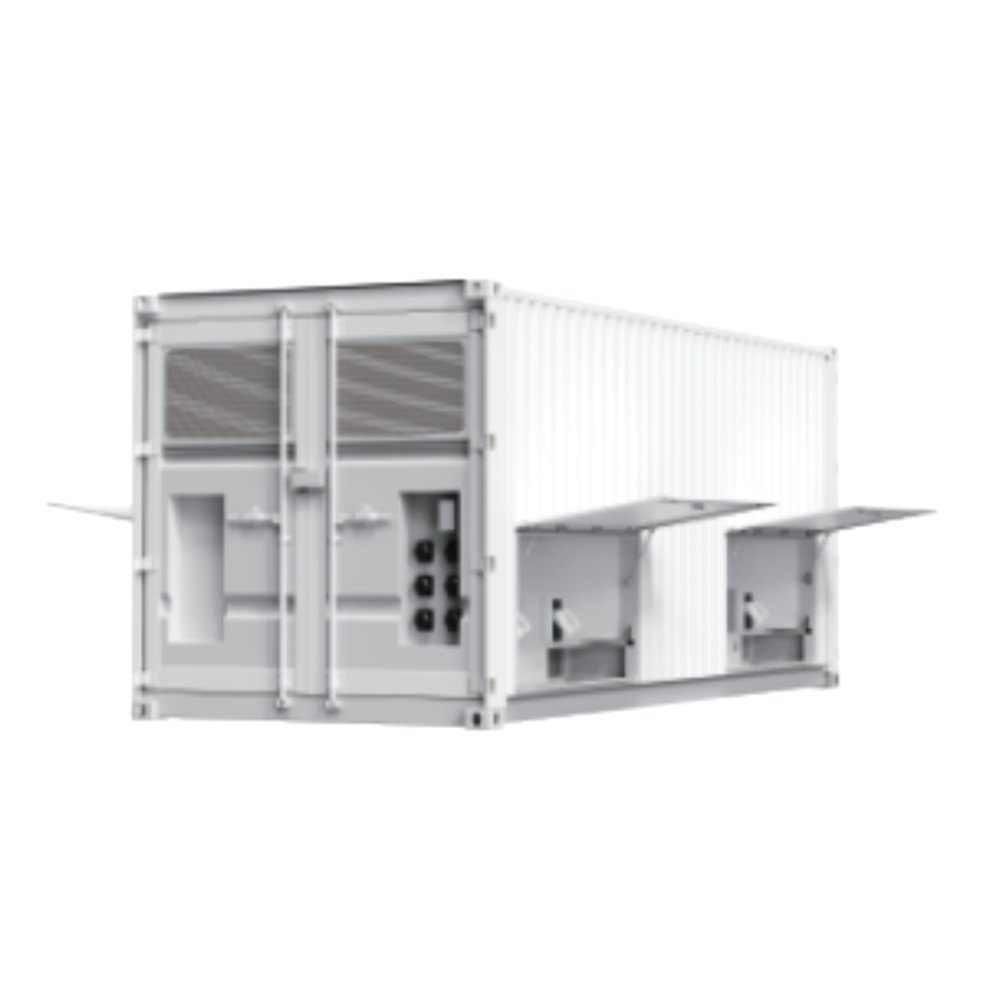
Mobile Charging-Storage Unit 1.5 MWh
Quick answer: The HG Power mobile charging-storage unit puts about 1.5 MWh of liquid-cooled battery and an 800 kW, two-gun EV charger in one 20-foot container. It runs on-grid or off-grid, so it suits sites with weak supply, temporary charging and emergency power. It weighs about 20 tonnes.
Application: temporary charging sites, weak-grid sites, off-grid and grid-tie operation.
- Highly integrated all-in-one design;
- Modular, easy transport and quick deployment;
- Off-grid and grid-tie dual-mode operation;
- High IP rating, strong environmental adaptability;
- Multi-scenario compatible with full functions;
SPECIFICATION
| Nominal Capacity | 1512kWh |
| Grid Power | 300kW |
| Charging Rate | ≤1C |
| Discharging Rate | ≤1C |
| Battery Voltage Range | 728~949V |
| Depth of Discharge | ≤90% DOD (Recommended) |
| Cycle Life | >4000 cycles |
| Cell Type | 314Ah / 0.5C |
| Nominal Voltage | 832V |
| Rated Frequency | 50Hz |
| Dimensions | 20ft Container |
| Pack Method | Liquid Cooling / 36S Pack |
| Charger Maximum Power | 800kW |
| Output Voltage Range | 200-1000V (DC) |
| Output Current Range | 0-350A |
| HMI | 12.1-inch Touch Screen |
| Number of Charging Guns | 2 |
| Payment Methods | Card Swipe / QR Code Payment |
| Network Mode | 4G |
| Network Protocol | OCPP |
| Charging Interface Standard | European Standard |
| Operating Temperature | -20°C - 55°C |
| Charger Cooling Method | Natural Air Cooling |
| Altitude | 4000m (Derated at 2000m) |
| Weight | 20t |
Specifications come from the HG Power 2026 product selection manual. Confirm the final specification for your configuration in the quotation.
Who uses a 1.5 MWh mobile unit?
- Sites that need charging before a grid upgrade is ready
- Temporary sites, events and construction phases
- Fleets that charge trucks where the supply is weak
- Emergency power work
For smaller loads, see the 158–316 kWh transportable ESS charger. For a fixed site, compare the containerized PV-ESS-charging system.
How many vehicles can it charge?
At the recommended 90% depth of discharge, 1512 kWh gives about 1,360 kWh of usable energy.
| Energy per session | Sessions per full battery |
|---|---|
| 60 kWh | About 22 |
| 150 kWh | About 9 |
| 300 kWh | About 4 |
We calculated these figures before conversion losses, so real results are lower.
How long does it take to recharge?
At the listed 300 kW grid power, 1,360 kWh takes at least 4.5 hours. This is simple arithmetic and excludes losses, so allow extra time in your plan. If the unit charges from a limited supply, it will take longer.
What should you plan for transport?
The unit is a 20-foot container and weighs about 20 tonnes. Plan the lifting, truck access and ground conditions before delivery. Our energy storage page shows how to size storage for a site.
Order terms
| Term | HG Power |
|---|---|
| Configuration | Agreed with our sales team |
| Standard lead time | 30–35 days after full payment |
| Warranty | 2 years |
| Payment | T/T (bank transfer) |
We confirm the terms for your configuration in the quotation.
Questions buyers ask
How fast can this unit charge a vehicle?
Maximum charger power is 800 kW, shared across two guns. Output current is listed at 0 to 350 A, so at 800 V one vehicle can draw about 280 kW. The vehicle sets the real power.
Which connector does it use?
The 2026 product selection manual lists the European standard charging interface for this unit. If your market needs another connector, tell our sales team before you order.
Can it run without the grid?
Yes. The manual lists off-grid and grid-tie dual-mode operation. In off-grid use, the battery must be recharged from another source, so tell us how you plan to do that.
Is it a truck or a container?
The manual lists a 20-foot container of about 20 tonnes. Transport and lifting are planned for each project, so send your route and site details with your request.
Technical review: Marvin Zhou. Reviewed 6 November 2026.