
What Is a GB/T EV Charger? Connector, DC Standard and Export Procurement Guide
Translate a GB/T label into a verified interface, electrical envelope, communication and destination-market compliance brief.
Direct answer: “GB/T charger” usually means EV charging equipment designed around China’s GB/T conductive-charging standards. The label does not, by itself, tell a buyer the charger’s power, voltage, current, vehicle coverage, backend protocol or destination-market certification. For procurement, translate the term into four boundaries: interface, electrical envelope, communication and compliance.
What does GB/T mean in EV charging?
GB/T refers to Chinese national standards. In charging quotations, it is commonly used as shorthand for equipment intended to use GB/T interfaces and related system requirements. The current GB/T 20234.3-2023 record identifies the DC charging coupler, while GB/T 20234.1-2023 covers general requirements for the conductive charging connection set.
That is a standards family and interface decision—not a complete charger specification. A supplier quote still needs the exact model, output basis, vehicle market, communication behavior, protection, installation conditions and conformity documents.
The GB/T Name Ladder
| Phrase in a quotation | What it may identify | What remains open |
|---|---|---|
| GB/T charger | Equipment using a GB/T-oriented interface | AC or DC, model, power, voltage/current, market |
| GB/T DC charger | Off-board DC charging equipment with a GB/T DC interface | vehicle acceptance, output allocation, cooling, certification |
| GB/T 20234.3 | DC charging coupler/interface standard reference | complete system requirements and exact implementation |
| China-standard charger | A market shorthand, not a full RFQ line | standard edition, vehicle, destination and test evidence |
The Four-Boundary Test
Four boundaries must agree before a quote is comparable
Boundary 1: interface
Confirm whether the request is GB/T AC, GB/T DC or a vehicle that has more than one inlet. Do not use “GB/T” as a substitute for AC/DC classification. The connector, inlet, cable assembly and locking/control arrangement must be named in the model documentation.
Boundary 2: electrical envelope
Power is a relationship between voltage and current, subject to equipment and vehicle limits. A GB/T connector does not imply 60 kW, 120 kW or 480 kW. Ask whether the stated rating is total cabinet output, a single connector limit, or a shared value across simultaneous sessions.
Boundary 3: communication
Conductive charging includes control and protection behavior between vehicle and supply equipment. A connector purchase without a communication and test plan leaves a major integration gap. Request the supported vehicle-control behavior, fault handling, session records and backend interface separately.
Boundary 4: compliance
The GB/T standard reference does not automatically satisfy every country’s electrical, EMC, metering, cybersecurity, payment, installation or grid requirements. Destination, utility and authority requirements must be reviewed for the actual project.
GB/T AC versus GB/T DC procurement
| Decision | GB/T AC | GB/T DC |
|---|---|---|
| Conversion boundary | Vehicle usually performs the main AC-to-DC conversion | Charger performs controlled DC conversion off board |
| Key sizing question | onboard charger acceptance and dwell | vehicle DC acceptance, charger output and dwell |
| Procurement risk | phase/current/site circuit mismatch | voltage/current, communication, thermal and allocation mismatch |
| Evidence | vehicle OBC record and installation design | exact charger model, vehicle test, protection and SAT record |
This article is DC-first because fleet, public and commercial buyers often use “GB/T charger” to mean a high-power DC product. The RFQ should still state AC or DC explicitly.
Vehicle and market compatibility matrix
| Question | Why it matters | Evidence to request |
|---|---|---|
| Which vehicle make/model/year? | inlet and acceptance can vary | OEM specification or controlled test |
| Which market will operate it? | local compliance and grid rules differ | destination compliance checklist |
| Which connector and cable? | physical fit is necessary but insufficient | model drawing and cable record |
| What voltage/current envelope? | vehicle may cap charger output | vehicle acceptance data |
| Which backend and payment model? | operations are not defined by connector | CSMS/API/payment interface record |
Never write “GB/T compatible with all Chinese EVs” without a maintained vehicle and market record. A country-of-origin label is not a vehicle acceptance test.
What a GB/T power label does not prove
| Label seen | It does not prove |
|---|---|
| 60 kW GB/T | 60 kW delivered to every vehicle or connector |
| 120 kW GB/T | a particular voltage/current combination or sustained output |
| dual-connector GB/T | both vehicles receive full rated power simultaneously |
| liquid-cooled GB/T | a specific cable current, ambient range or duty cycle |
| export GB/T charger | destination-market certification or utility approval |
The buyer should request the power basis, output curve, sharing policy, environmental assumptions and test method.
GB/T Export RFQ Bridge
Turn a shorthand label into testable fields
→
→
→
The standard reference starts the conversation; the RFQ closes the interfaces.
Include these fields in an international GB/T request:
- target vehicle models, model years and operating markets;
- AC or DC and the exact interface/connector requirement;
- target power, voltage and current, with cabinet-versus-connector basis;
- number of connectors, simultaneous sessions and power-sharing behavior;
- input voltage/frequency, earthing, protection and installation environment;
- cooling, cable length, enclosure and maintenance requirements;
- backend, OCPP/CSMS, payment and meter-data needs;
- required certificates, test reports and destination-market declarations;
- FAT/SAT session cases, fault recovery and acceptance data fields.
HG Power 40–480 kW portfolio context
HG Power’s public DC portfolio context spans 40–480 kW. This is a portfolio range, not a claim that every GB/T configuration provides every power value, connector, voltage/current envelope or certificate. The exact SKU and destination-market configuration must be confirmed before a quote is treated as technically comparable.
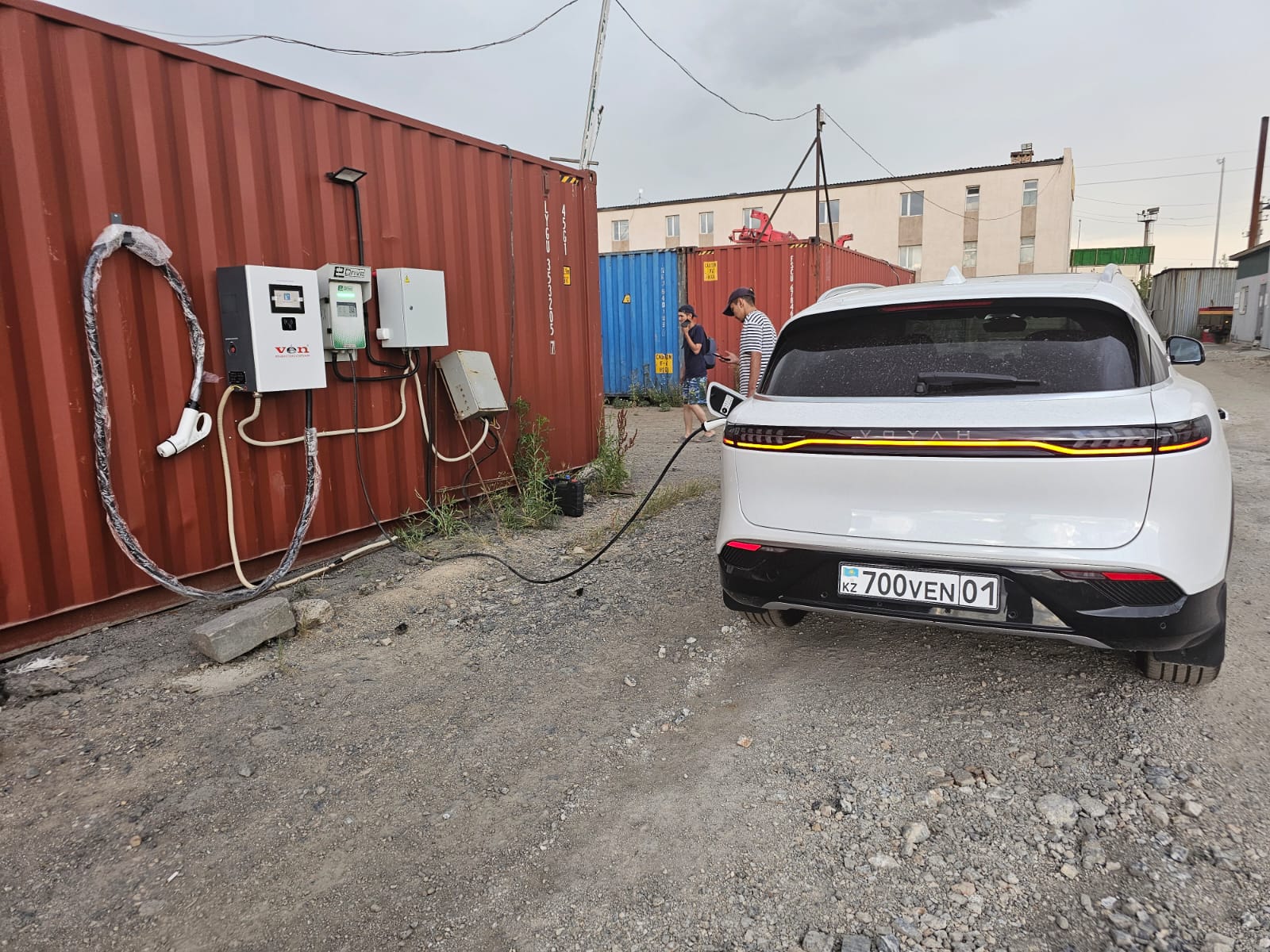
For a GB/T DC request, ask HG Power to map the target vehicle and site inputs to an exact model, then document the connector, output basis, power sharing, cooling, communication and conformity scope. The project photograph or product image can show equipment context; it cannot prove compatibility or field performance.
FAT and SAT evidence for a GB/T charger
| Stage | Test or record | Pass condition |
|---|---|---|
| Document review | model, connector, standard edition and destination scope | records match the purchase order |
| FAT | output, display, protection, emergency stop and connector | agreed test cases recorded |
| Vehicle session | actual target vehicle or approved simulator | session starts, controls and stops correctly |
| Sharing | simultaneous or priority session | allocation follows the agreed rule |
| SAT | site input, communications and recovery | site acceptance record completed |
Frequently asked questions
What is the full form of GB/T charger?
GB/T is a reference to Chinese national standards, commonly written as “Guobiao/Tuijian” in industry explanations. For procurement, the useful question is not the translation alone but which GB/T standard, interface, system, vehicle and market are intended.
Is a GB/T charger the same as a CCS charger?
No. They are different interface and standards families. A vehicle, charger and adapter must be evaluated for the exact market and electrical/communication implementation; connector appearance alone is not sufficient.
Can a GB/T charger be used outside China?
Possibly, but not automatically. The buyer must verify vehicle compatibility, destination electrical and conformity requirements, communications, metering/payment and utility approval.
Does GB/T tell me the charger power?
No. GB/T identifies a standards/interface direction. Power depends on the exact charger, voltage/current envelope, sharing, vehicle acceptance and site conditions.
Request a GB/T configuration review
Send the vehicle market and model, AC/DC requirement, connector, target power, voltage/current, site input, backend, certification target and FAT/SAT expectations. HG Power can then map the GB/T request to a model-specific 40–480 kW DC configuration without treating the standard name as a universal performance promise.
Sources
- GB/T 20234.3-2023 — DC charging coupler.
- GB/T 20234.1 — general connection-set requirements.
- GB/T 20234 DC charging system records.
Technical review: Marvin. This guide is procurement guidance, not a substitute for vehicle OEM requirements, local electrical engineering or destination-market compliance review.