
EV Charging Transformer Sizing: How to Calculate kVA, Demand and Headroom
Check spare capacity before you choose chargers. Convert input current to kVA, subtract your existing peak, then pick the cheapest way to close the gap.
Direct answer: To size a transformer for EV charging, convert each charger’s rated input current to kVA, add the units that can run together, then compare that demand with your spare capacity. An HG Power 120 kW Genesis unit draws 194 A at 380 Vac, or about 128 kVA, not 120.
The supply behind a charger decides how many units you can install, how fast they can run, and how long the project takes. This guide gives you the arithmetic to check that before you ask for quotations.
| Check | Formula or source | Example |
|---|---|---|
| Charger demand | √3 × 380 V × rated input A ÷ 1000 | 120 kW unit: 128 kVA |
| Site headroom | Transformer kVA × loading limit − measured peak kVA | 630 × 80% − 260 = 244 kVA |
| Pass or fail | Charging demand ≤ site headroom | Four 120 kW units fail; a 240 kVA cap passes |
Why does a charger need more kVA than its kW rating?
A charger’s kW rating describes its DC output. The transformer sees the AC input, which includes conversion losses and any reactive power, so the figure to use is kVA.
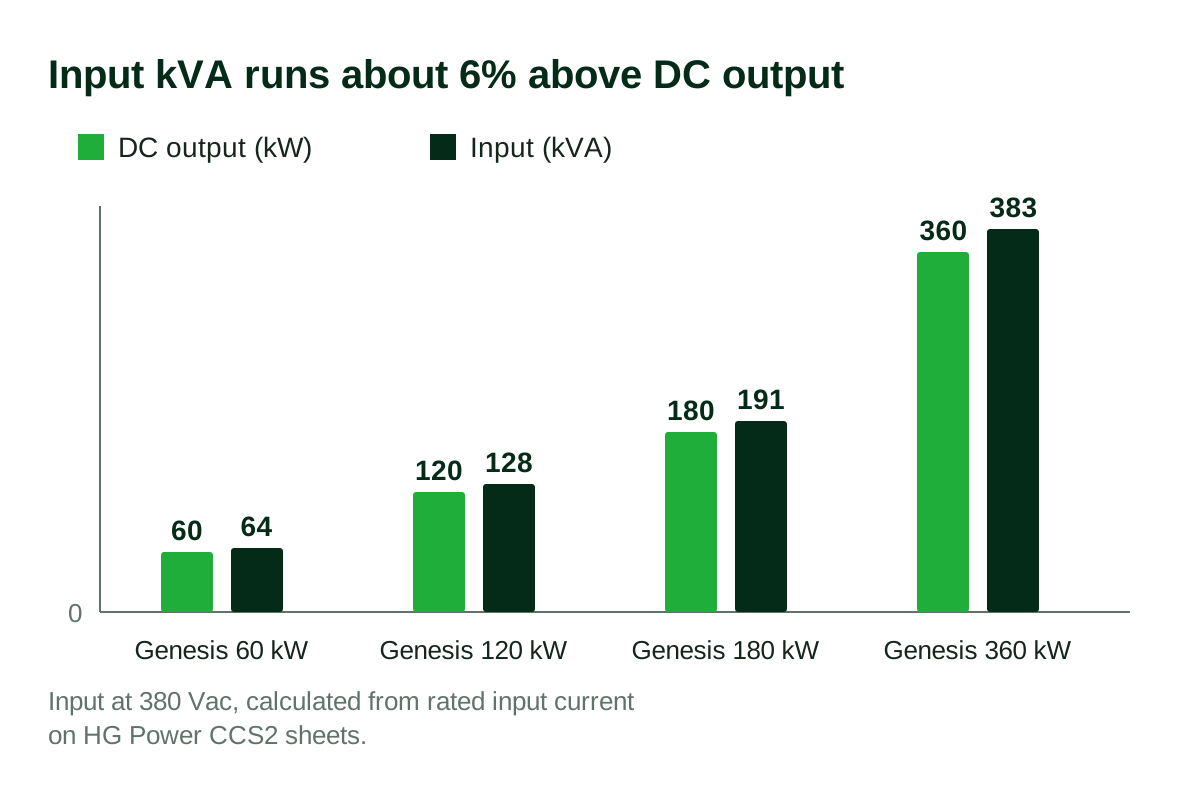
The clearest method is to use the rated input current on the specification sheet. For a three-phase supply, multiply it by √3 and the line voltage. These are the results for HG Power Genesis CCS2 models at 380 Vac:
| Model | DC output | Rated input current | Calculated input | kVA per kW |
|---|---|---|---|---|
| Genesis 60 kW | 60 kW | 97 A | 64 kVA | 1.06 |
| Genesis 120 kW | 120 kW | 194 A | 128 kVA | 1.06 |
| Genesis 180 kW | 180 kW | 290 A | 191 kVA | 1.06 |
| Genesis 360 kW | 360 kW | 582 A | 383 kVA | 1.06 |
Current comes from the specification sheets, and kVA is our calculation from it. The 6% matches the sheets: 95% efficiency and a 0.99 power factor give 1 ÷ (0.95 × 0.99) = 1.06. On a 360 kW unit, that is 23 kVA. These are rated values at nominal output, so use the sheet for your exact model and connector.
The Headroom Test: can your site take the chargers?
Compare two numbers: the capacity your site has left, and the capacity the chargers can draw.
Spare capacity must cover what can run together
× loading limit
−
over 12 months
=
for charging
≥
can run together
If headroom is smaller than charging demand, use one of the four routes below before you order hardware.
Work through it in three steps:
- Find usable capacity. Ask the utility or transformer owner for the rating and the loading limit they accept.
- Measure the existing peak. Use interval data from a full year if you can, so a hot month or a busy season does not surprise you. A single bill can hide the peak.
- Add charging demand. Without load management, count every unit at its full input unless your engineer and utility accept a lower figure.
A worked example
Take an illustrative site with a 630 kVA transformer and a measured peak of 260 kVA. We use an 80% loading limit as a planning assumption here. It is not a standard, so use the limit your utility gives you. Each 120 kW unit draws 127.7 kVA before rounding.
- Usable capacity: 630 × 0.8 = 504 kVA
- Headroom: 504 − 260 = 244 kVA
- Four 120 kW chargers, unmanaged: 4 × 127.7 = 511 kVA, which fails by 267 kVA
- Two 120 kW chargers, unmanaged: 2 × 127.7 = 255 kVA, which fails by 11 kVA
- One 180 kW charger: 191 kVA, which passes with 53 kVA left
- Four 120 kW chargers, capped at 240 kVA: passes, but see the trade-off below
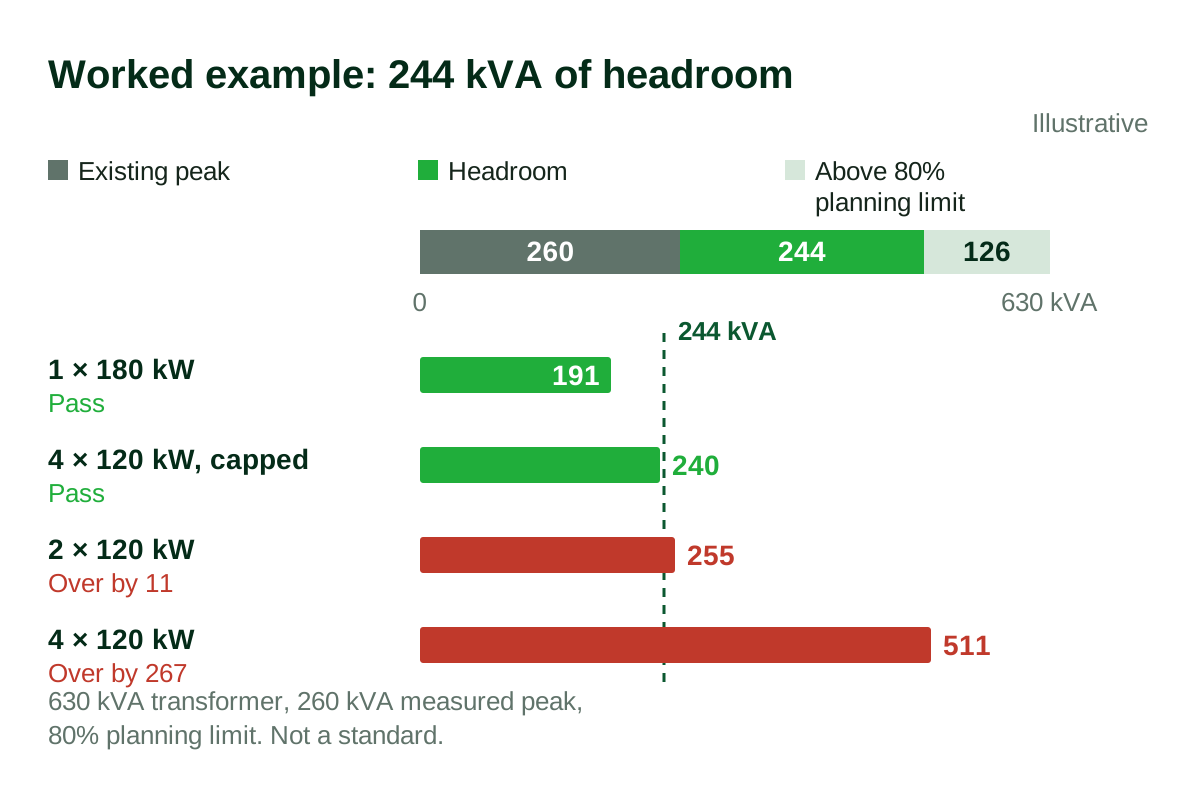
Two units fail by only 11 kVA, but do not ignore a small gap. Charging can hold a high load for a long time, and the US National Electrical Code treats EV charging as a continuous load.
Can you assume not every charger runs at once?
Sometimes. Vehicles arrive at different times, and they draw less as the battery fills, so real peaks are often lower than the total of all units. This is called diversity. The risk is that nothing stops a busy hour from exceeding it, so use a lower figure only with measured data from a similar site and your utility’s agreement. Otherwise, enforce the limit with load management.
Does the 125% rule apply to the transformer?
Separate what the code says from what people infer. EC&M’s guide to Article 625 of the US National Electrical Code, based on the 2017 edition, says EV charging loads are continuous, and that overcurrent protection for feeders and branch circuits must be rated at no less than 125% of the maximum load (EC&M).
That wording covers protection and feeder sizing. Whether your transformer also needs a 125% margin depends on the code edition, the local authority and the utility. Treat it as a question to put in writing, not a number to assume. Outside the US, local wiring rules apply instead, so have a qualified engineer confirm the design.
Four ways to close a capacity gap
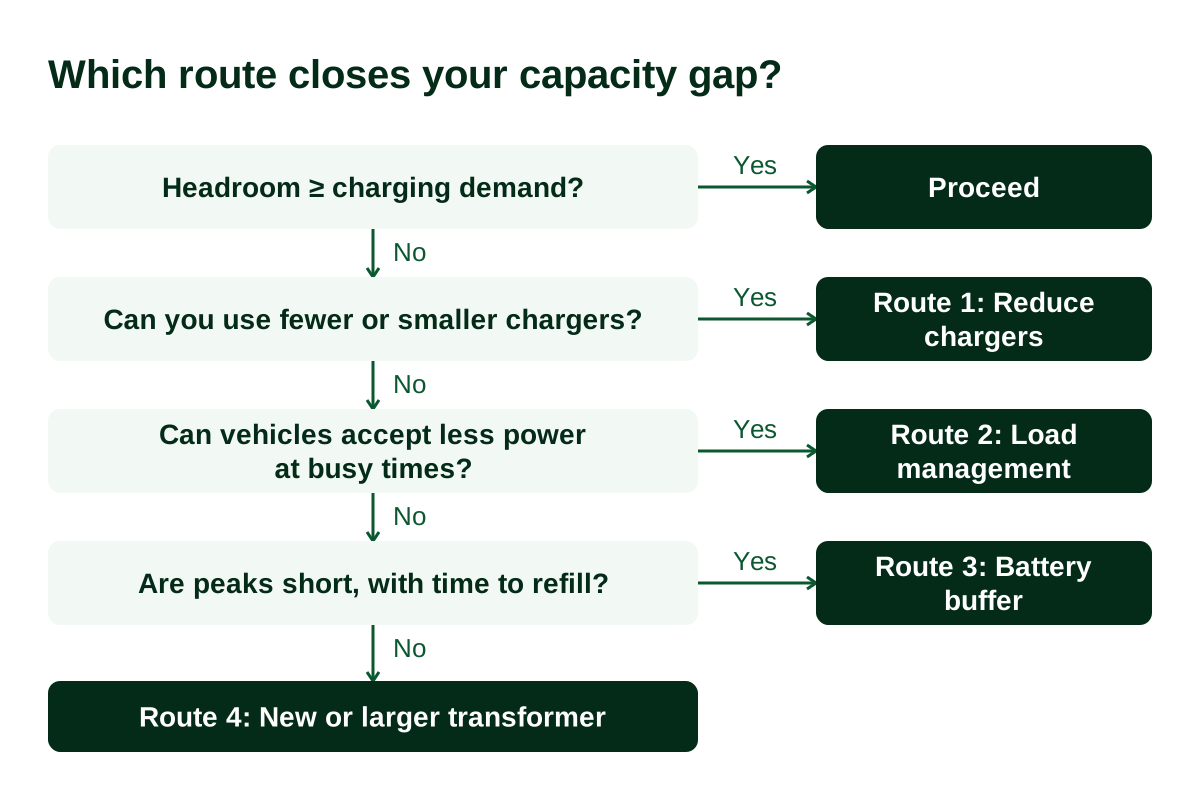
If the Headroom Test fails, you have four routes. Start with the first and move down the table only if it does not meet your needs.
| Route | What it changes | What you give up | What fails if you skip the check |
|---|---|---|---|
| 1. Fewer or smaller chargers | Lowers demand directly | Fewer bays or slower sessions | Queues at busy hours |
| 2. Load management | Caps total charging demand | Speed when the site is busy | Vehicles leave short of energy |
| 3. Battery buffer | Serves peaks from storage | Capital cost and floor space | Battery runs out in long peaks |
| 4. New or larger transformer | Raises capacity | Cost and utility lead time | Opening date slips |
Route 1: use fewer or smaller chargers
Start with how long vehicles stay. If they are parked for hours, you may not need DC at all, and our AC vs DC charger guide shows how to work that out. Ten 7 kW AC chargers add up to 70 kW, less than a single 120 kW DC unit. If you do need DC, the 40–80 kW DC charger station asks far less of the supply.
Route 2: add load management
Load management keeps total charging below a set limit by sharing power between sessions. A static limit is a fixed cap. A dynamic limit reads the site’s live load and gives charging whatever is spare, which suits sites whose other loads change through the day.
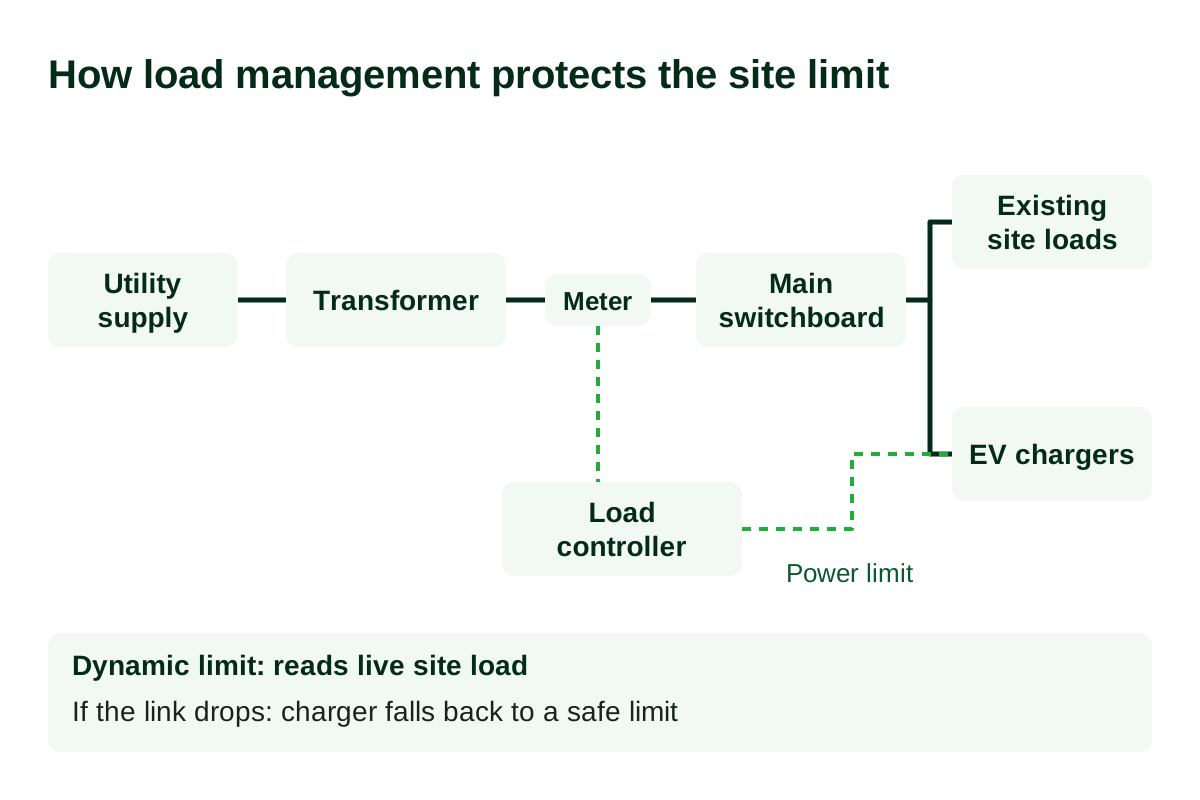
US code allows for this. Where an automatic load management system is used, Article 625 sets the maximum equipment load on a service and feeder at the maximum that system permits, as quoted in a Washington State Building Code Council document. Check how your code edition and inspector apply it.
The trade-off is energy, not just speed. In our example, a 240 kVA cap delivers about 225 kW to vehicles at most. That is roughly 4 sessions an hour if each session adds 52.5 kWh, which takes a 75 kWh battery from 10% to 80%. If your busiest hour needs more energy than that, load management alone will not solve the problem.
Test the failure case before you rely on it. Ask what each charger does if its link to the controller drops. It should fall back to a safe limit on its own, and that limit should keep the site within its cap. Our OCPP procurement guide covers what to test with your backend, and the dual-gun power allocation guide explains how power splits inside one unit.
Route 3: add a battery buffer
A battery recharges slowly from the site and discharges quickly into vehicles. This works when peaks are short and the supply has time to refill it between them.
Use this formula to estimate how long a battery can hold full output:
Runtime (hours) = usable kWh ÷ (charger kW − supply kW)
The HG Power CYD158K-120 transportable ESS charger has a 158 kWh battery and 120 kW DC output. At the recommended 90% depth of discharge, about 142 kWh is usable. If your site could spare an illustrative 50 kW, the battery would cover the 70 kW gap for about two hours, before losses. If your peak lasts longer than that, you need a larger battery or more supply. Confirm the grid connection rating for your exact model in the quotation.
Route 4: upgrade or add a transformer
Sustained high power, such as a highway hub on 200–480 kW chargers, often needs a dedicated supply. Plan the time first:
- The US Department of Energy, citing interconnection best-practice work, says DC fast chargers can take from 6 months to more than 2 years, mainly because of interconnection and permitting delays. Level 2 chargers can take 1 day to 6 months where power is already available (US DOE).
- In a February 2025 report, a manufacturer told Utility Dive that lead times for pad-mounted distribution transformers were double or triple their pre-pandemic level. The same article cites an April 2024 Wood Mackenzie report giving 80 to 120 weeks for larger transformers, which are bigger than most charging sites need (Utility Dive).
These are US figures from those dates, and they will change, so get a date from your own utility before you sign a charger order. You can also open with a capped site and move to full power when the new supply arrives.
What if your site is not 380 V?
Check voltage before capacity. HG Power Genesis models are specified at 380 Vac ±15%, or about 323–437 V, at 50/60 Hz. A 400 V supply is inside that range. A 220 V or 480 V three-phase supply is outside it, even if the site has plenty of spare kVA.
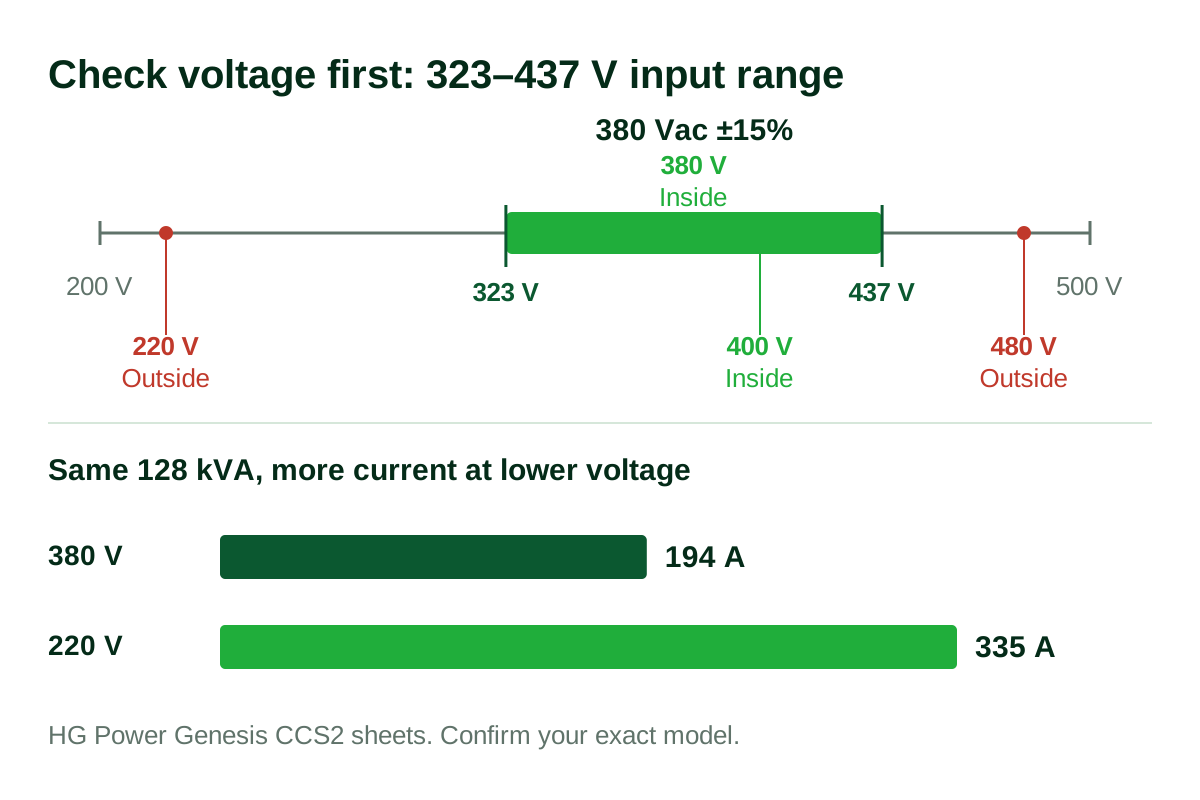
This matters in real markets. Canal Solar reports that some Brazilian states, including Mato Grosso, Minas Gerais, São Paulo and Paraná, are supplied at 127/220 V, and that equipment built for 220/380 V needs a transformer on those networks (Canal Solar). Supply can vary by city, so confirm yours with the local utility.
On a 220 V site, budget for a step-up transformer or a dedicated medium-voltage supply. Current also rises as voltage falls: the 128 kVA that draws 194 A at 380 V draws about 335 A at 220 V. Size the service, cables and transformer for that current, and add the transformer’s own losses. Frequency is less of a problem, because the sheets list both 50 and 60 Hz.
Five capacity mistakes that delay projects
| Mistake | What goes wrong | How to avoid it |
|---|---|---|
| Sizing on kW, not input current | Demand is understated by about 6% | Use rated input A from the sheet |
| Using the transformer nameplate as free capacity | Existing loads are ignored | Subtract the measured peak |
| Trusting a single bill | The seasonal peak is missed | Use a full year of interval data |
| Assuming software solves it | Vehicles leave short of energy | Check energy per hour at the cap |
| Checking kVA before voltage | Chargers cannot connect at all | Confirm line voltage first |
What should you send the utility and your supplier?
You will get a faster and more comparable answer if you send the same data pack to both:
- Line voltage, frequency and earthing system
- Transformer rating, owner and loading limit
- Twelve months of interval demand data, or the best records you have
- Charger models, rated input current and quantity
- Vehicle list, energy per session and time parked
- Busiest-hour sessions, now and after planned growth
- Single-line diagram and available space for equipment
Ask your engineer to check voltage drop, fault level and harmonics as well. The kVA test tells you whether a design is worth pursuing, but it is not a final design.
Our DC fast charger station design guide lists the wider site data, and the commercial DC charger cost guide shows where grid work sits in the budget.
Five questions buyers ask
What size transformer do I need for a 120 kW charger?
An HG Power Genesis 120 kW CCS2 unit draws 194 A at 380 Vac, or about 128 kVA. You need at least that much spare capacity after existing loads and the utility’s loading limit. For a new dedicated transformer, round up to the next standard size your utility accepts.
How many kVA does a 360 kW DC charger need?
The HG Power Genesis 360 kW CCS2 unit is rated at 582 A at 380 Vac, which works out at about 383 kVA. Other makes and configurations differ, so use the rated input current on the sheet for your exact model.
Do I need a new transformer for EV charging?
Not always. Run the Headroom Test first. Sites with spare capacity may need none, and load management or a battery can close a smaller gap. Sustained high-power charging often does need a new or dedicated supply.
Can load management avoid a transformer upgrade?
Yes, if the site can accept lower power at busy times. Load management caps demand, but it does not create energy. Check that the capped supply still delivers enough kWh in your busiest hour, and test what happens if communication fails.
How long does a DC charger grid connection take?
It varies widely by utility. In the US, the Department of Energy says DC fast charger interconnection can take from 6 months to more than 2 years. Ask your utility for a written date before you commit to a charger delivery schedule.
Send us your site data
Send your voltage, transformer rating, peak demand and vehicle plan. We will reply with a suggested charger model and layout to review. Request a site review, or compare our DC fast chargers, including the 120–180 kW commercial DC fast charger.
Sources
- US Department of Energy: Understanding the Soft Costs of EV Charging
- EC&M: The Apprentice’s Guide to Article 625 (2017 NEC)
- Washington State Building Code Council: load management examples, quoting Article 625
- Utility Dive: US electric transformer shortage reporting
- Canal Solar: three-phase low-voltage inverters (127/220 V)
- HG Power Genesis 60, 120, 180 and 360 kW CCS2 specification sheets; CYD158K-120 specification
Technical review: Marvin Zhou. Reviewed 4 November 2026.